Blog
Back to blog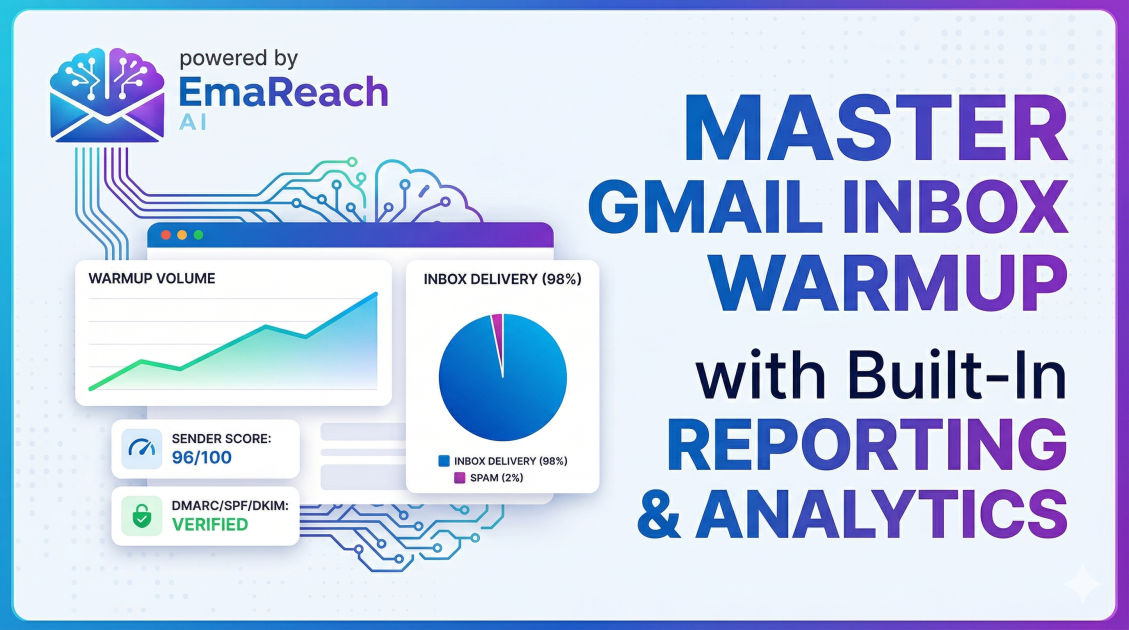
Gmail Inbox Warmup Tools with Built-In Reporting and Analytics
email deliverabilitygmail warmupcold outreachemail marketingsender reputationemail analyticsinbox placement
Introduction to Gmail Inbox Warmup
In the modern landscape of digital communication, email remains the undisputed king of professional outreach. However, the barrier to entry has never been higher. Google and other major providers have implemented increasingly sophisticated algorithms to protect users from spam. For businesses and marketers, this presents a significant challenge: how do you ensure your legitimate outreach lands in the primary inbox rather than the dreaded spam folder?
Enter the Gmail inbox warmup tool. These specialized platforms are designed to build and maintain the reputation of your email accounts by simulating human-like interaction. But as the market matures, simply 'sending emails' isn't enough. The most effective strategies now rely on Gmail inbox warmup tools with built-in reporting and analytics. These tools provide the transparency needed to understand deliverability health, identify bottlenecks, and optimize campaigns for maximum impact.
Understanding the Mechanics of Email Deliverability
To appreciate why reporting and analytics are vital, one must first understand the concept of sender reputation. Think of your email address like a credit score. If you have no history, or a history of bad behavior (like sending bulk emails that get marked as spam), your 'score' drops. When you attempt to send an email with a low score, Gmail’s filters are more likely to divert your message to the spam folder.
Deliverability is influenced by several factors:
- IP Reputation: The quality of the server sending the mail.
- Domain Reputation: The history of your specific domain (e.g., yourcompany.com).
- Engagement Rates: How often recipients open, reply to, or move your emails to the primary folder.
- Technical Setup: Proper implementation of SPF, DKIM, and DMARC records.
Warmup tools automate the process of boosting these factors. They send emails from your account to a network of other 'warm' accounts. These accounts then open the emails, move them out of spam if they land there, and reply to them. This consistent, positive engagement signals to Gmail that you are a trustworthy sender.
The Shift Toward Data-Driven Warmup
In the early days of email automation, warmup was a 'set it and forget it' task. You would toggle a switch and hope for the best. However, without data, you are essentially flying blind. You might be warming up your account, but you wouldn't know if your deliverability was actually improving or if a specific technical issue was holding you back.
Modern tools have shifted the focus toward built-in reporting and analytics. By providing a dashboard that visualizes your sender health, these tools allow you to make informed decisions. If you notice your spam rate is creeping up despite the warmup, you can pause your outreach and investigate the cause. This proactive approach is the only way to maintain long-term inbox placement.
Key Metrics to Track in a Warmup Dashboard
When evaluating a Gmail warmup tool, the analytics suite should, at a minimum, provide the following metrics:
- Placement Rate: This is the percentage of your emails that land in the Primary Inbox versus the Spam or Promotions folder. High-quality tools will break this down by provider (Gmail, Outlook, Yahoo).
- Reputation Score: A proprietary or third-party score that aggregates various data points to give you a quick 'health check' on your domain.
- Interaction Frequency: A log of how many opens, replies, and 'mark as not spam' actions have occurred on your behalf.
- Blacklist Monitoring: Continuous checks against global blacklists to ensure your domain hasn't been flagged for suspicious activity.
- Technical Validation: Real-time monitoring of your SPF, DKIM, and DMARC status to ensure your authentication doesn't break.
Why Reporting is Essential for Scalable Outreach
For solo entrepreneurs, a basic tool might suffice. However, for agencies and growing sales teams, reporting is non-negotiable. When you are managing dozens or even hundreds of sender accounts, you need a centralized way to monitor the fleet.
Analytics allow you to spot trends across your entire infrastructure. If five different accounts using the same domain are all seeing a dip in deliverability, you know the issue is likely at the domain level. If only one account is struggling, the problem might be the specific content or the 'burn' rate of that individual address. Without granular reporting, identifying these patterns is impossible.
Integrating Warmup with Outreach Platforms
One of the most effective ways to utilize these tools is by choosing a platform that bridges the gap between warming up and actual sending. This is where a solution like EmaReach (https://www.emareach.com/) shines. It’s not just about keeping the inbox warm; it’s about making sure your actual business communications get through. EmaReach: "Stop Landing in Spam. Cold Emails That Reach the Inbox." By combining AI-written cold outreach with sophisticated inbox warm-up and multi-account sending, it ensures that your emails land in the primary tab and actually get replies.
When your warmup analytics are integrated into your sending platform, you can create 'safety triggers.' For example, if the warmup tool detects a deliverability score drop below 80%, it can automatically pause your cold email campaigns to protect your domain until the reputation recovers.
Deep Dive: Advanced Analytics Features
Beyond basic placement rates, the next generation of Gmail warmup tools offers advanced insights that can drastically change your strategy.
Provider-Specific Heatmaps
Gmail's filters behave differently than Outlook's. Advanced reporting will show you a heatmap of where your emails are landing across different providers. You might find you have a 95% primary inbox rate on Gmail, but a 40% spam rate on Outlook. This data tells you that you need to adjust your technical settings or content specifically for Microsoft’s filters.
Reply Rate Analysis
It’s not enough to just send replies; the quality and timing of those replies matter. AI-driven warmup tools use natural language processing to ensure that the replies generated during the warmup process look like real human conversations. Reporting on these interactions helps you see if the volume of replies is scaling naturally alongside your sending volume.
Domain Age and History Correlation
A mature reporting suite will factor in the age of your domain. A brand-new domain (less than 3 months old) cannot handle the same volume as a 5-year-old domain. Analytics help you set realistic 'ramp-up' schedules so you don't accidentally trigger spam filters by increasing your volume too quickly.
The Role of AI in Warmup and Analytics
Artificial Intelligence has revolutionized how we approach email deliverability. Traditional warmup tools used static templates that were easily detectable by Google’s algorithms. Modern AI-driven tools generate unique, contextually relevant content for every warmup email sent.
In terms of analytics, AI can perform 'predictive deliverability.' By analyzing billions of data points across thousands of accounts, these tools can predict when a domain is at risk of being blacklisted before it actually happens. This shift from reactive to proactive management is why built-in intelligence is so valuable.
Setting Up Your Warmup Tool for Success
To get the most out of the reporting and analytics features, you must set up your tool correctly from day one. Here is a step-by-step guide to maximizing your results:
- Connect Your Accounts via OAuth: Whenever possible, use OAuth to connect your Gmail accounts rather than App Passwords. This is more secure and provides more reliable data sync for the reporting dashboard.
- Configure Your Ramp-up Speed: Don't start at 50 emails a day. Start with 2-5 and let the tool’s automated logic increase the volume based on the engagement metrics it sees.
- Monitor Your 'Spam to Inbox' Ratio: Pay close attention to the number of emails being moved from spam to the inbox. This is the single most powerful signal to Google that your content is valuable.
- Review the Content Log: Periodically check the content being sent. Ensure it doesn't contain 'spammy' keywords that could hurt your reputation. High-quality tools will flag these words for you in their analytics section.
- Set Up Alerts: Configure the tool to send you an email or Slack notification if your deliverability score drops below a certain threshold. This ensures you don't have to check the dashboard every hour.
Common Pitfalls to Avoid
Even with the best tools, users often make mistakes that negate the benefits of the analytics.
- Ignoring the Data: The most common mistake is seeing a 'Poor' health rating and continuing to send high-volume cold emails anyway. The data is there to protect you; listen to it.
- Over-Warming: Sending too many warmup emails can actually look suspicious if your account has no other organic activity. Balance your warmup volume with your actual outbound volume.
- Neglecting Technical Setup: No amount of warmup can fix a domain that doesn't have SPF, DKIM, and DMARC configured properly. Use the tool's built-in technical checker to ensure your foundation is solid.
Future Trends in Gmail Warmup Technology
As Google continues to update its 'Spam Resource' and sender guidelines, warmup tools will evolve. We expect to see deeper integration with CRM platforms, allowing for a 360-degree view of how email reputation impacts actual sales revenue. Furthermore, we will likely see more 'collaborative' warmup networks where accounts within the same industry help warm each other up, creating a more realistic 'neighborhood' of sender activity.
Transparency will remain the primary differentiator. Users will move away from 'black box' tools and toward platforms that offer comprehensive, real-time analytics. Knowing the why behind your deliverability status is just as important as the status itself.
Conclusion
Mastering Gmail deliverability is no longer a matter of luck or simple automation. It requires a strategic approach powered by deep insights and actionable data. Gmail inbox warmup tools with built-in reporting and analytics provide the visibility necessary to navigate the complex world of email filters.
By monitoring key metrics like placement rates, engagement scores, and technical health, you can ensure that your outreach efforts aren't wasted in the spam folder. Whether you are a small business owner or a lead generation expert, investing in a data-driven warmup strategy is the key to sustainable growth and high-impact communication. Remember that email reputation is an asset—one that requires constant maintenance and the right set of tools to protect. Stay informed, monitor your analytics, and keep your inbox warm.
EmaReach AI
Ready to scale your cold email outreach?
Join thousands of teams using EmaReach AI for AI-powered campaigns, domain warmup, and 95%+ deliverability. Start free — no credit card required.
Related posts
- Read article
Instantly vs EmaReach: What SDRs Actually Think After 90 Days
After 90 days, SDRs prioritize deliverability over volume. We compare Instantly and EmaReach to see which tool actually helps you land in the primary inbox.
- Read article
Instantly vs EmaReach: The Comparison That Saves You Months of Testing
Discover the critical differences between Instantly and EmaReach. Learn how to choose the right outreach tool to ensure your emails land in the primary inbox.