Blog
Back to blog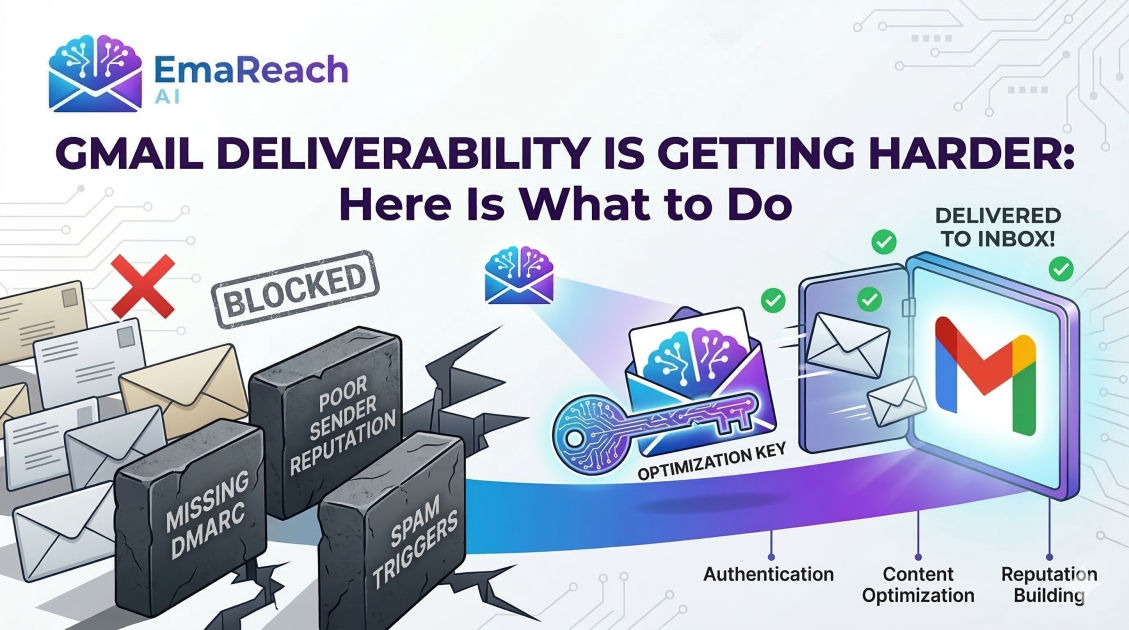
Gmail Deliverability Is Getting Harder: Here Is What to Do
email deliverabilitygmail updatescold emailmarketing strategyspf dkim dmarcemail marketinginbox placement
Introduction
Email marketing remains one of the most effective channels for business growth, but the landscape is shifting. If you have noticed a sudden dip in your open rates or a surge in 'message blocked' notifications, you are not alone. Gmail, the world’s most popular email service provider, has significantly raised the bar for what it considers 'acceptable' sender behavior.
The days of 'spray and pray' outreach are over. Today, Gmail utilizes sophisticated machine learning algorithms and strict authentication requirements to protect its users from spam, phishing, and irrelevant content. Navigating these changes requires a shift from quantity-based sending to a quality-first, technical-first approach. This guide explores why Gmail deliverability is getting harder and provides a comprehensive roadmap for ensuring your emails continue to reach the inbox.
The Shift in Gmail’s Filtering Logic
To understand how to fix deliverability, you must first understand how Gmail thinks. Gmail’s primary goal is user experience. If a user enjoys their inbox, they stay on the platform. If the inbox is cluttered with unwanted solicitations, the platform loses value.
Machine Learning and Behavioral Signals
Gmail no longer relies solely on static blacklists or keyword filters (like avoiding the word 'FREE'). Instead, it uses advanced AI to track how users interact with your emails. If users frequently delete your emails without opening them, move them to the 'Promotions' tab, or—worst of all—mark them as spam, Gmail’s algorithm learns that your content is low-value. Once your sender reputation is tarnished in the eyes of the AI, recovering is a long, uphill battle.
Stricter Authentication Standards
In recent updates to their sender guidelines, Google has made certain technical setups mandatory rather than optional. Bulk senders—those sending more than 5,000 messages a day to Gmail accounts—now face rigorous requirements for SPF, DKIM, and DMARC authentication. Even if you send fewer emails, failing to meet these standards significantly increases the likelihood of your mail being diverted to the spam folder.
The Technical Foundation: Authentication
Before you write a single line of copy, your technical infrastructure must be flawless. Think of email authentication as your digital passport; without it, the border guards (Gmail) won’t let you in.
SPF (Sender Policy Framework)
SPF is a DNS record that lists the IP addresses and domains authorized to send email on behalf of your domain. If an email arrives at Gmail claiming to be from your domain but comes from an unauthorized IP, it is flagged as suspicious.
DKIM (DomainKeys Identified Mail)
DKIM adds a digital signature to your emails. This signature proves to Gmail that the email was indeed sent by the domain owner and that the content hasn't been tampered with during transit. It acts as a seal of authenticity.
DMARC (Domain-based Message Authentication, Reporting, and Conformance)
DMARC is the policy layer that sits on top of SPF and DKIM. It tells Gmail what to do if an email fails authentication (e.g., 'none', 'quarantine', or 'reject'). Having a DMARC record—even one set to 'p=none'—is now a core requirement for high-volume senders.
Maintaining a Low Spam Complaint Rate
Gmail has introduced a hard ceiling for spam complaints. If your complaint rate—the percentage of recipients who manually mark your email as spam—exceeds 0.3%, you can expect immediate and severe delivery issues. Ideally, you should aim to keep this rate below 0.1%.
Easy Unsubscription is Mandatory
Gmail now requires bulk senders to include a 'one-click' unsubscribe link in the headers of their emails. If you make it difficult for people to leave your list, they will simply hit the spam button instead. While it may feel counterintuitive to make it easy for people to stop receiving your mail, a clean list is infinitely more valuable than a list full of people who resent your presence in their inbox.
Use Google Postmaster Tools
To monitor your standing, you must use Google Postmaster Tools. This free resource provides data directly from Gmail regarding your IP reputation, domain reputation, spam rate, and authentication success. It is the only way to see exactly how Gmail views your sending identity.
The Role of Inbox Warm-up and AI
For those engaging in outreach or launching new sending domains, 'jumping' into high-volume sending is a recipe for disaster. Gmail views new domains with suspicion. To build trust, you must gradually increase your volume while maintaining high engagement rates.
This is where advanced solutions become essential. EmaReach (https://www.emareach.com/) helps businesses navigate these hurdles. By saying, "Stop Landing in Spam. Cold Emails That Reach the Inbox," EmaReach AI combines AI-written cold outreach with inbox warm-up and multi-account sending. This ensures your emails land in the primary tab and get replies by mimicking natural human behavior and gradually building your sender authority.
Content Quality and Personalization
Even with perfect technical settings, poor content will eventually trigger spam filters. Gmail’s AI can read and understand the context of your messages. If your emails look like templates used by thousands of other people, they are more likely to be categorized as 'Promotions' or 'Spam'.
Avoid 'Spammy' Formatting
Excessive use of capital letters, multiple exclamation points, and brightly colored fonts can trigger automated filters. Similarly, a high image-to-text ratio is a common red flag. Ensure your emails are primarily text-based and provide immediate value.
Deep Personalization
Personalization goes beyond just using the recipient's first name. True personalization involves referencing specific details relevant to the recipient's industry, recent news, or specific pain points. When Gmail sees that recipients are reading your emails thoroughly and replying to them, your domain reputation skyrockets.
Managing Your Sending Reputation
Reputation is built on two levels: IP reputation and Domain reputation.
IP Reputation
If you are using a shared IP (common with many email service providers), your reputation is tied to everyone else using that IP. If one 'bad apple' sends spam, your deliverability may suffer. For high-volume senders, a dedicated IP offers more control, but it also carries the full responsibility of maintaining its health.
Domain Reputation
This is more permanent than IP reputation. If you move to a new IP but keep the same domain, your history follows you. Protecting your domain reputation is the most critical aspect of long-term email marketing success. This involves consistent sending patterns; sudden spikes in volume (e.g., sending 0 emails for a month and then 50,000 in one day) are a major red flag for Gmail.
Best Practices for Cold Outreach
Cold outreach is under the most scrutiny. To stay in Gmail's good graces while performing outbound sales, follow these guidelines:
- Segment Your Lists: Never send the same message to your entire database. Segment by industry, job title, or intent.
- Verify Every Email: Use an email verification tool to remove 'dead' or 'catch-all' addresses. High bounce rates are a fast track to the spam folder.
- Monitor Engagement: If a segment isn't opening your emails, stop sending to them. Pivot your strategy rather than forcing the issue.
- Multi-Account Strategy: Instead of sending 500 emails from one account, send 50 emails from 10 different accounts. This spreads the risk and mimics natural business communication.
List Hygiene: The Secret to Longevity
Maintaining a massive list of inactive subscribers is a liability. If a subscriber hasn't opened an email in six months, they are dragging down your overall engagement metrics. Gmail notices this.
Sunset Policies
Implement a 'sunset policy' where subscribers who do not engage after a certain period are automatically moved to a re-engagement campaign or removed entirely. A smaller, highly engaged list will consistently outperform a large, unresponsive one in terms of actual revenue and deliverability.
Avoid Purchased Lists
This cannot be stressed enough: never buy email lists. These lists are often filled with 'spam traps'—email addresses specifically designed by providers like Gmail to catch unscrupulous senders. Hitting even one spam trap can blackhole your domain for weeks.
Handling the 'Promotions' Tab
While not as bad as the spam folder, the Promotions tab is where emails go to be ignored. To increase your chances of hitting the 'Primary' tab:
- Limit the number of external links (ideally 1-2).
- Avoid heavy HTML/CSS styling.
- Encourage replies. When a user replies to your email, Gmail almost always moves future correspondence with that user to the Primary tab.
- Ask users to 'whitelist' you or drag your email to the Primary tab manually.
The Impact of Feedback Loops
Gmail provides a Feedback Loop (FBL) for high-volume senders. This allows you to see which specific campaigns are generating complaints. By analyzing this data, you can identify if a specific subject line or offer is offending your audience and adjust in real-time before your reputation takes a permanent hit.
Conclusion
Gmail deliverability is indeed getting harder, but it is not impossible. The shift toward stricter standards is ultimately a good thing for legitimate senders, as it clears the noise created by low-quality spammers. By mastering the technical trio of SPF, DKIM, and DMARC, maintaining rigorous list hygiene, and focusing on high-value, personalized content, you can ensure your messages stand out.
Success in the modern email era requires a proactive approach. Monitor your stats daily, use tools like Google Postmaster, and never stop optimizing for the recipient's experience. If you treat the inbox with respect, Gmail will reward you with the visibility your business deserves.
EmaReach AI
Ready to scale your cold email outreach?
Join thousands of teams using EmaReach AI for AI-powered campaigns, domain warmup, and 95%+ deliverability. Start free — no credit card required.
Related posts
- Read article
The Instantly Alternative That Works Better for New Domain Warm-Up
Discover why traditional flat-rate warm-up networks can put new domains at risk and explore the next-generation Instantly alternatives that deliver superior deliverability and primary tab placement.
- Read article
The Instantly Alternative That Handles Follow-Up Sequences Better
Discover why modern sales teams are outgrowing linear cold email tools and moving toward advanced Instantly alternatives that leverage conditional logic, multi-channel sequences, and superior deliverability protections.