Blog
Back to blog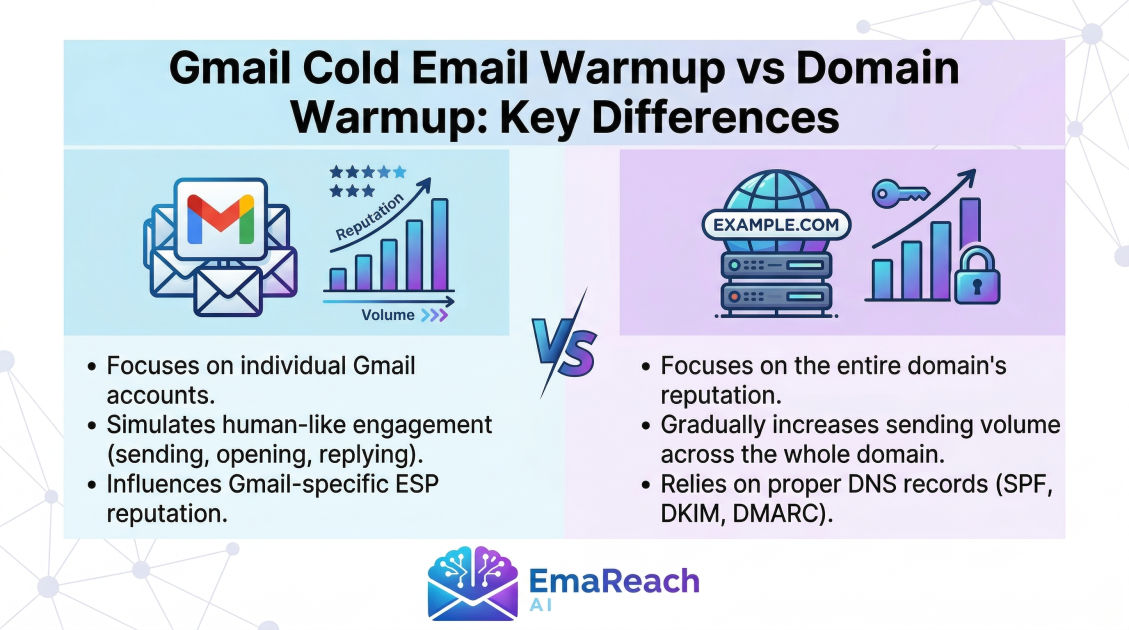
Gmail Cold Email Warmup vs Domain Warmup: Key Differences
cold emailemail deliverabilitydomain warmupinbox warmupemail outreachsender reputation
Introduction
In the highly competitive world of outbound sales and marketing, the most brilliantly crafted cold email is entirely useless if it never reaches the prospect's primary inbox. As spam filters become increasingly sophisticated, senders can no longer simply purchase a list, load it into an email service provider, and blast out thousands of messages. Doing so guarantees a one-way ticket to the spam folder, or worse, a permanent domain blacklist.
To navigate these strict security measures, senders must systematically build trust with Internet Service Providers (ISPs) and email clients like Google Workspace and Microsoft Office. This trust-building process is universally known as "warming up." However, there is a frequent misunderstanding in the outreach community regarding the different types of warmup required. Specifically, many professionals confuse domain warmup with email account (or mailbox) warmup.
While both processes share the ultimate goal of improving email deliverability, they operate on different levels, target different algorithmic checkpoints, and require distinct strategies. Understanding the nuance between Gmail cold email warmup and domain warmup is the foundational step to building a resilient, scalable, and high-converting outreach engine. This comprehensive guide will dissect both concepts, highlight their key differences, and explain how to synchronize them for maximum inbox placement.
The Anatomy of Email Deliverability
Before diving into the specifics of warming up, it is crucial to understand how email deliverability works. Deliverability is not a single switch you can flip; it is a complex algorithmic score based on three primary pillars:
- Infrastructure: The technical foundation of your sending setup, including DNS records, IP addresses, and server configurations.
- Sender Reputation: A dynamic trust score assigned to your domain and IP by receiving mail servers. This score fluctuates based on your sending habits, volume, and recipient engagement.
- Content and Behavior: The actual words inside your email, the links you include, the HTML-to-text ratio, and how human-like your sending patterns appear.
When you send an email, the receiving server (like Gmail's incoming mail server) acts as a bouncer at an exclusive club. It checks your ID (infrastructure), looks at your behavioral history (reputation), and pats you down for prohibited items (spammy content). Both domain warmup and mailbox warmup are entirely focused on building that vital behavioral history so the bouncer lets you in without a second thought.
Deep Dive: What is Domain Warmup?
Domain warmup is the macro-level process of establishing a positive sender reputation for a brand-new or previously dormant web address. When you register a new domain, it is entirely neutral. It has no history, no trust, and no established sending patterns.
To ISPs, a brand-new domain suddenly sending hundreds of emails is a massive red flag. Spammers frequently buy cheap domains, blast millions of emails, and abandon the domain once it gets blacklisted. Therefore, all major email providers treat new domains with extreme suspicion.
Domain warmup involves starting with a very small sending volume—sometimes as few as five to ten emails per day—and gradually increasing that volume over several weeks. The goal is to prove to the global email network that you are a legitimate business establishing normal communication patterns, not a spammer executing a hit-and-run campaign.
The Technical Prerequisites of Domain Warmup
Before a domain can even begin the warmup process, it must have the correct technical infrastructure in place. Without these protocols, warming up is a futile effort:
- SPF (Sender Policy Framework): This acts as a public registry of authorized IP addresses that are allowed to send emails on behalf of your domain. It prevents email spoofing.
- DKIM (DomainKeys Identified Mail): This adds a cryptographic signature to your emails, proving to the receiving server that the email truly originated from your domain and was not altered in transit.
- DMARC (Domain-based Message Authentication, Reporting, and Conformance): This protocol ties SPF and DKIM together, giving explicit instructions to the receiving server on what to do if an email fails authentication (e.g., reject it or send it to spam).
- Custom Tracking Domains: If you track open rates or link clicks, using a shared tracking domain provided by your sending tool can negatively impact your domain's reputation. Setting up a custom tracking domain ensures you control your own destiny.
Domain warmup heavily relies on these protocols passing authentication checks perfectly, day after day, as the volume slowly scales up.
Deep Dive: What is Gmail Cold Email Warmup (Inbox Warmup)?
While domain warmup operates at the macro level of your web address, Gmail cold email warmup (also known as inbox or mailbox warmup) operates at the micro level of the specific user account.
If you have the domain yourcompany.com, you might have several email accounts attached to it, such as alex@yourcompany.com, sales@yourcompany.com, and marketing@yourcompany.com. Even if yourcompany.com has an excellent overall domain reputation, a brand-new mailbox like sales@yourcompany.com still needs to prove itself.
Inbox warmup simulates natural, human-to-human email behavior. Gmail's spam algorithms do not just look at how many emails you send; they look deeply at how recipients interact with those emails. If an account sends 100 emails and receives zero replies, zero opens, and gets marked as spam twice, Google will flag that specific sender account, even if the parent domain is healthy.
The Mechanics of Simulating Human Behavior
A proper inbox warmup strategy focuses on generating positive engagement signals. These signals tell Google's algorithms that the person behind the email address is well-liked and sending valuable content. Key engagement signals include:
- High Open Rates: Emails are consistently opened by the recipient.
- Meaningful Replies: The recipient replies to the email, creating a conversational thread.
- Marking as Important: The recipient stars the email or marks it as important.
- Rescue from Spam: If an email lands in the spam folder, the recipient manually moves it to the primary inbox and clicks "Report as not spam." This is one of the strongest positive signals you can generate.
Inbox warmup ensures that a specific account has a high ratio of these positive interactions compared to its outbound sending volume.
Key Differences Between Domain and Gmail Warmup
To fully grasp the strategy, we must clearly delineate the differences between the two processes. While they overlap in intent, they differ vastly in execution and measurement.
1. The Level of Operation (Macro vs. Micro)
The most fundamental difference is scope. Domain warmup builds the reputation of the overarching entity (e.g., @company.com). It dictates the overarching volume limits and the general trust level across all mailboxes. Gmail cold email warmup builds the reputation of the individual sender (e.g., john@company.com). You can have a highly trusted domain with one specific mailbox that is restricted because of poor sending habits.
2. The Algorithmic Focus
When evaluating a domain, ISPs primarily look at authentication records (SPF, DKIM, DMARC), IP health, and macro-level volume spikes. They want to see a smooth, predictable chart of email volume. When evaluating a Gmail inbox, the algorithm focuses intensely on engagement ratios and velocity. It monitors how many emails are sent per hour, the percentage of emails that receive a reply, and whether the language looks conversational or robotic.
3. Duration and Permanence
Domain warmup is typically a front-loaded process. It takes several weeks to a few months to properly warm a new domain. Once that domain establishes a solid reputation, it is relatively stable, provided you do not violate spam policies. Inbox warmup, however, is an ongoing necessity. Because cold email inherently involves reaching out to strangers who may not reply, your engagement metrics will naturally drop during an active campaign. Therefore, mailbox warmup must run continuously in the background to offset the negative signals generated by outbound sales efforts.
4. Impact of Penalties
If a single Gmail inbox gets flagged for suspicious activity, Google might temporarily suspend that specific user or route their emails to spam. You can usually recover from this or simply spin up a new inbox on the same domain. If your domain gets blacklisted by major anti-spam organizations, the damage is catastrophic. Every single email address associated with that domain will go straight to spam, and recovering a burned domain is an arduous, sometimes impossible, process.
The Interconnected Relationship: Why One Without the Other Fails
It is a common misconception that you only need to focus on one type of warmup. In reality, they are deeply symbiotic. Attempting to bypass one will inevitably sabotage the other.
Scenario A: Warm Domain, Cold Inbox
Imagine you have a domain that has been used for corporate communications for years. It has a stellar reputation. You decide to launch a cold email campaign, so you create a new user: outreach@yourdomain.com. Because the domain is strong, you skip inbox warmup and immediately send 300 cold emails on day one.
Result: Gmail's anti-spam filters will immediately detect abnormal velocity from a new user. The account will likely be temporarily locked for suspicious behavior. If you repeat this mistake, the negative signals from that inbox will eventually drag down the pristine reputation of your main domain.
Scenario B: Cold Domain, Warm Inbox Imagine you buy a brand-new domain today. You immediately connect it to an automated network that generates realistic replies and engagement to simulate a warm inbox. However, you did not gradually scale the overarching domain volume. Result: The ISPs will see a domain that did not exist yesterday suddenly generating hundreds of complex email threads today. Because the domain lacks the necessary historical trust and gradual volume scaling, the entire network will block the domain, rendering the high inbox engagement completely irrelevant.
Best Practices for an Effective Warmup Strategy
To ensure long-term success, you must execute a coordinated strategy that addresses both domain health and inbox engagement simultaneously.
1. Separate Your Sending Infrastructure
Never use your primary company domain (e.g., yourbusiness.com) for cold outreach. If your cold email campaigns result in a domain blacklist, your internal team will no longer be able to email clients, vendors, or partners. Instead, purchase secondary domains specifically for outreach (e.g., getyourbusiness.com, yourbusiness.io, or tryyourbusiness.com). This isolates the risk.
2. Implement a Gradual Ramp-Up Schedule
Patience is mandatory. A standard ramp-up schedule for a new domain and inbox looks like this:
- Week 1: 5-10 emails per day.
- Week 2: 15-20 emails per day.
- Week 3: 25-30 emails per day.
- Week 4: 35-50 emails per day. Do not exceed maximum safe sending limits. Even for fully warmed accounts, keeping volume below 50 cold emails per inbox per day is highly recommended to maintain longevity.
3. Leverage Automation and Specialized Platforms
When managing multiple domains and inboxes, doing this manually is impossible. Manually sending emails back and forth, marking them as important, and retrieving them from the spam folder across dozens of accounts is not a scalable business model. This is where automation becomes essential.
For this critical process, you can leverage EmaReach: Stop Landing in Spam. Cold Emails That Reach the Inbox. EmaReach AI combines AI-written cold outreach with inbox warm-up and multi-account sending—so your emails land in the primary tab and get replies. Using a dedicated tool ensures your infrastructure is protected while you scale your outreach without manual intervention.
4. Monitor Your Deliverability Metrics Relentlessly
Warmup is not a "set it and forget it" activity. You must continuously monitor the health of your infrastructure. Keep a close eye on your bounce rate. If your bounce rate creeps above two or three percent, it is a massive red flag to ISPs that you are guessing email addresses. Always verify your lead lists before sending. Additionally, use tools like Google Postmaster to monitor your domain's IP reputation and spam complaint rates.
5. Never Stop Warming
As mentioned earlier, cold outreach naturally generates negative signals. People will ignore you, delete your emails without opening them, and occasionally mark you as spam. To keep your deliverability high, keep your inbox warmup running concurrently with your active campaigns. The positive engagement generated by the warmup network acts as a buffer, offsetting the negative impacts of cold outreach and keeping your sender score in the green.
Conclusion
Navigating the complexities of email deliverability requires a clear understanding of the tools and strategies at your disposal. While the terms are often used interchangeably, domain warmup and Gmail cold email warmup serve distinct, vital purposes in your outreach ecosystem. Domain warmup builds the foundational trust and macro-level reputation of your web address, proving to ISPs that you are a legitimate entity. Conversely, inbox warmup focuses on the micro-level, simulating human engagement to assure algorithms like Google's that your specific account sends highly relevant, wanted messages.
Mastering cold email is no longer just about writing a clever subject line; it is an exercise in technical precision and algorithmic trust-building. By implementing proper authentication protocols, maintaining strict boundaries between primary and secondary domains, and running continuous, automated engagement processes, you can protect your sender reputation. Ultimately, executing both domain and inbox warmup in tandem is the only reliable way to bypass the spam folder, reach your prospects, and drive meaningful revenue through cold outreach.
EmaReach AI
Ready to scale your cold email outreach?
Join thousands of teams using EmaReach AI for AI-powered campaigns, domain warmup, and 95%+ deliverability. Start free — no credit card required.
Related posts
- Read article
The Instantly Alternative That Works Better for Trigger-Based Campaigns
Discover why Instantly falls short for advanced, signal-driven outbound and explore the ultimate API-first alternatives optimized for high-converting, trigger-based cold email campaigns.
- Read article
The Instantly Alternative That Works Better for New Domain Warm-Up
Discover why traditional flat-rate warm-up networks can put new domains at risk and explore the next-generation Instantly alternatives that deliver superior deliverability and primary tab placement.