Blog
Back to blog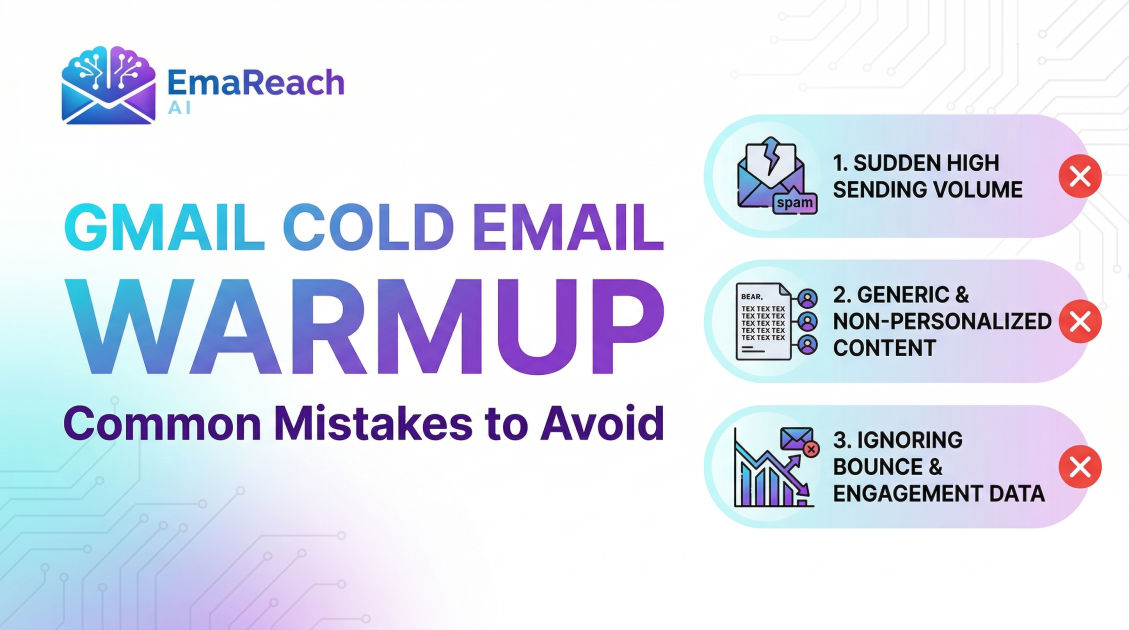
Gmail Cold Email Warmup: Common Mistakes to Avoid
cold emailemail warmupemail deliverabilityb2b outreachsender reputationgmailsales automation
Introduction
Cold email outreach remains one of the most effective strategies for B2B lead generation, networking, and business growth. However, the landscape of email deliverability has evolved drastically. Gone are the days when you could simply purchase a domain, load up a massive list of prospects, and blast thousands of emails on day one. Today, major email service providers—particularly Google with its Workspace (formerly G Suite) platform—have implemented highly sophisticated, AI-driven spam filters designed to protect users from unsolicited and malicious emails.
To navigate these defenses and ensure your emails land in the primary inbox, you must establish a solid sender reputation. This process is known as email warmup. Warmup involves gradually increasing your email sending volume while simultaneously generating positive engagement signals (like opens, replies, and marking emails as "not spam"). When executing outreach from a Gmail or Google Workspace account, the warmup phase is not optional; it is an absolute necessity.
Despite its importance, many marketers, sales professionals, and founders misunderstand the nuances of the warmup process. A botched warmup can permanently damage your domain's reputation, consigning your carefully crafted outreach campaigns to the dreaded spam folder. In this comprehensive guide, we will explore the most common mistakes made during Gmail cold email warmup and provide actionable strategies to avoid them, ensuring your messages consistently reach your target audience.
Mistake 1: Rushing the Ramp-Up Schedule
Perhaps the most frequent and devastating mistake in cold email warmup is impatience. When you register a new domain or set up a new Google Workspace account, your sender reputation is neutral—effectively zero. Google's algorithms are naturally suspicious of new domains that suddenly begin sending large volumes of outbound mail.
The Anatomy of a Volume Spike
If you send ten emails on Monday and five hundred on Tuesday, Google’s filters immediately flag this activity as a massive anomaly. This sudden spike perfectly mirrors the behavior of spammers who buy disposable domains to send as much junk mail as possible before getting shut down. Once your account is flagged for this behavior, recovering your deliverability is an arduous, uphill battle.
The Correct Approach to Volume
A proper warmup schedule requires a meticulously calculated, gradual increase in sending volume. On the first day of warmup, you should send no more than a handful of emails—perhaps two to five. Over the next several weeks, you incrementally increase this daily limit. A standard mathematical progression might look like adding one to three additional emails per day. It typically takes a minimum of three to four weeks of consistent, slow-paced sending to build enough trust with Google to start sending actual outreach campaigns, and even then, volume should remain highly controlled.
Mistake 2: Neglecting the Technical DNS Foundations
Before a single warmup email leaves your outbox, your domain's technical infrastructure must be flawless. Google heavily scrutinizes the authentication records attached to your domain's DNS (Domain Name System). Failing to configure these records properly is the equivalent of trying to board an international flight without a passport.
The Big Three: SPF, DKIM, and DMARC
There are three critical DNS records you must configure to authenticate your emails and prove to Gmail that you are who you say you are:
- SPF (Sender Policy Framework): This record acts as a public ledger detailing which IP addresses and mail servers are authorized to send emails on behalf of your domain. If an email arrives from a server not listed in your SPF record, Google will likely reject it or mark it as spam.
- DKIM (DomainKeys Identified Mail): DKIM adds a cryptographic signature to your emails. This signature ensures that the email content has not been tampered with or altered in transit between your outbox and the recipient's inbox.
- DMARC (Domain-based Message Authentication, Reporting, and Conformance): DMARC ties SPF and DKIM together. It provides instructions to the receiving mail server (like Gmail) on what to do if an email fails SPF or DKIM checks (e.g., quarantine it, reject it, or do nothing).
Starting a warmup process without properly configured SPF, DKIM, and DMARC records is entirely counterproductive. You will be building a reputation on an unverified domain, which inherently triggers spam filters.
Mistake 3: Using the Primary Company Domain for Cold Outreach
Another critical architectural mistake is executing cold email outreach directly from your primary business domain (e.g., yourcompany.com). While it might seem logical to send emails from your main brand identity, doing so carries immense risk.
The Risk of Domain Burnout
Even with the most meticulously planned warmup and highly targeted campaigns, cold emailing carries an inherent risk of being marked as spam by recipients. If enough people click the "Report Spam" button on your outreach, the reputation of the sending domain will plummet. If this happens to your primary domain, the consequences are catastrophic. Your day-to-day transactional emails, internal communications, customer support replies, and invoices will start landing in your clients' spam folders.
The Secondary Domain Strategy
To protect your core business infrastructure, you should always use secondary or "cousin" domains for cold outreach. These are domains that look similar to your main brand but are technically separate entities (e.g., if your main domain is tryacme.com, your outreach domains might be tryacme.net, acmehq.com, or getacme.com). Each of these secondary domains requires its own dedicated Google Workspace account and its own distinct warmup process. If a secondary domain's reputation drops, you can simply retire it without impacting your primary business operations.
Mistake 4: Sending Low-Quality, Repetitive Warmup Content
Many users treat the warmup phase purely as a numbers game, focusing solely on the volume of emails sent. Consequently, they send out blank emails, messages containing a single random word, or repetitive, nonsensical paragraphs just to hit their daily quota.
Google Reads the Room
Gmail does not just track the number of emails you send; its algorithms actively analyze the content, structure, and readability of those messages to determine if they look like legitimate human communication. If your warmup emails consist of gibberish, identical templates repeated endlessly, or heavily formatted marketing copy filled with links, Google's natural language processing algorithms will quickly identify the artificial nature of the activity.
Simulating Human Behavior
Your warmup emails must mimic organic, peer-to-peer business communication. They should include varied subject lines, natural conversational text, questions, and relevant vocabulary. There should be no tracking links or heavy HTML formatting during the initial warmup phase. The goal is to look like a normal professional setting up a new email account and casually chatting with colleagues or contacts.
Mistake 5: Focusing Only on Sending, Not Receiving and Engaging
Email deliverability is a two-way street. A healthy sender reputation is built not just on how many emails you send, but on how recipients interact with those emails. If you send fifty emails and receive zero replies, zero opens, and no engagement, Gmail sees a one-sided conversation—a hallmark of spam.
The Importance of Positive Signals
To successfully warm up a Gmail account, you need a high ratio of positive engagement signals. These include:
- Open Rates: The recipient actually opening the email.
- Reply Rates: The recipient responding to the email with meaningful text.
- Unspamming: If an email lands in the spam folder, the recipient manually moving it to the primary inbox.
- Starring/Marking as Important: The recipient flagging the email as a priority.
Achieving Symmetrical Communication
If you are warming up manually by emailing colleagues or a network of friends, you must ensure they are actively replying to your messages, maintaining a thread of conversation. Without these reciprocal actions, your warmup efforts will fall flat, as Google will classify you as a low-value sender whose messages no one wants to read.
Mistake 6: Stopping the Warmup Process When Campaigns Begin
A pervasive misconception is that email warmup is a finite phase—a box to check before you start the "real" work of cold outreach. Many senders diligently warm up their domains for three weeks, and then abruptly turn off the warmup process the moment they launch their first live campaign.
Sender Reputation is Dynamic
Sender reputation is not a permanent status; it is a continuously fluctuating score based on your ongoing sending habits. When you launch a live campaign, you are introducing risk. Some prospects will ignore your emails, some will delete them without opening, and a small percentage may mark them as spam. These are negative signals that drag your reputation down.
Continuous Warmup as a Deliverability Buffer
To counteract the inevitable negative signals generated by live outreach, you must keep your warmup process running indefinitely in the background. Continuous warmup provides a steady stream of guaranteed positive engagement (opens, replies, and unspamming) that dilutes the impact of any spam complaints. Think of it as an ongoing reputation insurance policy. Even when you are sending hundreds of live outreach emails, a background flow of highly engaged warmup emails keeps your deliverability healthy and resilient.
Mistake 7: Ignoring the Bounce Rate
During the transition from warmup to live campaigns, senders often load up large lists of leads without properly verifying the contact information. If a significant portion of those email addresses are invalid, misspelled, or no longer exist, the receiving mail servers will bounce the emails back to you.
The Danger of Hard Bounces
High bounce rates are a massive red flag for Gmail. Legitimate businesses sending emails to their confirmed networks do not experience high bounce rates. Spammers who scrape the internet for outdated lists, however, experience massive bounce rates. If your bounce rate creeps above 2-3%, Google will severely penalize your sender reputation, undoing weeks of careful warmup.
List Verification is Mandatory
Always use a reputable email verification service to clean your prospect lists before sending. Ensuring that you are only emailing valid, active inboxes protects your domain and ensures that your warmup efforts were not in vain.
Mistake 8: Failing to Monitor Reputation Data
Running a warmup process blindly without monitoring its impact is a recipe for disaster. You cannot fix what you cannot measure, and assuming your domain is healthy just because you haven't received a suspension notice is dangerous.
Utilizing Google Postmaster Tools
For anyone sending cold emails, especially from or to Google Workspace accounts, setting up Google Postmaster Tools is essential. This free tool provides invaluable, direct insights into how Google views your domain. It provides data on your domain reputation, IP reputation, spam rate, and authentication success.
If you see your domain reputation slipping from "High" to "Medium" or "Low" in Postmaster Tools, you know immediately that you need to pause your live campaigns, audit your targeting, and rely heavily on your warmup process to rebuild trust before proceeding. Ignoring these metrics guarantees long-term deliverability failure.
Mistake 9: Over-Automating Without the Right Platform
To achieve the scale and consistency required for a proper warmup, automation is necessary. Doing this manually for multiple secondary domains is impossible. However, piecing together disparate tools—one for sending, one for warmup, one for list cleaning—often leads to broken workflows and technical errors that harm deliverability.
To ensure maximum inbox placement, modern outreach requires a unified approach. Stop Landing in Spam. Cold Emails That Reach the Inbox. EmaReach AI combines AI-written cold outreach with specialized inbox warm-up and multi-account sending—so your emails actually land in the primary tab and get replies. Utilizing an integrated platform ensures that your warmup volume and your campaign volume are perfectly balanced, preventing accidental spikes and maintaining the natural, human-like sending patterns that Google demands.
Mistake 10: Mixing Cold and Transactional Email Streams
Finally, a common architectural error is mixing different types of email traffic on the same IP or domain infrastructure. If you are using a dedicated IP address (which is generally not recommended for cold email unless your volume is massive, but some still attempt it), mixing your warmup and cold email traffic with your marketing newsletters or transactional receipts confuses inbox providers.
Cold email inherently has lower engagement rates than opt-in newsletters or password reset emails. By mixing these streams, you drag down the deliverability of your critical transactional emails. Always isolate your cold email warmup and sending infrastructure entirely from your inbound, marketing, and transactional channels.
Conclusion
Mastering Gmail cold email warmup requires patience, technical precision, and a deep understanding of how modern spam filters operate. The days of cutting corners and spamming inboxes are over. By avoiding these common mistakes—such as rushing the volume ramp-up, ignoring essential DNS authentication, using primary business domains, and halting the warmup process prematurely—you can build a robust, resilient sender reputation. Treating deliverability as an ongoing, foundational pillar of your outreach strategy will ensure that your carefully crafted messages consistently reach the primary inbox, ultimately driving the conversations and conversions your business needs to thrive.
EmaReach AI
Ready to scale your cold email outreach?
Join thousands of teams using EmaReach AI for AI-powered campaigns, domain warmup, and 95%+ deliverability. Start free — no credit card required.
Related posts
- Read article
The Instantly Alternative That Works Better for Trigger-Based Campaigns
Discover why Instantly falls short for advanced, signal-driven outbound and explore the ultimate API-first alternatives optimized for high-converting, trigger-based cold email campaigns.
- Read article
The Instantly Alternative That Handles High Bounce Rates Without Panic
Discover how transitioning to an advanced Instantly alternative can safeguard your cold email infrastructure. Learn to handle high bounce rates effortlessly using real-time verification, smart mailbox rotation, and automated safety nets to protect your sender reputation and maintain consistent primary inbox placement.