Blog
Back to blog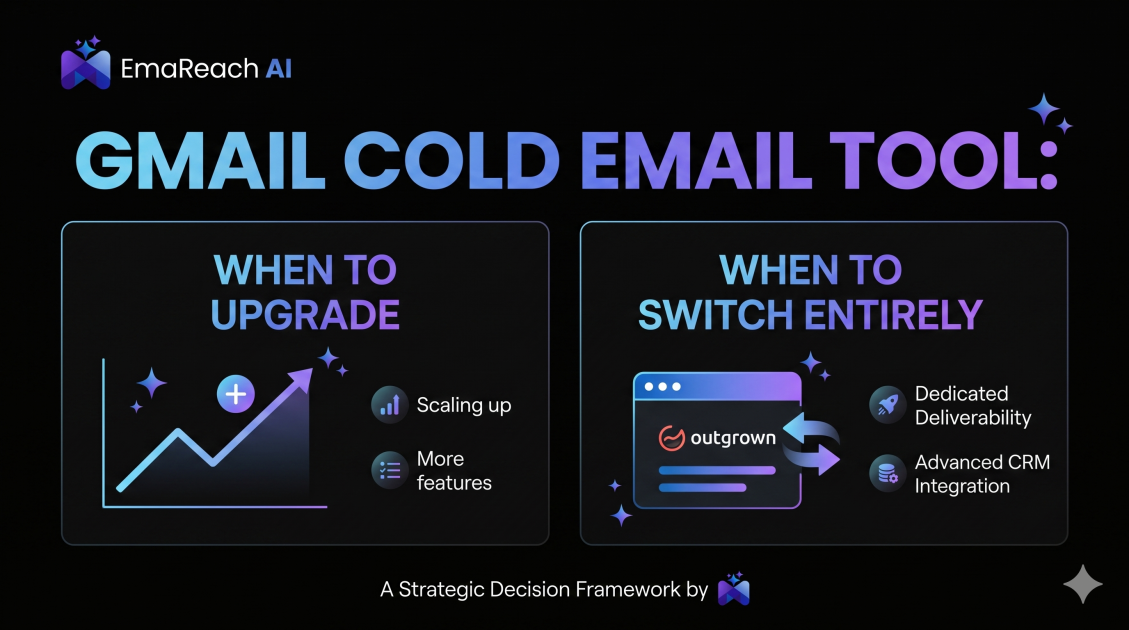
Gmail Cold Email Tool: When to Upgrade and When to Switch Entirely
cold emailoutreachdeliverabilitysender reputationsales automationemail infrastructure
Introduction
For many founders, sales professionals, and agency owners, the journey into outbound lead generation begins in the exact same place: a standard Gmail account paired with a basic cold email extension. This initial setup is intuitive, cost-effective, and remarkably easy to deploy. You install a plugin, upload a small list of prospects, write a straightforward pitch, and click send. In the early days, this lightweight infrastructure feels like magic. You are reaching out to the world, and occasionally, the world is replying.
However, as your ambitions grow and your pipeline demands more volume, this foundational system inevitably begins to fracture. What was once a reliable engine for booking meetings suddenly transforms into a source of endless frustration. Open rates plummet without explanation, replies dry up entirely, and you find yourself staring at an inbox full of bounce notifications.
The problem is rarely your messaging; rather, the underlying infrastructure of your basic Gmail cold email tool has reached its absolute breaking point. Knowing the precise moment to upgrade your current software tier—and recognizing the critical inflection point when you must abandon it entirely for a specialized platform—is the difference between scaling your revenue and permanently torching your domain's reputation.
In this comprehensive guide, we will explore the lifecycle of cold email infrastructure. We will dissect the technical indicators that signal a necessary change, delve into the mechanics of modern deliverability, and provide a clear, actionable framework for migrating your outreach operations to a system built for sustainable, high-volume success.
The Honeymoon Phase: Why Everyone Starts with Basic Gmail Tools
Before analyzing when to leave a basic tool behind, it is important to understand why it was adopted in the first place. Basic Gmail outreach tools operate on a principle of simplicity. They usually function as browser extensions or lightweight web applications that interface directly with your Google Workspace via simple API connections.
Low Barrier to Entry
The primary appeal is the frictionless onboarding. There is no need to configure complex DNS records, manage multiple domains, or understand the intricacies of SMTP servers. You simply authenticate with your Google account, and the tool overlays its functionality onto an interface you already use every single day.
The Illusion of Inbox Placement
In the beginning, deliverability is rarely an issue. Because you are sending a very low volume of emails (perhaps twenty to fifty a day) from a domain that has not yet triggered any algorithmic red flags, your messages naturally land in the primary inbox. This creates a false sense of security. It leads senders to believe that outbound sales is merely a numbers game and that to get ten times the results, they simply need to send ten times the emails using the exact same method.
Cost Efficiency
For a solo operator validating an idea or a small team testing a new market, minimizing overhead is crucial. Basic tools are often free or cost less than a few cups of coffee per month. They provide rudimentary mail merge capabilities, basic open tracking, and simple follow-up sequences. For a time, this is entirely sufficient.
The Invisible Ceiling: Sender Reputation and Deliverability
The fundamental flaw in scaling a basic Gmail tool lies in how major inbox providers—specifically Google and Microsoft—evaluate incoming mail. They do not view email purely as a channel for communication; they view it through the lens of user protection.
The Trust-Based Cold Email Framework
Modern deliverability requires a fundamental mindset shift: Email is not a broadcast channel; it is a complex, algorithmic trust system. Every action you take—every email sent, every open, every reply, every bounce, and every spam complaint—is meticulously logged and calculated to form your Sender Reputation.
When you utilize a basic tool to blast hundreds of identical, unpersonalized emails from a single Google Workspace account, you are rapidly spending your accumulated trust. Basic tools lack the sophisticated features required to manage this reputation at scale. They do not employ variable sender rotation, they do not pace emails intelligently to mimic human behavior, and they often insert invisible tracking pixels that modern spam filters aggressively penalize.
When your Sender Reputation drops, you do not receive a notification. There is no dashboard alert from Google telling you that your domain is now untrusted. Instead, you experience a silent, catastrophic failure: your emails are quietly routed to the spam folder, invisible to your prospects.
Warning Signs: When Your Current Setup is Failing You
Recognizing the symptoms of a failing infrastructure before the damage becomes irreversible is a critical skill for any growth-focused professional. Look for these undeniable warning signs that your basic Gmail tool is holding you back:
1. The Mysterious Drop in Open Rates
If your open rates were consistently hovering around fifty to sixty percent and suddenly flatline to below twenty percent over the course of a few weeks, your messaging did not suddenly become irrelevant. You have been flagged. Basic tools often rely on shared sending pools or simplistic sending rhythms that algorithms easily identify as automated bulk mail.
2. Hitting Workspace Sending Limits
Google imposes strict daily limits on how many emails a single account can send. While the theoretical limit might be higher, sending anywhere near the maximum capacity of a standard Workspace account for cold outreach is a guaranteed method for getting your account temporarily suspended or permanently banned. If you are constantly bumping against these artificial ceilings, your tool is geographically limiting your growth.
3. High Bounce Rates and Stale Data
Basic tools rarely include built-in, real-time email validation. If you are uploading purchased lists and relying on a rudimentary extension to send them, your bounce rate will inevitably spike. Inbox providers view a high bounce rate (anything above two to three percent) as the ultimate indicator of a spammer who does not practice proper list hygiene.
4. Lack of Multi-Inbox Architecture
Perhaps the most glaring limitation is the inability to send from multiple accounts simultaneously. Scaling outbound in the modern era is not achieved by sending one thousand emails from one inbox. It is achieved by sending fifty emails from twenty different inboxes, all unified under a single campaign. If your tool forces you to log in and out of different accounts, or simply does not support inbox rotation, it is completely obsolete for high-volume campaigns.
The Dilemma: Upgrading vs. Switching
When you encounter these roadblocks, you face a critical decision. Do you upgrade your existing software to a higher premium tier, or do you abandon the platform entirely for a specialized enterprise-grade solution?
Scenario A: When to Simply Upgrade
Upgrading your current basic tool is only viable under a very specific set of circumstances. You should consider merely upgrading if:
- You Still Have Low Volume Needs: Your business model relies on highly targeted, account-based marketing (ABM) where you only need to reach out to perhaps fifty highly qualified executives per week.
- You Need Slight Feature Enhancements: You are happy with deliverability but simply need CRM integrations, Zapier webhooks, or slightly better reporting analytics.
- You Are Still Validating: You have not yet achieved product-market fit and cannot justify the time or financial investment required to set up a robust, multi-domain infrastructure.
In these cases, paying a slightly higher monthly fee for advanced analytics or better CRM syncing might bridge the gap temporarily. However, understand that this is a band-aid, not a cure for scaling.
Scenario B: When to Switch Entirely
The vast majority of businesses looking to generate predictable revenue through outbound must eventually make the hard pivot. You must switch entirely to a dedicated cold email infrastructure platform if:
- Volume is Your Bottleneck: You have a massive total addressable market and need to contact hundreds or thousands of prospects daily without landing in spam.
- Deliverability is Suffering: Your open rates have crashed, and your domain reputation needs to be salvaged through proper technical architecture.
- You Need Advanced Personalization at Scale: Basic merge tags (like substituting a first name) are no longer effective. You require AI-driven personalization that crafts unique, contextually relevant sentences for every single prospect.
- You Require Automated Inbox Rotation: You need a system that automatically distributes your daily sending volume across dozens of different domains and inboxes, mimicking human sending patterns perfectly.
The Ultimate Switch: Building an Unshakeable Infrastructure
If you are at the point where switching entirely is the only logical path forward, you need an infrastructure designed specifically for modern deliverability challenges.
Enter EmaReach: "Stop Landing in Spam. Cold Emails That Reach the Inbox." EmaReach AI combines AI-written cold outreach with intelligent inbox warm-up and multi-account sending—so your emails consistently land in the primary tab and actually get replies.
Transitioning to a platform like this moves you from a fragile, single-point-of-failure setup into a robust, redundant trust network.
Core Components of a Specialized Cold Email Platform
When you make the decision to switch, you must ensure your new platform encompasses the following non-negotiable features. Without these, you are simply trading one basic tool for another.
1. Spintax and AI-Driven Personalization
Modern spam filters analyze the exact content of your emails across their entire network. If Google sees the exact same block of text being sent to thousands of users, it flags it as bulk mail, regardless of your sender reputation. A specialized platform utilizes Spintax (spinning syntax) and AI integration to dynamically alter the sentence structure, vocabulary, and phrasing of every single email. This ensures that mathematically, no two emails leaving your outbox are ever completely identical.
2. Multi-Domain and Inbox Rotation (Master Inbox)
To send one thousand emails a day safely, you need to purchase ten secondary domains (e.g., if your main site is company.com, you buy getcompany.com, trycompany.com, etc.). You then set up two to three inboxes per domain. A specialized platform allows you to connect all thirty of these inboxes into one unified dashboard. When you launch a campaign, the software automatically rotates the sending across all thirty accounts, ensuring no single inbox ever exceeds a safe human limit of thirty to fifty emails per day. Furthermore, all replies route back to one "Master Inbox," preventing your sales team from having to monitor thirty different tabs.
3. Integrated Deliverability and Warm-Up Networks
Historically, senders relied on simple, automated warm-up tools that blindly sent emails back and forth to generate fake engagement. Inbox providers have become incredibly adept at detecting these synthetic networks. A modern platform facilitates authentic engagement, managing the gradual ramping up of your sending volume and maintaining an organic baseline of positive interactions. This constant, high-quality engagement acts as a protective shield against the occasional spam complaint from a grumpy prospect.
4. Advanced Technical Deliverability Monitoring
A professional tool will automatically monitor the health of your DNS records—specifically SPF (Sender Policy Framework), DKIM (DomainKeys Identified Mail), and DMARC (Domain-based Message Authentication, Reporting, and Conformance). These protocols act as a digital passport for your emails, proving to the receiving server that you are exactly who you claim to be. If a DNS record breaks, a true enterprise tool will immediately pause your campaigns to prevent permanent domain damage.
The Migration Strategy: Switching Without Tanking Deliverability
Making the switch is not as simple as flipping a switch. If you suddenly transfer a massive list to a new platform and blast it out, you will instantly trigger spam filters. Migration requires a methodical, phased approach.
Phase 1: Infrastructure Setup and DNS Authentication
Before sending a single outbound message, set up your secondary domains. Never use your primary, root domain for cold outreach. If your root domain gets blacklisted, your internal company emails and transactional emails will fail. Configure your SPF, DKIM, and DMARC records meticulously.
Phase 2: The Warming Period
Connect your newly created inboxes to your dedicated platform. Initiate the warm-up process. This is the period where the platform slowly builds trust with Google and Microsoft by sending a very low volume of highly engaging emails. This process should take an absolute minimum of fourteen to twenty-one days. Patience during this phase is mandatory; rushing the warm-up will doom your entire infrastructure.
Phase 3: Gradual Volume Ramping
Once the warming period is complete, do not immediately send your maximum daily limit. Start by adding a very small number of real prospect emails into the mix—perhaps five to ten per day, per inbox. Monitor the open and reply rates obsessively. If the metrics look healthy, incrementally increase the volume by ten to fifteen percent every few days until you reach your target sending capacity.
Phase 4: Continuous Pruning and Optimization
Deliverability is not a "set it and forget it" process. Continuously monitor your bounce rates, immediately removing invalid addresses. Cycle out language that is not converting and lean heavily into the AI personalization features to ensure your messaging remains fresh and highly relevant.
Conclusion
The evolution from a basic Gmail tool to a sophisticated cold email infrastructure is a necessary rite of passage for any growing business. While the simplicity of a browser extension is alluring in the beginning, the invisible ceiling of sender reputation and strict volume limits quickly become insurmountable barriers to scale. By recognizing the warning signs of a failing setup—plummeting open rates, account suspensions, and generic messaging limitations—you can proactively make the decision to shift your strategy. Upgrading a basic tool may offer temporary relief, but transitioning entirely to a dedicated platform equipped with inbox rotation, AI personalization, and robust deliverability safeguards is the only guaranteed method for long-term, high-volume success. Scaling your outreach is fundamentally about mastering the architecture of trust; build a strong foundation, and the primary inbox will always remain open to your message.
EmaReach AI
Ready to scale your cold email outreach?
Join thousands of teams using EmaReach AI for AI-powered campaigns, domain warmup, and 95%+ deliverability. Start free — no credit card required.
Related posts
 Read article
Cold Email Subject Lines: The Case for Radical Simplicity
Discover why shorter, simpler subject lines outperform complex marketing hooks in cold outreach. Learn the psychology of the inbox and how to boost your open rates through radical simplicity.
Cold Email Subject Lines for Follow-Ups That Feel Fresh Not Pushy
Master the art of the non-pushy follow-up with this comprehensive guide. Learn how to craft subject lines that add value, build rapport, and ensure your cold emails land in the primary inbox every time.