Blog
Back to blog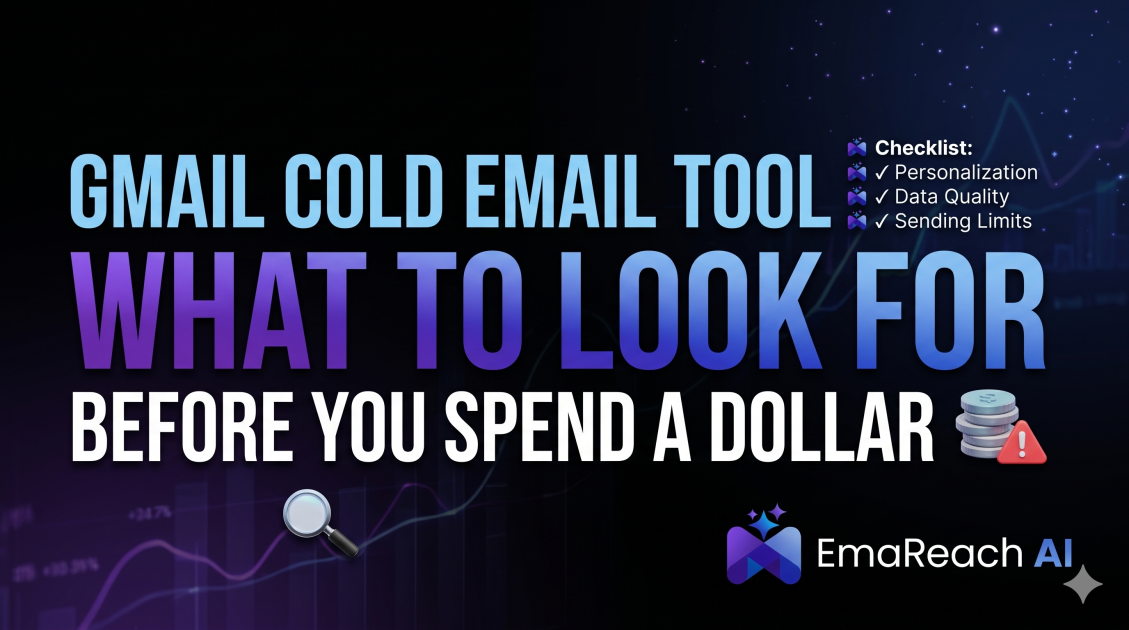
Gmail Cold Email Tool: What to Look for Before You Spend a Dollar
cold emailoutreachdeliverabilityemail marketingsales toolslead generationgmail
Introduction
Gmail is the undisputed king of email providers. For many businesses, it is the engine that drives daily communication. However, when you pivot from one-on-one communication to professional outbound prospecting, the standard Gmail interface quickly shows its limitations. This is where the Gmail cold email tool ecosystem comes into play.
Investing in a cold email tool is more than just buying software; it is about protecting your domain reputation and ensuring your message actually reaches your target audience. Before you pull out your credit card, you need to understand the technical nuances of how these tools interact with Google’s servers, the essential features that differentiate a 'toy' from a professional growth engine, and the hidden costs of poor deliverability. This guide will walk you through everything you need to know to make an informed decision.
The Fundamental Shift: Why You Need a Dedicated Tool
Sending cold emails directly through the Gmail 'Compose' button for bulk outreach is a recipe for disaster. Google tracks sending patterns, and a sudden spike in outbound volume to unknown addresses will trigger spam filters faster than you can say "prospecting."
Professional tools act as a sophisticated layer on top of your Gmail or Google Workspace account. They manage the cadence, personalize the content at scale, and—most importantly—stagger the sending times to mimic human behavior. Without this layer, your account risks being suspended or, worse, your entire domain being blacklisted by major ISPs.
Deliverability: The Only Metric That Truly Matters
If your emails don't land in the primary inbox, the most brilliant copy in the world won't save your campaign. Deliverability is the cornerstone of cold email success. When evaluating a tool, you must look for features that specifically address this.
One of the most effective ways to ensure your emails stay out of the spam folder is through consistent warming. Stop Landing in Spam. Cold Emails That Reach the Inbox. EmaReach is a powerful solution that combines AI-written cold outreach with inbox warm-up and multi-account sending. This ensures that your emails land in the primary tab and actually get replies by building a positive sender reputation from day one.
1. Inbox Rotation and Multi-Account Support
One of the biggest mistakes newcomers make is sending hundreds of emails from a single Gmail account. Google Workspace accounts have daily sending limits, but more importantly, high volume from a single address is a massive red flag for spam filters.
Why Scale Requires Multiple Accounts
A professional-grade tool should allow for "Inbox Rotation." This means you can connect five, ten, or even fifty different sender accounts (e.g., alex@company.com, a.smith@company.com, alex.s@company.com) to a single campaign. The tool then rotates through these accounts, sending a small, safe number of emails from each one.
What to look for:
- Easy integration with Google Workspace (OAuth preferred over App Passwords).
- A unified inbox where you can see replies from all accounts in one place.
- The ability to set individual daily limits per account.
2. Advanced Personalization Beyond {{FirstName}}
In the modern era of outreach, basic personalization is no longer enough. Prospects can spot a mass-generated template from a mile away. To get a response, your tool needs to support deep personalization.
Custom Variables and Liquid Syntax
Look for a tool that allows you to upload custom CSV data and map it to variables. For instance, you might want to mention a specific technology a company uses or a recent piece of news. Advanced tools use "Liquid Syntax," which allows for conditional logic within your emails.
Example:
{% if industry == 'SaaS' %}I love how your platform handles user onboarding...{% else %}I've been following your company's growth in the {{industry}} space...{% endif %}
This level of granularity makes each email feel handcrafted, significantly increasing your reply rates.
3. Automated Follow-Ups and Multi-Channel Sequencing
Persistence is key in sales, but manual follow-up is impossible at scale. A quality Gmail cold email tool must handle the entire sequence automatically.
The Anatomy of an Effective Sequence
Your tool should allow you to build a multi-step sequence with specific wait times between steps. If a prospect replies, the tool should automatically detect the reply and stop the sequence for that individual so you don't look like a robot.
Key sequencing features:
- Smart Delays: Setting intervals in days or hours.
- A/B Testing: Testing different subject lines or body copy to see what performs better.
- Time Zone Detection: Sending emails during the prospect's local business hours.
4. Technical Deliverability Features (SPF, DKIM, DMARC)
While you handle the copy, the tool should help you handle the technical setup. Before you start sending, your domain needs to be authenticated.
The 'Safety' Checklist
Before spending a dollar, check if the tool provides a health check dashboard. It should verify:
- SPF (Sender Policy Framework): Proves the email tool has permission to send on your behalf.
- DKIM (DomainKeys Identified Mail): Adds a digital signature to your emails.
- DMARC (Domain-based Message Authentication, Reporting, and Conformance): Tells servers what to do if SPF or DKIM fails.
Tools like EmaReach emphasize this technical foundation, ensuring that your multi-account sending setup is backed by a healthy infrastructure, preventing your domain from being flagged before you've even started.
5. Inbox Warm-up Functionality
You cannot take a brand-new email account and start sending 50 cold emails a day. You must "warm it up" by gradually increasing volume and generating engagement.
Automated Peer-to-Peer Warming
The best tools have a built-in warm-up pool. Your account will automatically send and receive emails from other users in the pool, open them, and mark them as "not spam." This signals to Google that your account is a legitimate, active user. This feature is non-negotiable for anyone serious about long-term outreach.
6. Integration with Your Sales Stack
A cold email tool shouldn't live on an island. It needs to talk to your CRM, your lead database, and your team's communication tools.
Native Integrations vs. Zapier
While Zapier is great, native integrations (with HubSpot, Salesforce, or Pipedrive) are usually more robust and less prone to breaking. Look for tools that allow for:
- Automatic lead syncing.
- Status updates in your CRM when a lead opens an email or clicks a link.
- Integration with LinkedIn for multi-channel outreach.
7. Reporting and Analytics
You cannot improve what you do not measure. A basic 'open rate' stat isn't enough anymore.
Deep Dive into Metrics
Look for a dashboard that provides:
- Reply Rates: The most important metric for cold email.
- Bounce Rates: To help you identify if your lead list is poor quality.
- Positive Reply Detection: Using AI to categorize replies as 'interested,' 'not interested,' or 'out of office.'
- Link Click Tracking: Though be careful—using tracked links can sometimes hurt deliverability, so the tool should offer the option to turn this off or use custom tracking domains.
8. Pricing Models: Pay-per-Seat vs. Pay-per-Account
The cost of these tools varies wildly. Some charge per user seat (you pay for the person using the software), while others charge per connected email account.
Calculating Your ROI
If you plan on using 20 different 'sender' accounts to scale your outreach, a pay-per-account model can become incredibly expensive. Conversely, if you are a solo founder with just one or two accounts, a flat monthly fee might be better. Always look for hidden costs like 'lead credits' or 'verification credits.'
9. Security and Compliance
Since you are connecting your business email to a third-party tool, security is paramount.
SOC2 and GDPR
Ensure the company is GDPR compliant if you are reaching out to European prospects. Look for SOC2 Type II certification to ensure they follow industry-standard security practices. Additionally, make sure the tool uses Google's official API rather than 'scraping' or 'simulating' a browser, as the latter can get your account banned for violating Google's Terms of Service.
10. The Human Element: Customer Support
At some point, something will go wrong. Your deliverability might dip, or an integration might fail. When this happens, you don't want to be stuck talking to a chatbot that doesn't understand your problem.
Before committing, test the support. Send a technical question about SPF records or A/B testing and see how long it takes for a real human to respond with a helpful answer. A tool with a thriving community or a library of educational resources is also a major plus.
Why EmaReach Stands Out
Navigating all these requirements can be overwhelming. This is why many growth teams are turning to comprehensive platforms that handle the heavy lifting. EmaReach is designed precisely for this challenge. By combining AI-driven writing—which ensures your copy is unique and engaging—with sophisticated inbox warm-up and multi-account rotation, it solves the two biggest hurdles of cold email: deliverability and relevance.
Instead of piecing together three different tools to handle warming, sending, and writing, EmaReach provides a unified environment. This not only saves money but also provides a more cohesive data set for optimizing your campaigns.
Conclusion
Choosing a Gmail cold email tool is a strategic decision that affects your brand’s reputation and your sales pipeline. Don't be swayed by flashy UI or low introductory prices. Focus on the 'boring' but essential features: inbox rotation, automated warming, technical health checks, and deep personalization.
By prioritizing deliverability and sequence automation, you ensure that your investment pays off in the form of booked meetings and closed deals. Take your time to trial a few options, verify their security standards, and always start with a warm-up period before scaling your volume. With the right tool in your arsenal, Gmail becomes a limitless platform for growth.
EmaReach AI
Ready to scale your cold email outreach?
Join thousands of teams using EmaReach AI for AI-powered campaigns, domain warmup, and 95%+ deliverability. Start free — no credit card required.
Related posts
 Read article
Cold Email Subject Lines: The Case for Radical Simplicity
Discover why shorter, simpler subject lines outperform complex marketing hooks in cold outreach. Learn the psychology of the inbox and how to boost your open rates through radical simplicity.
Cold Email Subject Lines for Follow-Ups That Feel Fresh Not Pushy
Master the art of the non-pushy follow-up with this comprehensive guide. Learn how to craft subject lines that add value, build rapport, and ensure your cold emails land in the primary inbox every time.