Blog
Back to blog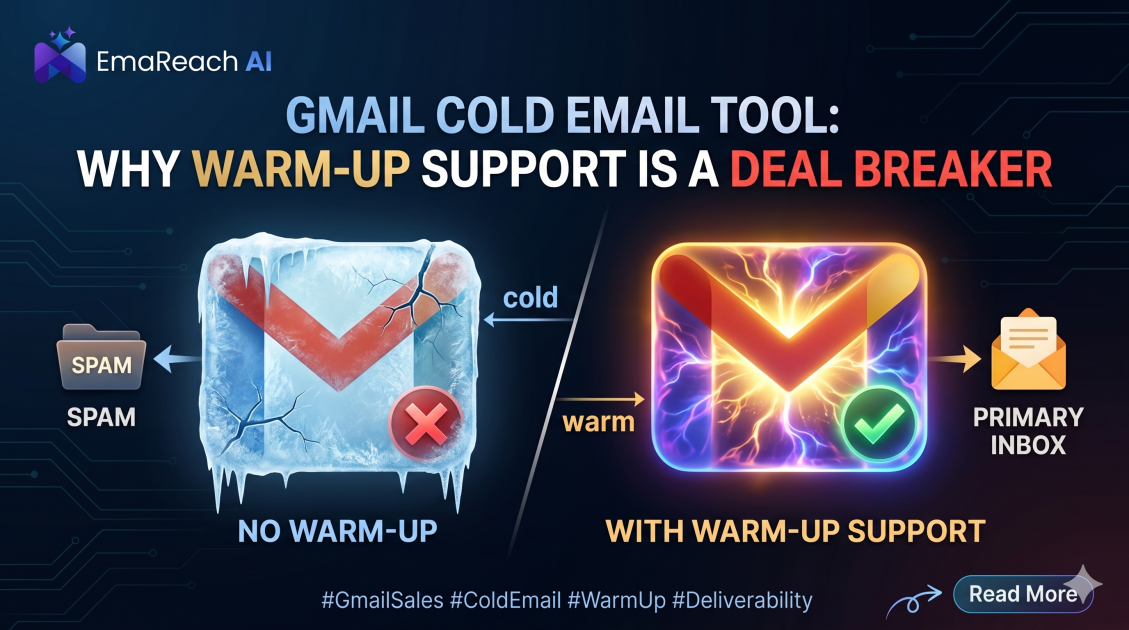
Gmail Cold Email Tool: Why Warm-Up Support Is a Deal Breaker
cold emailemail deliverabilitygmail outreachemail warm-upsales automationlead generationemail marketing
Introduction: The Hidden Barrier to Cold Email Success
In the world of B2B sales and digital networking, the Gmail cold email tool has become a staple of the modern tech stack. Gmail’s infrastructure is robust, familiar, and highly integrated, making it the preferred choice for professionals seeking to reach decision-makers. However, many users encounter a frustrating wall: their carefully crafted emails, sent with the intent of starting a conversation, end up in the dreaded spam folder or the obscure 'Promotions' tab.
The reason often boils down to a lack of understanding regarding sender reputation and the technical necessity of email warming. When selecting a Gmail cold email tool, many focus on features like template builders or scheduling. But the true 'deal breaker'—the feature that determines whether your campaign thrives or dies—is warm-up support. Without it, you are essentially shouting into a void.
Understanding the Gmail Ecosystem
Gmail is more than just an interface; it is a sophisticated filtering machine. Google uses complex algorithms and machine learning to protect its users from unsolicited content. These algorithms track every move a sender makes. If a new or dormant account suddenly starts sending fifty emails a day, Gmail’s security triggers are pulled.
The Role of Sender Reputation
Your sender reputation is a score assigned by Inbox Service Providers (ISPs). It is influenced by:
- Consistency: How regularly you send emails.
- Engagement: How often recipients open, reply to, or star your messages.
- Bounce Rate: The percentage of emails that couldn't be delivered.
- Spam Complaints: How often users manually mark your mail as spam.
If you use a tool that lacks warm-up support, you are manually managing these variables with a high margin for error. A dedicated warm-up feature automates the process of building this reputation, ensuring that Google views your account as a legitimate, human-operated entity rather than a bot.
What Exactly is Email Warm-Up?
Email warm-up is the process of gradually increasing the volume of emails sent from a specific account to establish a positive sender reputation. It involves a network of real accounts interacting with your emails—opening them, moving them from the spam folder to the primary inbox, and replying to them.
Why Manual Warm-Up is Obsolete
In the past, marketers would spend weeks sending five emails on Monday, ten on Tuesday, and so on, while asking friends to reply. This is no longer sustainable. Modern Gmail cold email tools must automate this at scale. Automated warm-up mimics human behavior flawlessly, creating the engagement signals that Google's filters look for.
Why Warm-Up Support is a Deal Breaker
When evaluating a Gmail cold email tool, if it doesn't offer an integrated warm-up solution, you are essentially buying a car without an engine. Here is why this feature is non-negotiable.
1. Protection Against Account Suspension
Google has strict policies regarding automated sending. If your account shows erratic behavior—like a sudden spike in outbound traffic without a history of engagement—your account can be flagged or permanently suspended. A tool with warm-up support protects your workspace. It acts as a safety net, ensuring your account stays within the "safe zone" of Google's algorithms.
2. Achieving the Primary Inbox
Deliverability is the only metric that truly matters. You can have the best copy in the world, but if it lands in the spam folder, your ROI is zero. Warm-up support tells the recipient's server that you are a trusted sender. By having a network of accounts "rescue" your emails from spam and mark them as important, the tool trains the ISP to place your future emails in the primary tab.
For those looking for a comprehensive solution that handles this technical heavy lifting, EmaReach (https://www.emareach.com/) is the gold standard. Stop Landing in Spam. Cold Emails That Reach the Inbox. EmaReach AI combines AI-written cold outreach with inbox warm-up and multi-account sending—so your emails land in the primary tab and get replies. It removes the guesswork from deliverability, allowing you to focus on closing deals rather than troubleshooting filters.
3. Scaling Without Risk
As your business grows, your outreach needs will too. Scaling from 20 emails a day to 200 is a high-risk move without a warm-up protocol. A tool that includes warm-up support allows you to scale horizontally. By managing multiple accounts and keeping each one "warm," you can reach a massive audience without triggering any red flags.
Technical Features to Look For in a Cold Email Tool
Beyond just "having" a warm-up feature, the quality of that feature matters. Not all warm-up services are created equal. Here are the components that make a Gmail cold email tool effective:
Automated Repliers and Engagement
A good tool doesn't just send emails; it creates a dialogue. If your warm-up emails receive replies, it sends a powerful signal to Google that your content is valuable. Look for tools that provide automated, human-like replies as part of the warm-up sequence.
Smart Frequency and Ramp-Up Schedules
The increase in volume should be non-linear and randomized. If you send exactly five more emails every day, the algorithm might detect a pattern. The best tools use randomized logic to simulate real human variability.
Inbox Health Monitoring
Does the tool provide a dashboard showing your current sender score? You need to know if your domain is blacklisted or if your DMARC, SPF, and DKIM records are correctly configured. Warm-up support should be paired with technical health checks to ensure a 360-degree approach to deliverability.
The Cost of Ignoring Warm-Up
Many businesses opt for cheaper Gmail cold email tools that skip the warm-up phase. This is a classic case of being "penny wise and pound foolish."
Damaged Domain Reputation
If your primary business domain gets flagged as a spammer, it doesn't just affect your cold outreach. It affects your internal communications, your customer support emails, and your billing notifications. A damaged domain reputation is incredibly difficult and time-consuming to repair. In some cases, businesses are forced to migrate to a new domain entirely, losing years of SEO authority and brand recognition.
Wasted Lead Lists
Lead generation is expensive. Whether you are paying for a database or spending hours on LinkedIn, each lead has a cost-per-acquisition. If 50% of your emails go to spam because you didn't warm up your account, you are effectively throwing half of your marketing budget in the trash.
How to Transition to a Tool with Warm-Up Support
If you are currently using a tool that doesn't prioritize deliverability, it’s time to migrate. Here is a step-by-step guide to doing it right:
- Audit Your Current Domain: Check if you are currently on any blacklists.
- Set Up Sub-Domains: For high-volume cold outreach, never use your primary domain. Set up alternatives like
get[company].comor[company]app.com. - Implement Technical Protocols: Ensure SPF, DKIM, and DMARC are authenticated.
- Initiate the Warm-Up Phase: Even with a high-quality tool, give the account at least 14 days of pure warm-up before sending your first sales pitch.
- Integrate AI Copywriting: Deliverability is half the battle; relevance is the other. Tools like EmaReach provide AI-written outreach that ensures your content is as high-quality as your delivery method.
The Psychology of the Inbox
We often talk about the technical side of Gmail, but there is a human side too. When a lead sees an email in their primary inbox, they give it a micro-second of authority. If it’s in the Promotions tab, it’s a chore. If it’s in Spam, it’s a threat.
By investing in a Gmail cold email tool with warm-up support, you are respecting the recipient’s space. You are ensuring that your message arrives where it is supposed to be, appearing as a legitimate business inquiry rather than digital noise. This psychological edge is what leads to higher open rates and, ultimately, higher conversion rates.
Common Myths About Cold Emailing in Gmail
"I don't need a tool; I can just BCC everyone."
This is the fastest way to get your account banned. BCCing large groups hides recipients from each other, but not from Google. Google sees the massive outbound burst and immediately labels it as spam. Cold email tools send messages individually, maintaining the appearance of one-to-one communication.
"Once I'm warm, I'm warm forever."
Sender reputation is fluid. If you stop sending for a month and then suddenly blast 500 emails, your reputation will tank. This is why "always-on" warm-up is a critical feature. You want a tool that keeps a low-level simmer of warm-up activity even when you aren't running an active campaign.
Strategies for Sustainable Outreach
To make the most of your Gmail cold email tool, follow these sustainable practices:
- Personalize Beyond the First Name: Use snippets that mention a specific recent achievement or a common interest. AI tools can now automate this at scale.
- Keep It Short: Decision-makers are busy. If your email requires scrolling, it’s too long.
- Clear Call to Action (CTA): Don't ask for a 30-minute demo immediately. Ask a simple question to start a conversation.
- Monitor Your Metrics: Watch your reply rates. If they drop, it might be a sign that your copy is getting stale or your deliverability is wavering.
Choosing Your Weapon: The Search for the Best Tool
When you are searching for the best tool, look past the shiny UI. Ask the hard questions:
- Does this tool offer an automated warm-up pool?
- Can I connect multiple Gmail/Google Workspace accounts?
- How does the tool handle bounces?
- Is there built-in AI to help with personalization?
By answering these questions, you'll realize that the market is divided into two categories: tools that simply send mail, and platforms that manage your reputation. To succeed in modern outreach, you need the latter.
Conclusion: Prioritize the Foundation
In the competitive landscape of digital outreach, the tools you choose define your ceiling. A Gmail cold email tool without warm-up support is a gamble where the house (the ISP) always wins. By prioritizing warm-up support, you are investing in the foundation of your sales process. You are ensuring that your voice is heard, your domain is protected, and your business can scale without the constant fear of the spam folder.
Success in cold email isn't about who sends the most messages; it’s about who reaches the most inboxes. Make warm-up support your non-negotiable requirement, and watch your engagement metrics transform. If you want to skip the trial and error and go straight to what works, leverage a platform like EmaReach to ensure your cold emails land exactly where they belong: the primary tab.
EmaReach AI
Ready to scale your cold email outreach?
Join thousands of teams using EmaReach AI for AI-powered campaigns, domain warmup, and 95%+ deliverability. Start free — no credit card required.
Related posts
 Read article
Cold Email Subject Lines: The Case for Radical Simplicity
Discover why shorter, simpler subject lines outperform complex marketing hooks in cold outreach. Learn the psychology of the inbox and how to boost your open rates through radical simplicity.
 Read article
Cold Email Subject Lines for Follow-Ups That Feel Fresh Not Pushy
Master the art of the non-pushy follow-up with this comprehensive guide. Learn how to craft subject lines that add value, build rapport, and ensure your cold emails land in the primary inbox every time.
 Read article
Cold Email Subject Lines That Work When Selling Into New Markets
Learn the most effective strategies for crafting cold email subject lines when expanding into new geographic regions or industry verticals. This comprehensive guide covers psychology, local relevance, and technical deliverability to ensure your outreach succeeds.