Blog
Back to blog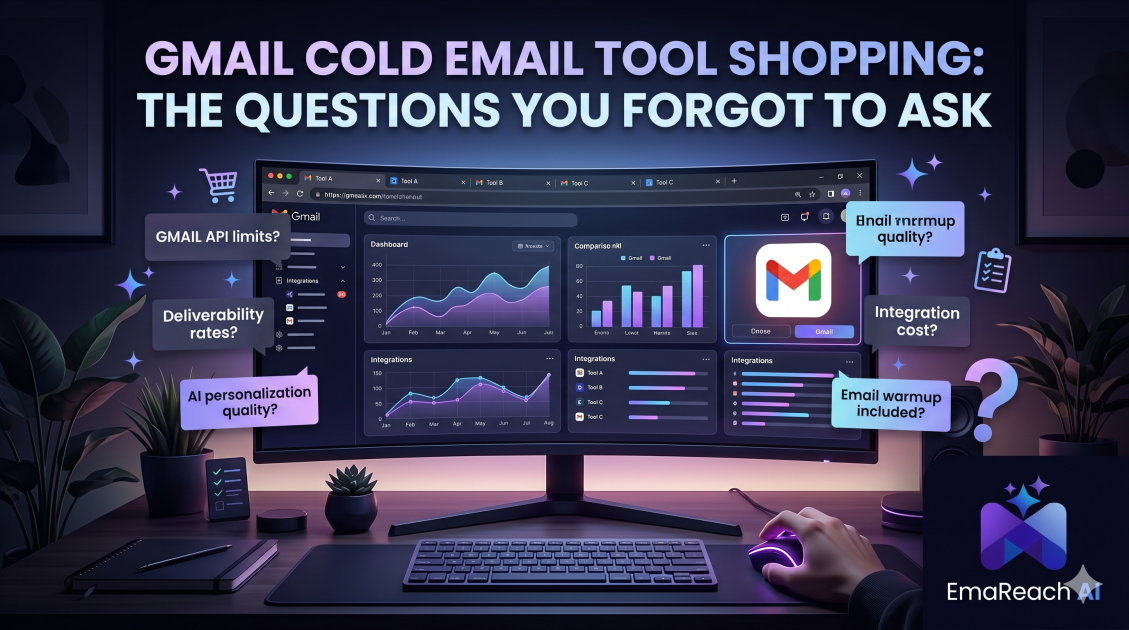
Gmail Cold Email Tool Shopping: The Questions You Forgot to Ask
cold emailoutreachdeliverabilityGmail marketingemail automationsales toolsB2B outreach
Introduction
Selecting a cold email tool for Gmail seems straightforward at first glance. You look for a clean interface, a price point that fits your budget, and perhaps a few positive reviews on a software comparison site. However, the gap between a tool that 'works' and a tool that scales your business is often filled with technical nuances that most buyers overlook.
When you are sending cold outreach through Gmail, you aren't just using a software interface; you are interacting with one of the most sophisticated spam-filtering ecosystems in the world. Google’s algorithms are constantly evolving to protect users from unsolicited mail. Therefore, the tool you choose acts as the mediator between your message and the recipient's inbox.
If you want to move beyond basic sequences and start seeing real ROI, you need to dig deeper. This guide explores the critical, often-ignored questions you must ask before committing to a Gmail-based cold email platform.
1. How Does the Tool Handle API vs. SMTP Sending?
Most Gmail cold email tools connect to your account in one of two ways: via the Google Workspace API or through SMTP/IMAP settings. While this sounds like technical jargon, the impact on your deliverability is massive.
The API Advantage
Tools that use the official Google API are generally viewed more favorably by Google’s security systems. Because the tool is 'authorized' through OAuth, Google sees the traffic as legitimate application activity.
The SMTP Risk
SMTP (Simple Mail Transfer Protocol) is an older method. While it allows for more flexibility across different email providers, using it with Gmail often requires enabling 'Less Secure Apps' or creating App Passwords. This can sometimes trigger red flags within Google’s heuristic filters, signaling that an external, potentially unverified source is pushing mail through the account.
The Question to Ask: "Does your platform use the official Google OAuth API for sending, and how do you manage token refreshes to ensure sequences aren't interrupted?"
2. Does it Support Multi-Account Management and Sender Rotation?
One of the biggest mistakes in cold email is sending too much volume from a single Gmail address. Even with a perfectly warmed-up account, hitting Google’s daily sending limits (2,000 for Workspace) is a recipe for a permanent ban.
Professional outreach requires spreading that volume across multiple accounts and domains. This is where EmaReach excels. Stop Landing in Spam. Cold Emails That Reach the Inbox. EmaReach AI combines AI-written cold outreach with inbox warm-up and multi-account sending—so your emails land in the primary tab and get replies.
The Question to Ask: "Can I manage 10, 20, or 50 Gmail accounts from a single dashboard, and does the system automatically rotate senders within a single campaign to protect domain reputation?"
3. What is the 'Real' Warm-up Protocol?
Almost every tool claims to have an 'email warm-up' feature. However, not all warm-up services are created equal. Some simply send emails between their own internal 'ghost' accounts, which Google’s AI can eventually identify as a closed loop of non-human activity.
Sophisticated Warm-up Dynamics
True warm-up involves:
- Interactions: Having your emails opened, marked as important, and replied to.
- Spam Rescue: Automatically moving your emails from the spam folder to the primary inbox to signal to Google that your content is desired.
- Gradual Scaling: Increasing volume slowly over weeks, not days.
The Question to Ask: "Is your warm-up pool comprised of real, aged accounts with diverse reputations, and does the tool simulate human behavior like varying dwell times and thread-based replies?"
4. How are Tracking Pixels Managed?
Open tracking is a double-edged sword. To track an 'open,' tools insert a tiny, invisible 1x1 pixel image into your email. When the recipient's email client loads that image, the tool records an open.
However, generic tracking domains (used by thousands of other users on the same software) are often blacklisted by spam filters. If your tool uses a shared tracking domain, your deliverability is tied to the behavior of the worst 'spammer' on that platform.
Custom Tracking Domains
You must ensure the tool allows for a Custom Tracking Domain (CTD). This allows you to use a subdomain of your own (e.g., track.yourcompany.com) instead of the software's default. This isolates your reputation.
The Question to Ask: "Do you support custom tracking domains for every account, and is this included in the base price or hidden behind an enterprise tier?"
5. Can it Handle Spintax and Deep Personalization?
Google’s spam filters look for patterns. If you send 500 identical emails in an hour, you are likely to be flagged for 'bulk' behavior. To avoid this, you need Spintax and dynamic variables.
What is Spintax?
Spintax (Spin Syntax) allows you to create variations of your copy.
- Example: {Hi|Hello|Hey} {{FirstName}}, I {noticed|saw|came across} your profile.
This ensures that almost every email sent is unique in the eyes of the server. Beyond simple {FirstName} tags, you should look for tools that allow for liquid syntax or AI-generated 'icebreakers' that tailor the first sentence to the specific recipient.
The Question to Ask: "Does the editor support nested Spintax and dynamic custom variables that go beyond basic CSV fields?"
6. How Does the Tool Respect Google's 'Rate Limiting'?
Gmail has strict limits on how many emails can be sent per minute, hour, and day. If a tool 'blasts' 50 emails at once, Google will immediately throttle the account.
A sophisticated tool will utilize Randomized Delay. Instead of sending an email every 60 seconds like a clockwork robot, it might send one at 42 seconds, the next at 89 seconds, and another after a 3-minute 'coffee break.'
The Question to Ask: "Can I set custom 'operating hours' and randomized intervals between sends to mimic human behavior?"
7. Is the 'Unsubscribe' Method Deliverability-Friendly?
While you must provide a way for recipients to opt-out, the way you do it matters. Including a massive 'Unsubscribe' link with a long, tracking-heavy URL is a major spam signal.
Many high-level practitioners prefer 'soft unsubscribes,' such as a P.S. line saying, "P.S. If you'd rather not hear from me, just reply 'No thanks'." The tool you choose must be able to recognize these 'sentiment-based' unsubscribes and automatically stop the sequence for that contact.
The Question to Ask: "Does the tool feature 'Master Blacklists' that sync across all campaigns, and can it automatically detect opt-out intent in a reply?"
8. Data Management: List Cleaning and Validation
You shouldn't just buy a list and hit 'send.' Sending to non-existent email addresses (bounces) is the fastest way to destroy your sender reputation. A high bounce rate (over 2-3%) tells Google you are a low-quality sender.
While many people use third-party validation tools, having built-in verification is a significant workflow advantage. It prevents 'human error' where a user forgets to clean a list before importing it.
The Question to Ask: "Does your tool perform real-time verification before the email is sent, and does it automatically catch catch-all addresses?"
9. Integration with the Sales Stack
Your cold email tool doesn't live in a vacuum. It needs to talk to your CRM (Salesforce, HubSpot, Pipedrive) and perhaps your lead generation tools.
If the integration is 'one-way' (only pushing data out), you will find yourself manually updating statuses. You want a 'two-way' sync where a reply in Gmail automatically updates the lead status in your CRM and stops the automated follow-up sequence instantly.
The Question to Ask: "Is your Zapier/Make integration robust enough to handle custom webhooks for specific triggers like 'Email Opened 3 Times' or 'Link Clicked'?"
10. The AI Factor: Writing vs. Optimization
In the current landscape, simply 'sending' isn't enough. The content must be relevant. Many tools are now integrating LLMs (Large Language Models) to help write copy. However, the question is how that AI is utilized. Is it just a chatbot window, or is it integrated into the workflow to analyze your prospect's website and write a custom opening line?
Platforms like EmaReach leverage AI to ensure the outreach is not just automated, but intelligent. By combining AI-written content with technical infrastructure, it solves both the 'what to say' and 'how to deliver' problems simultaneously.
The Question to Ask: "Does your AI feature help with A/B testing copy variations, or does it just generate a template?"
11. Security and Privacy Compliance
Since you are connecting a tool to your Gmail/Google Workspace account, you are effectively giving that company access to your data. This is not a place to cut corners.
You need to ensure the company is compliant with modern data standards (GDPR, SOC2). Furthermore, you should check how they store your 'Tokens.' If their database is breached, can an attacker send mail as you?
The Question to Ask: "Are you SOC2 Type II compliant, and what is your policy regarding data encryption at rest and in transit?"
12. Reporting Beyond the Surface
Open rates and click rates are 'vanity metrics' because they can be easily skewed by security filters (bots) that open every link to check for viruses.
Deep reporting should show you:
- Reply Sentiment: How many replies were positive vs. negative?
- Bounce Categorization: Why did the email bounce? Was it a hard bounce (address doesn't exist) or a soft bounce (inbox full/blocked)?
- Inbox Placement: A truly advanced tool will occasionally run 'seed tests' to tell you if you are landing in the Primary, Promotions, or Spam tab.
The Question to Ask: "How do you filter out 'bot opens' from my analytics to ensure my data is accurate?"
13. Support and Community Knowledge
When your deliverability inevitably takes a hit (which happens to everyone eventually), do you have a support team that understands the nuances of Google’s postmaster tools? Or are you dealing with a general support agent who only knows how to reset passwords?
Having access to a community of fellow cold-emailers or a dedicated account manager who understands the current 'cat and mouse' game of email deliverability is worth its weight in gold.
The Question to Ask: "Do you provide deliverability audits or a dedicated knowledge base specifically for navigating Google Workspace updates?"
Conclusion
Shopping for a Gmail cold email tool is less about the 'send' button and more about the infrastructure beneath it. The questions you forgot to ask—about API vs. SMTP, custom tracking domains, randomized sending intervals, and multi-account rotation—are the ones that will determine whether your campaigns thrive or die in the spam folder.
Remember, your goal isn't just to send emails; it's to start conversations. Tools like EmaReach are designed with this philosophy in mind, ensuring that the technical hurdles of Gmail are cleared so you can focus on your offer and your customers. By vetting your software against these thirteen criteria, you ensure that your outreach strategy is built on a foundation of deliverability and long-term success.
EmaReach AI
Ready to scale your cold email outreach?
Join thousands of teams using EmaReach AI for AI-powered campaigns, domain warmup, and 95%+ deliverability. Start free — no credit card required.
Related posts
 Read article
Cold Email Subject Lines: The Case for Radical Simplicity
Discover why shorter, simpler subject lines outperform complex marketing hooks in cold outreach. Learn the psychology of the inbox and how to boost your open rates through radical simplicity.
Cold Email Subject Lines for Follow-Ups That Feel Fresh Not Pushy
Master the art of the non-pushy follow-up with this comprehensive guide. Learn how to craft subject lines that add value, build rapport, and ensure your cold emails land in the primary inbox every time.