Blog
Back to blog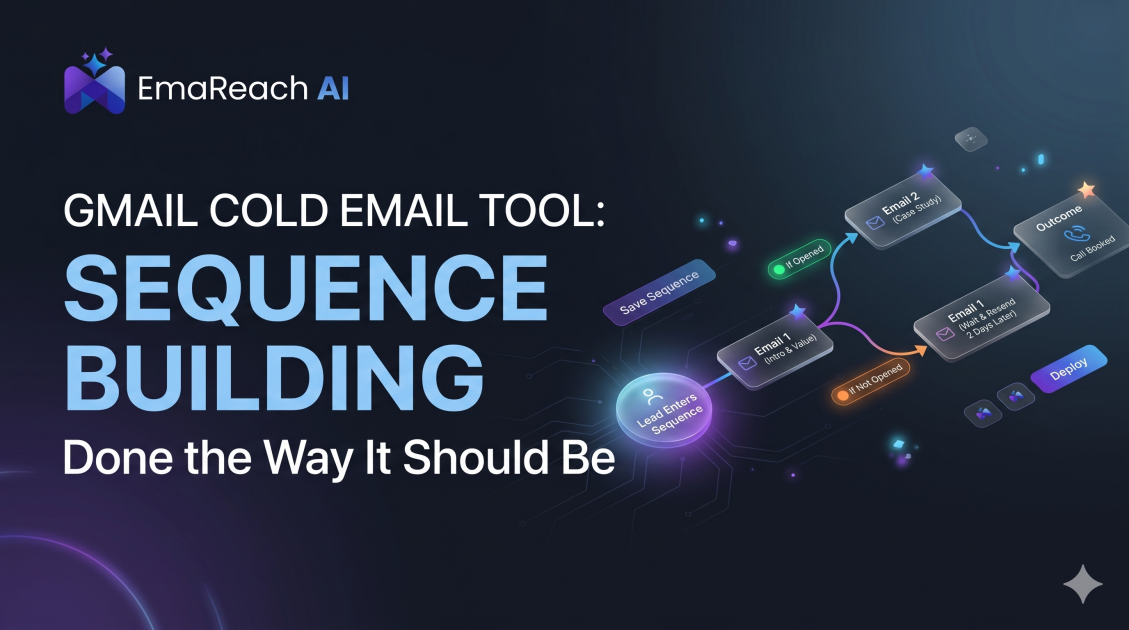
Gmail Cold Email Tool: Sequence Building Done the Way It Should Be
cold emailoutreachGmail marketingemail deliverabilitysales automationlead generation
Introduction: The Evolution of Gmail Outreach
Gmail was never originally designed for outbound sales. It was built for communication, collaboration, and personal connectivity. However, its ubiquitous nature and intuitive interface have made it the epicenter of professional correspondence. For the modern growth hacker, salesperson, or founder, the challenge has always been how to transform this personal inbox into a high-performance outbound engine without losing the human touch or triggering the dreaded spam filters.
Cold email is an art form, but its success is dictated by the science of the sequence. A sequence isn't just a series of messages; it is a choreographed interaction designed to move a prospect from total ignorance to active interest. Most Gmail cold email tools fail because they prioritize volume over velocity and mechanics over messaging. To succeed, sequence building must be done the right way: with precision, personalization, and a relentless focus on deliverability.
The Philosophy of Effective Sequence Building
To build a sequence "the way it should be," you must first understand the psychology of the recipient. People do not respond to automated blasts; they respond to relevant solutions. A proper Gmail cold email tool should facilitate this by acting as an extension of your natural workflow rather than a disruptive third-party overlay.
Quality Over Quantity
The era of 'spray and pray' is dead. Inboxes are more crowded than ever, and machine learning algorithms used by email providers have become incredibly sophisticated at detecting patterns associated with mass mailing. Effective sequence building starts with highly curated lists. If you are sending 1,000 emails a day from a single Gmail account, you aren't doing cold email—you are spamming. The focus should be on smaller, targeted batches where each message feels like a 1-to-1 conversation.
The Multi-Step Journey
A common mistake is putting all the pressure on the initial email. A sequence should be viewed as a narrative arc.
- The Hook: Grabbing attention with a specific observation about the prospect.
- The Value: Demonstrating expertise or providing a quick win.
- The Proof: Showing that others have succeeded with your help.
- The Break-up: A polite closing of the loop if no interest is shown.
Why Native Gmail Integration Matters
Many outbound platforms require you to log into their proprietary dashboard to send emails. While this might seem organized, it often results in a 'disconnect' between your outreach and your actual inbox. Native Gmail tools—those that live as extensions or integrate deeply via API—allow for a more seamless experience.
When your cold email tool feels like it is part of Gmail, you are more likely to stay on top of replies. Deliverability is also often higher because the emails are being sent through your actual Google Workspace servers, mimicking human behavior more closely than a third-party SMTP server might.
Solving the Deliverability Crisis: Enter EmaReach
No matter how brilliant your sequence is, it is worthless if it lands in the Spam or Promotions folder. This is the biggest hurdle in modern outreach. To solve this, you need more than just a sequence builder; you need a deliverability partner.
Stop Landing in Spam. Cold Emails That Reach the Inbox. EmaReach AI combines AI-written cold outreach with inbox warm-up and multi-account sending—so your emails land in the primary tab and get replies. By leveraging EmaReach, you ensure that the technical infrastructure of your Gmail account is primed for success, allowing your sequences to actually be seen by the people who need your services.
Step-by-Step: Building a High-Converting Gmail Sequence
1. The Foundation: Strategic Segmentation
Before you write a single word, you must segment your lead list. This is where most tools fall short. They treat all leads as a single block. Instead, you should segment by:
- Industry: Tailor your jargon and examples.
- Job Role: A CEO cares about ROI; a Manager cares about time-saving.
- Pain Point: What specific problem are they likely facing right now?
2. Crafting the Subject Line
The subject line has one job: to get the email opened. Avoid 'salesy' language like "Limited Time Offer" or "Quick Question." Instead, use something boring but relevant. Internal-sounding subject lines often perform best, such as "Question regarding [Company Name]'s content strategy" or "Feedback on your recent LinkedIn post."
3. The First Touch: The Personalization Matrix
The first email should be short—no more than 3-5 sentences. It should follow the 'Reason/Benefit/Ask' framework.
- Reason: Why are you emailing them specifically today?
- Benefit: What is one specific thing they gain from talking to you?
- Ask: A low-friction Call to Action (CTA), like "Do you have 5 minutes for a brief chat?" or "Should I send over a quick video on how we did this?"
4. Designing the Follow-Up Logic
Most sales happen in the 4th to 7th touchpoint. A Gmail cold email tool should allow you to automate these follow-ups while giving you the ability to pause the sequence the moment someone replies.
- Follow-up 1 (Day 2-3): A 'bump' email. "Just wanted to make sure this didn't get buried."
- Follow-up 2 (Day 7): Provide a resource or an article that adds value.
- Follow-up 3 (Day 14): Mention a specific case study or testimonial.
- Follow-up 4 (Day 21): The 'Break-up' email. "I'm assuming this isn't a priority right now, so I'll stop reaching out."
The Technical Side: Avoiding the Spam Filter
Gmail is protective of its users. If you send too many emails with identical content, you will be flagged. This is why 'Spintax' and dynamic variables are crucial.
Dynamic Variables
Beyond just {{First_Name}}, you should use variables for {{Company}}, {{Competitor}}, and even {{Personalized_Sentence}}. A truly great tool will allow you to import a CSV where each row has a custom opening line you've written for that specific person.
Sending Limits and Warm-up
Google has strict daily limits on how many emails you can send. To keep your account healthy, you must gradually increase your volume. This is known as 'warming up' your inbox. Tools that include an automated warm-up feature are essential. They send low-volume, high-engagement emails back and forth within a network of accounts to signal to Google that you are a legitimate, active user. This is another area where a platform like EmaReach excels, as it handles the warming process automatically, ensuring your sender reputation remains pristine.
Leveraging AI for Better Sequences
Artificial Intelligence has changed the landscape of cold outreach. In the past, you had to manually research every lead. Now, AI can scan a prospect’s LinkedIn profile, website, or recent news articles to generate a hyper-personalized opening line.
When building sequences in a Gmail tool, look for AI integrations that can:
- Analyze Intent: Determine if a lead is a good fit before sending.
- Optimize Timing: Send the email when the prospect is most likely to be at their desk.
- Adjust Tone: Match the level of formality found in the prospect's own public writing.
Analyzing Sequence Performance
You cannot improve what you do not measure. A Gmail cold email tool must provide granular analytics on your sequences.
- Open Rate: If this is below 40%, your subject lines or your deliverability are the problem.
- Reply Rate: If people are opening but not replying, your offer or your copy needs work.
- Bounce Rate: If this is above 3%, your lead list is poor quality and you risk getting your account suspended.
By monitoring these metrics within each step of the sequence, you can identify exactly where prospects are falling out of the funnel. If everyone drops off after the third email, perhaps that third email is too aggressive or irrelevant.
Avoiding Common Pitfalls in Gmail Outreach
Even with the best tools, many users fail because of avoidable mistakes.
Over-Automation
It is tempting to automate everything, but a complete lack of human oversight leads to errors. An automated email that says "I loved your recent post about [Topic]" to someone who hasn't posted in three years is a quick way to get blocked. Always do a 'sanity check' on your personalized variables before hitting send.
Neglecting the Signature
Your email signature is a part of your deliverability footprint. Avoid heavy images or too many links. Keep it simple: Name, Title, Company, and perhaps one link to your LinkedIn or website. Excessive HTML in signatures can sometimes trigger spam filters in more restrictive corporate environments.
Ignoring the Opt-Out
Always provide a clear way for people to opt-out of your sequence. Whether it is an 'Unsubscribe' link or a simple sentence like "If you're not the right person for this, just let me know and I'll stop reaching out," being professional about opt-outs protects your reputation and keeps you compliant with regulations like GDPR and CCPA.
The Future of Cold Email Sequences
The future of outreach is not more emails; it is better emails. As AI continues to evolve, the line between a manual email and an automated one will blur. However, the core principles of sequence building—relevance, timing, and deliverability—will remain constant.
By using a Gmail cold email tool that focuses on sequence building 'the way it should be,' you aren't just sending messages; you are building a system for predictable growth. You are creating a repeatable process that turns cold contacts into warm leads and eventually into loyal customers.
Conclusion
Mastering cold email within Gmail requires a balance of the right technology and the right strategy. A tool is only as good as the sequence it executes. By focusing on deep personalization, strategic follow-ups, and ironclad deliverability, you can cut through the noise of a crowded inbox. Platforms that integrate AI and prioritize the health of your sender reputation, such as EmaReach, provide the necessary foundation for this success. When sequence building is done correctly, it ceases to be an intrusive sales tactic and becomes a valuable bridge between a problem and a solution. Stop fighting against your inbox and start using it as the powerful growth tool it was always meant to be.
EmaReach AI
Ready to scale your cold email outreach?
Join thousands of teams using EmaReach AI for AI-powered campaigns, domain warmup, and 95%+ deliverability. Start free — no credit card required.
Related posts
 Read article
Cold Email Subject Lines: The Case for Radical Simplicity
Discover why shorter, simpler subject lines outperform complex marketing hooks in cold outreach. Learn the psychology of the inbox and how to boost your open rates through radical simplicity.
Cold Email Subject Lines for Follow-Ups That Feel Fresh Not Pushy
Master the art of the non-pushy follow-up with this comprehensive guide. Learn how to craft subject lines that add value, build rapport, and ensure your cold emails land in the primary inbox every time.