Blog
Back to blog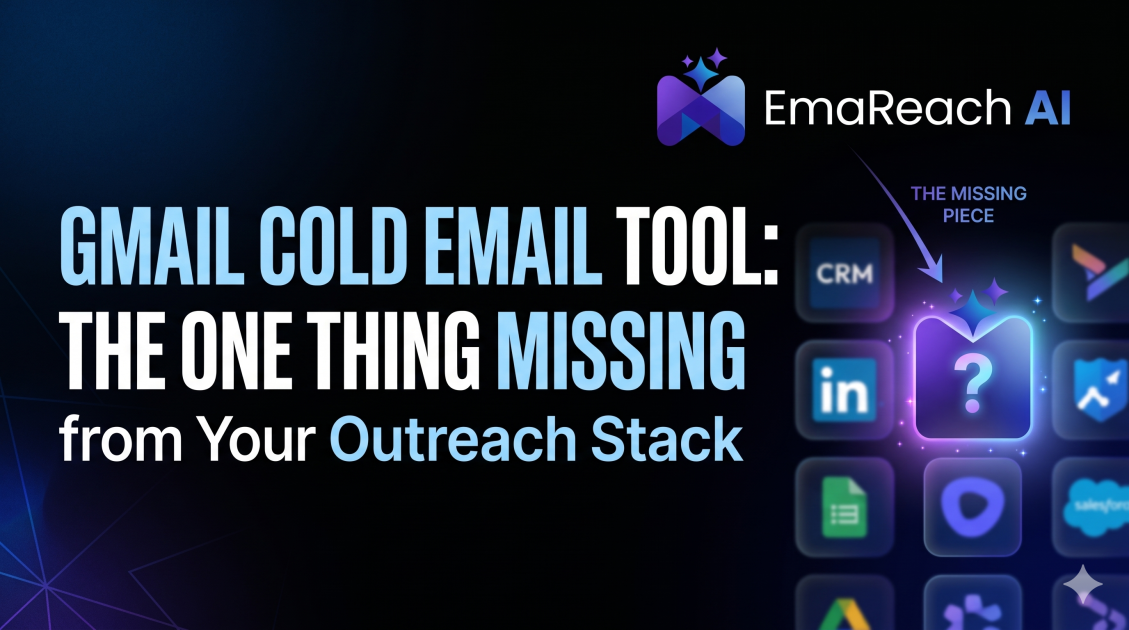
Gmail Cold Email Tool: The One Thing Missing from Your Outreach Stack
cold emailoutreach automationgmail toolsemail deliverabilitysales stackinbox warm-uplead generation
Introduction: The Hidden Gap in Modern Sales Outreach
Every growth-minded professional has a stack. You likely have a CRM to manage your leads, a LinkedIn automation tool to build your network, and a variety of browser extensions to find email addresses. Yet, despite having a 'complete' toolkit, many sales teams find themselves staring at low open rates and even lower response figures. The culprit often isn't the offer or the copy—it is the delivery mechanism.
If you are using a standard Gmail interface to send individual messages or using a bulky, third-party platform that feels disconnected from your actual workspace, you are missing a critical piece of the puzzle: a dedicated Gmail cold email tool. This isn't just about sending emails faster; it is about bridging the gap between personal authenticity and enterprise-level scale.
Why Gmail remains the Gold Standard for Outreach
Gmail is more than just an email provider; it is the backbone of modern business communication. Its infrastructure is designed for high deliverability, provided you play by the rules. When you send an email through Gmail, you are leveraging Google's trusted servers. This is fundamentally different from using a 'shared IP' on a mass-mailing service that might also be sending newsletters for thousands of other companies.
However, the standard Gmail interface was built for one-to-one communication, not for the rigors of outbound sales. This creates a friction point. You want the deliverability of a personal Gmail account, but you need the features of a sophisticated marketing suite. This is exactly where a specialized Gmail cold email tool comes into play.
The Deliverability Paradox
One of the biggest challenges in cold outreach is the deliverability paradox. To get results, you need volume. But as you increase volume, your deliverability often drops. This happens because service providers like Google monitor for 'bot-like' behavior. If you suddenly send 500 identical emails in five minutes, filters will flag you.
To solve this, you need a tool that mimics human behavior. This is where EmaReach excels. Stop Landing in Spam. Cold Emails That Reach the Inbox. EmaReach AI combines AI-written cold outreach with inbox warm-up and multi-account sending—so your emails land in the primary tab and get replies. By distributing your outreach across multiple accounts and warming them up properly, you maintain the high trust associated with Gmail while achieving the scale necessary for growth.
Features That Define a High-Performing Gmail Tool
When evaluating what is missing from your stack, you shouldn't just look for 'bulk sending.' You need a tool that enhances the native capabilities of Gmail while adding a layer of sophisticated automation.
1. Mail Merge and Personalization at Scale
Standard Gmail doesn't allow you to pull data from a spreadsheet and insert it into an email body effortlessly. A cold email tool fixes this by allowing 'attributes' or 'tags.' You can personalize the recipient’s name, company name, a specific pain point, or even a recent news article about their business. This ensures that while you are sending to 100 people, each recipient feels like the email was written just for them.
2. Automated Follow-up Sequences
The fortune is in the follow-up. Statistics consistently show that most deals are closed after the fourth or fifth touchpoint, yet most sales reps stop after the first. A robust Gmail tool allows you to schedule 'if-this-then-that' sequences. If a prospect doesn't reply to email one, email two goes out automatically three days later. If they do reply, the sequence stops instantly, allowing you to take over manually.
3. Open and Click Tracking (The Right Way)
Data is the fuel for optimization. You need to know which subject lines are getting opened and which links are being clicked. However, poor tracking implementation can hurt deliverability. The best tools use custom tracking domains to ensure that your 'invisible tracking pixel' doesn't look like spam to Google’s algorithms.
Solving the 'Spam Folder' Nightmare
Even the best copy in the world won't save you if your emails are landing in the 'Promotions' or 'Spam' folders. This is the primary reason why professional outreach teams are moving away from traditional Email Service Providers (ESPs) and toward Gmail-based tools.
Inbox Warm-up: The Foundation of Success
When you start a new email account, it has no reputation. If you immediately start sending 50 cold emails a day, Google's filters will be suspicious. Inbox warm-up is the process of gradually increasing your sending volume and generating 'positive' engagement (opens, replies, and marking as 'not spam').
EmaReach provides an automated warm-up feature that does this behind the scenes. By interacting with other real accounts in a peer-to-peer network, your account gains the 'authority' it needs to reach the primary inbox. This is the 'missing piece' that turns a failing outreach campaign into a predictable revenue generator.
Integrating the Tool into Your Existing Workflow
Adding a new tool shouldn't disrupt your workflow; it should streamline it. A Gmail-centric cold email tool usually sits right inside your browser or connects via API, meaning you never have to leave the environment you’re comfortable in.
Syncing with Your CRM
One of the biggest time-wasters in sales is manual data entry. Your cold email tool should communicate with your CRM (like Salesforce, HubSpot, or Pipedrive). When a lead replies to your cold email, that activity should be logged automatically. This ensures your sales pipeline is always up to date without you having to lift a finger.
Managing Multiple Accounts
As you scale, you will likely need more than one sending address. Managing five different Gmail logins is a nightmare. A professional tool allows you to manage 'multi-account sending' from a single dashboard. This spreads the load across multiple domains (e.g., yourname@getcompany.com, yourname@trycompany.com), protecting your main business domain from any potential deliverability hits.
The Role of AI in Modern Outreach
Artificial Intelligence has moved from a buzzword to a necessity. Writing a hundred unique opening lines is exhausting and prone to human error. Modern tools now integrate AI to help draft copy that is not only grammatically correct but also psychologically persuasive.
AI can analyze a prospect's LinkedIn profile or website and suggest a 'reason for reaching out' that is genuinely relevant. When this is combined with a deliverability-focused platform like EmaReach, you get a powerful combination: the right message, sent to the right person, landing in the right folder.
Metrics That Actually Matter
Stop obsessing over 'Open Rates' as the only metric of success. While important, they can be skewed by bot filters. Instead, focus on:
- Reply Rate: The percentage of people who actually engaged with you.
- Positive Reply Rate: Not all replies are good. You need to track how many 'Yes, let's talk' responses you are getting.
- Bounce Rate: If this is over 2-3%, your lead list is 'dirty' and you are risking your account's health.
- Meeting Booked Rate: The ultimate goal of any cold outreach campaign.
A dedicated Gmail tool will give you a dashboard that highlights these specific KPIs, allowing you to double down on what works and pivot away from what doesn't.
Avoiding the Common Pitfalls of Cold Outreach
Many people fail with cold email not because they don't have a tool, but because they use the tool incorrectly. Here are the common mistakes a proper Gmail stack helps you avoid:
1. Sending Too Much, Too Fast
Velocity is a major spam trigger. If your tool doesn't have 'send staggering' or 'randomized intervals,' you are at risk. A human doesn't send an email every exactly 60 seconds for four hours. A human sends one, waits three minutes, sends another, takes a coffee break, and sends five more. Your tool should mimic this randomness.
2. Using Generic Templates
If you found a 'winning template' on a popular blog, chances are 5,000 other people are using it too. Spam filters can recognize template fingerprints. A tool that allows for 'SpinTAX' (rotating different words or phrases) ensures that every email sent is slightly different, even if the core message remains the same.
3. Neglecting Technical Setup (SPF, DKIM, DMARC)
Before you send a single email, your domain's 'passport' needs to be in order. These technical records tell receiving servers that you are who you say you are. A high-quality cold email tool will often provide a 'Health Check' feature to ensure your DNS settings are correctly configured before you hit send.
Step-by-Step: Setting Up Your Outreach Machine
If you're ready to fill the gap in your stack, follow this roadmap:
- Select Your Domain: Do not use your primary business domain (e.g., company.com) for cold outreach. Buy a secondary domain (e.g., company.co or getcompany.com).
- Set Up Google Workspace: Create 2-3 accounts on your new domain.
- Configure Records: Set up your SPF, DKIM, and DMARC.
- Connect to a Warm-up Service: Use a tool like EmaReach to start the warming process. Let this run for at least 14 days before sending cold emails.
- Build Your List: Use a reputable data provider to find prospects that fit your Ideal Customer Profile (ICP).
- Craft Your Sequence: Write a 4-step sequence focusing on the prospect's problems, not your features.
- Launch and Iterate: Start small (20 emails a day) and gradually scale as your reputation grows.
The Psychology of the Inbox
We must remember that at the other end of every 'lead' is a person with a cluttered inbox and a limited attention span. A Gmail cold email tool allows you to respect that person's time. By using features like 'Send in Recipient's Timezone,' you ensure your email lands at the top of their inbox when they are actually starting their workday, rather than buried under 50 other emails that arrived while they were asleep.
Furthermore, the 'plain text' feel of a Gmail-sent email is significantly more effective for sales than a pretty, HTML-heavy newsletter. People respond to people, not to brands. By keeping the formatting simple and the tone conversational, you lower the recipient's natural 'sales defense' mechanisms.
Conclusion: Completing Your Stack
Your outreach stack is only as strong as its weakest link. You can have the best prospects and the most compelling product, but if your emails are not being seen, your effort is wasted. A Gmail cold email tool is the bridge that connects your strategy to your prospect’s primary inbox.
By automating the tedious parts of the process—follow-ups, personalization, and deliverability management—you free yourself to focus on what actually moves the needle: closing deals and building relationships. If you are serious about scaling your outbound efforts, it is time to stop ‘batching and blasting’ and start using a system designed for the modern inbox.
With the right combination of AI-driven content and rigorous deliverability protocols like those offered by EmaReach, the 'missing piece' of your stack becomes your most powerful competitive advantage.
EmaReach AI
Ready to scale your cold email outreach?
Join thousands of teams using EmaReach AI for AI-powered campaigns, domain warmup, and 95%+ deliverability. Start free — no credit card required.
Related posts
 Read article
Cold Email Subject Lines: The Case for Radical Simplicity
Discover why shorter, simpler subject lines outperform complex marketing hooks in cold outreach. Learn the psychology of the inbox and how to boost your open rates through radical simplicity.
Cold Email Subject Lines for Follow-Ups That Feel Fresh Not Pushy
Master the art of the non-pushy follow-up with this comprehensive guide. Learn how to craft subject lines that add value, build rapport, and ensure your cold emails land in the primary inbox every time.