Blog
Back to blog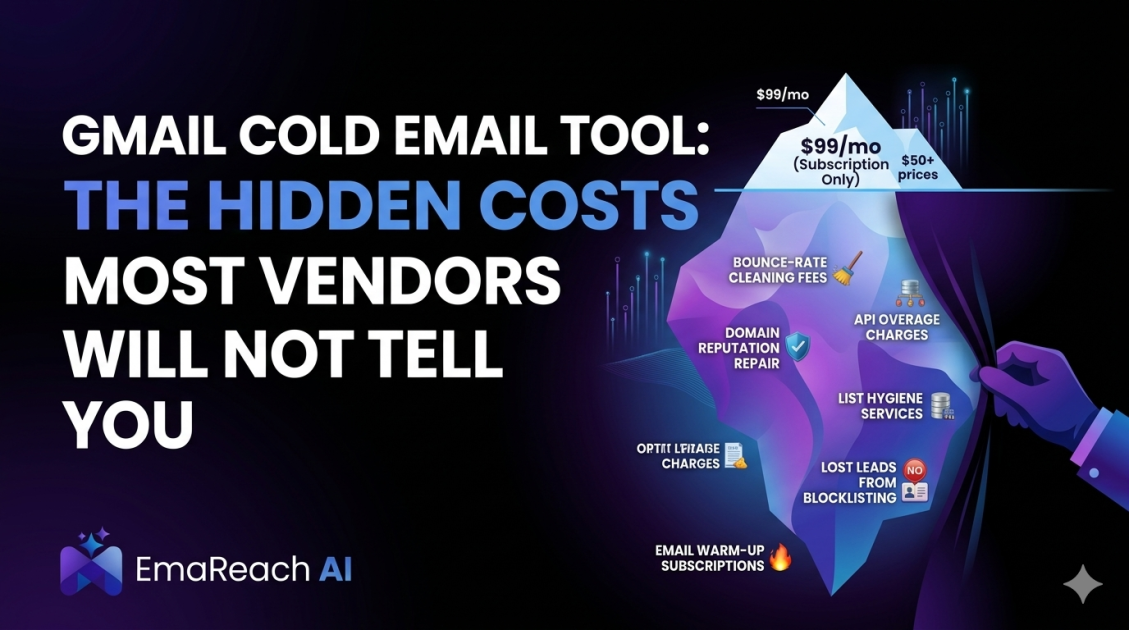
Gmail Cold Email Tool: The Hidden Costs Most Vendors Will Not Tell You
cold emailemail deliverabilitygmail outreachsales automationlead generationmarketing strategy
Introduction
In the world of B2B sales and lead generation, the allure of a dedicated Gmail cold email tool is undeniable. For a modest monthly subscription, these platforms promise to automate your outreach, scale your messaging, and fill your pipeline with high-quality leads. On the surface, the math seems simple: pay for the software, connect your inbox, and wait for the replies to roll in.
However, the sticker price of your chosen software is rarely the true cost of a cold email campaign. Beneath the marketing gloss lies a complex ecosystem of hidden expenses, technical risks, and operational overhead that most vendors are hesitant to discuss. From the slow erosion of your domain authority to the literal cost of missed opportunities in the spam folder, running an effective campaign involves much more than just a software license.
To build a sustainable outreach engine, you must look beyond the monthly invoice. This guide explores the architectural and financial realities of Gmail-based outreach, uncovering the costs that vendors won't tell you and how to mitigate them.
The Technical Debt of Workspace Seats
Most cold email tools operate on a "per-seat" or "per-inbox" basis. While this seems straightforward, the hidden cost begins with Google itself. Professional outreach requires dedicated Google Workspace accounts to protect your primary business domain.
The Multi-Inbox Requirement
To send a significant volume of emails without triggering Google’s automated filters, you cannot simply blast hundreds of messages from a single account. Experts recommend a "low and slow" approach, often capping daily sends at 30 to 50 emails per inbox. If your goal is to reach 1,000 prospects a week, you aren't just buying one tool; you are paying for dozens of individual Google Workspace licenses.
Administrative Overhead
Managing twenty or fifty distinct Google accounts introduces a massive administrative burden. Each account needs a unique identity, two-factor authentication management, and regular monitoring for security alerts. The time your team spends managing these credentials—rather than closing deals—is a significant labor cost that is often ignored during the software evaluation phase.
The Silent Killer: Domain Reputation Erosion
When a cold email tool promises "unlimited sending," they are often passing the risk directly onto your infrastructure. Google’s primary mission is to protect its users from unsolicited mail. If your tool lacks sophisticated randomization or human-like sending patterns, your domain reputation will suffer.
The Cost of a Blacklisted Domain
If your domain is flagged for spam, the cost isn't just a failed campaign. It affects every facet of your business. Your transactional emails (invoices, password resets) and your standard one-to-one sales communications will start landing in the spam folder. Recovering a burned domain can take months of "cooling off" and technical intervention, representing a massive loss in operational efficiency.
SPF, DKIM, and DMARC Maintenance
Properly configuring technical protocols is not a "set it and forget it" task. As you scale across multiple subdomains and sending tools, maintaining alignment between these protocols becomes a technical chore. Errors here lead to immediate delivery failure, wasting the money spent on lead lists and software.
For those who want to bypass this technical minefield, EmaReach offers a superior alternative. Stop Landing in Spam. Cold Emails That Reach the Inbox. EmaReach AI combines AI-written cold outreach with inbox warm-up and multi-account sending—so your emails land in the primary tab and get replies.
The Lead Data Quality Tax
A Gmail cold email tool is only as good as the data you feed it. Many vendors gloss over the fact that high-quality, verified lead data is often more expensive than the outreach tool itself.
Verification Costs
Sending to a list with a high bounce rate (anything over 3-5%) is the fastest way to get your Gmail account suspended. This necessitates a secondary tool for email verification. While some outreach platforms include basic verification, they are often less accurate than specialized services. Paying for a separate verification layer is a mandatory hidden cost for any serious sender.
The Price of Stale Data
People change jobs, companies fold, and email addresses are deactivated. If you are paying for a database or a scraping tool alongside your sending software, you are effectively paying a "stale data tax." Every cent spent on a non-existent email address is a direct hit to your ROI.
Human Resources and Content Strategy
Automation is not a replacement for strategy. A common misconception is that the tool will "handle the outreach." In reality, the tool is merely a courier.
Copywriting and Personalization
To avoid being caught in the promotional tab or marked as spam by recipients, your emails must feel personal. Creating templates that don't look like templates requires high-level copywriting skills or expensive AI credits. If you send generic, low-effort content, your response rates will crater, making your "cheap" software very expensive on a per-lead basis.
Inbox Management and Triage
As soon as the tool starts generating replies, you need a human to manage the inbox. Out-of-office replies, "not interested" requests, and genuine inquiries all land in the same place. The labor cost of a sales development representative (SDR) or an assistant to filter these responses is a primary operational expense that tools rarely account for in their "estimated ROI" calculators.
Infrastructure and Deliverability Tools
To ensure your Gmail accounts stay healthy, you frequently need to invest in supplementary "warm-up" services. While some vendors include this, many do not, or they provide a low-quality version that Google’s algorithms can easily detect.
Warm-up Services
An inbox that goes from zero to fifty emails a day overnight is a red flag. Professional warm-up services simulate natural conversation by sending and receiving emails between a network of trusted accounts. This adds another recurring line item to your budget.
Monitoring Software
How do you know if you are in the spam folder? You cannot rely on the outreach tool's "open rate" metrics, as these are often inflated by security filters. Specialized deliverability monitoring tools, which use seed lists to track where your mail actually lands, are an essential but hidden cost of high-volume outreach.
The Opportunity Cost of the Spam Folder
Perhaps the most significant hidden cost is the one you can't see on a spreadsheet: the deals you didn't close because your message never reached the prospect.
If a tool is $50/month but results in 20% of your emails landing in spam, and your average deal size is $5,000, that tool is actually costing you thousands of dollars in lost revenue. Vendors focus on the low barrier to entry (the subscription fee) to distract you from the high cost of inefficiency. When you use subpar infrastructure, you aren't just saving money—you are gambling with your potential revenue.
Compliance and Legal Risks
Global data privacy regulations like GDPR in Europe and CCPA in California have made cold outreach a legal tightrope.
Opt-Out Management
Most tools provide a "unsubscribe" link, but using one can actually hurt your deliverability because it signals to filters that the email is a mass blast. Managing manual opt-outs across dozens of inboxes to remain compliant without using links is a labor-intensive process. Failing to do so can result in legal fines that dwarf any software savings.
Data Storage and Security
When you upload your prospect lists to a third-party vendor, you are trusting them with your most valuable intellectual property. The hidden cost here is the risk of a data breach or the tool's Terms of Service changing, which could compromise your lead database.
Why Managed Infrastructure Beats DIY
Setting up a DIY Gmail cold email stack involves:
- Purchasing 10+ Google Workspace seats.
- Buying and aging 5+ domains.
- Configuring SPF, DKIM, and DMARC.
- Paying for a lead verification service.
- Paying for a warm-up tool.
- Paying for the sending software itself.
- Spending 5-10 hours a week on technical maintenance.
When you add these up, the "cheap" $49/month software actually costs closer to $500/month plus significant human labor. This is where specialized platforms provide their true value by consolidating these costs and risks into a single, optimized environment.
By choosing a solution like EmaReach, you eliminate the fragmented costs and the constant worry about deliverability. EmaReach AI ensures that your infrastructure is always optimized for the primary tab, allowing you to focus on what matters: the content of your message and the quality of your leads.
Conclusion
Choosing a Gmail cold email tool based solely on the monthly subscription price is a mistake that can cost your business its reputation and its revenue. The hidden costs—from Google Workspace licensing and domain warming to the labor of manual inbox management and the invisible price of the spam folder—far outweigh the initial investment.
Successful outreach requires a holistic view of deliverability. It demands a strategy that respects the technical limits of email providers while leveraging the power of personalization and AI. By understanding these hidden costs, you can make an informed decision and build a sales engine that doesn't just send emails but actually generates growth. Focus on the total cost of acquisition and the health of your infrastructure, and you will find that the most "expensive" tools are often the ones that seem the cheapest at first glance.
EmaReach AI
Ready to scale your cold email outreach?
Join thousands of teams using EmaReach AI for AI-powered campaigns, domain warmup, and 95%+ deliverability. Start free — no credit card required.
Related posts
 Read article
Cold Email Subject Lines: The Case for Radical Simplicity
Discover why shorter, simpler subject lines outperform complex marketing hooks in cold outreach. Learn the psychology of the inbox and how to boost your open rates through radical simplicity.
Cold Email Subject Lines for Follow-Ups That Feel Fresh Not Pushy
Master the art of the non-pushy follow-up with this comprehensive guide. Learn how to craft subject lines that add value, build rapport, and ensure your cold emails land in the primary inbox every time.