Blog
Back to blog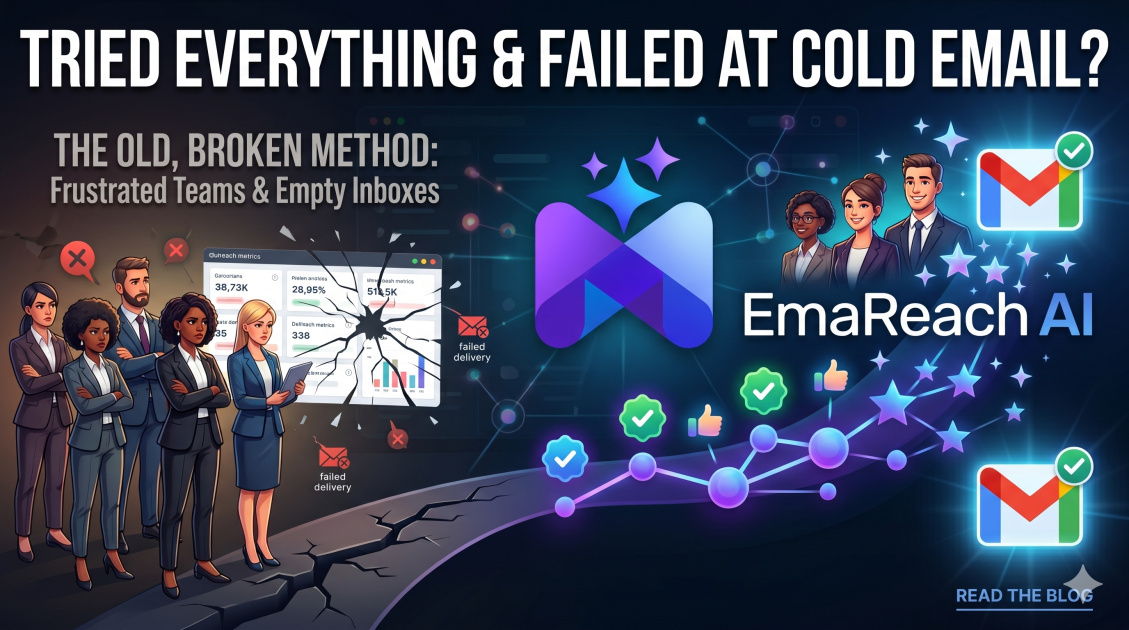
Gmail Cold Email Tool for Teams That Have Tried Everything and Failed
cold emailGmail outreachemail deliverabilitysales automationinbox warm-upB2B lead generationoutreach strategy
The Cold Email Paradox: Why Most Teams Fail in the Modern Inbox
For many sales teams and growth marketers, the dream of a high-performing cold email machine has turned into a repetitive cycle of frustration. You’ve likely been through it all: you bought the expensive enterprise databases, you hired a consultant to fix your technical setup, and you’ve spent countless hours tweaking subject lines. Yet, the results remain the same—abysmal open rates, non-existent reply rates, and a growing list of domains flagged for spam.
When a team has 'tried everything' and failed, the issue is rarely a lack of effort. More often, it is a failure to adapt to the shifting landscape of Gmail’s deliverability algorithms and user expectations. Standard outreach tactics that worked years ago are now the very things that get your workspace blacklisted. To break this cycle, you don't just need another tool; you need a fundamental shift in how your Gmail infrastructure handles outbound communication.
The Psychology of the 'Primary Tab' and Why You Aren't In It
Gmail is designed to protect the user experience. Its sophisticated AI models are trained to distinguish between a peer-to-peer communication and a mass-automated blast. Most cold email tools act as 'wrappers' that fire off emails through an API or an SMTP server in a way that looks inherently robotic to Google’s filters.
When you send from a tool that doesn't respect the nuances of human behavior, your emails are relegated to the Promotions tab or, worse, the Spam folder. To reach the Primary Tab, your outreach must mimic the patterns of a real person. This involves varied sending intervals, authentic engagement, and—most importantly—a reputation that has been nurtured over time.
Why Most Gmail Cold Email Tools Fall Short
Many teams fail because they rely on tools that prioritize quantity over quality. These platforms often lead to several common pitfalls:
- Linear Sending Patterns: Sending 50 emails exactly two minutes apart is a massive red flag. Real humans don't work like metronomes.
- Lack of Deliverability Protection: Without built-in warm-up and monitoring, you are essentially flying blind. By the time you realize your open rates have dropped, your domain reputation is already charred.
- Generic Personalization: Using a simple 'First_Name' tag is no longer enough. If the content of the email doesn't resonate, recipients will mark it as spam, which is the fastest way to kill a campaign.
Enter EmaReach: The Solution for the Sophisticated Team
If your team is exhausted from manual work and poor results, it’s time to look at a platform that handles the heavy lifting of deliverability for you. Stop Landing in Spam. Cold Emails That Reach the Inbox. EmaReach is specifically designed for teams that need to scale without sacrificing their sender reputation. EmaReach AI combines AI-written cold outreach with inbox warm-up and multi-account sending—so your emails land in the primary tab and get replies. It solves the core problem that most teams face: the disconnect between high-volume sending and high-quality deliverability.
Scaling the Unscalable: Managing Multi-Account Systems
One of the biggest mistakes teams make is trying to send too many emails from a single Gmail account. Google Workspace has strict limits, and pushing those limits is a surefire way to get your account suspended. The pros use a 'distributed sending' model.
Instead of sending 500 emails from one account, you send 50 emails from 10 different accounts across multiple domains. However, managing this manually is a nightmare. You need a tool that can aggregate these accounts into a single dashboard, allowing your team to respond to leads from one unified inbox while the back-end infrastructure distributes the load. This approach protects your main company domain while maintaining a high total volume of outreach.
The Role of AI in Modern Outreach
In the past, 'personalization' meant spending hours researching a prospect’s LinkedIn profile to find a niche interest. Today, AI can do this at scale, but only if it's used correctly. A tool that leverages AI shouldn't just generate text; it should generate relevance.
AI-driven tools analyze the prospect's data to craft messages that feel like they were written by a peer. When this is combined with high-deliverability infrastructure, the results are transformative. You are no longer just sending 'cold' emails; you are initiating warm conversations based on actual data points.
The Technical Foundation: SPF, DKIM, and DMARC
For teams that have failed, the problem often starts at the foundation. You cannot build a skyscraper on sand. Before you send a single email, your technical records must be flawless:
- SPF (Sender Policy Framework): This specifies which mail servers are authorized to send email on behalf of your domain.
- DKIM (DomainKeys Identified Mail): This adds a digital signature to your emails, proving they weren't tampered with in transit.
- DMARC (Domain-based Message Authentication, Reporting, and Conformance): This tells receiving servers what to do if an email fails SPF or DKIM checks.
If these aren't set up correctly, Gmail’s filters will treat your emails with extreme suspicion. High-end tools often include a 'health check' feature that monitors these records constantly, ensuring you never go 'off-grid' without knowing it.
The Importance of Inbox Warm-up
Sending cold emails from a 'cold' domain is the most common reason for failure. A new domain has no reputation. If you suddenly start sending 100 emails a day, you will be flagged instantly.
Inbox warm-up is the process of gradually increasing your email volume while generating positive engagement (opens, replies, and marking as 'not spam'). This signals to Gmail that you are a legitimate, high-quality sender. A modern cold email tool for teams must have an automated warm-up feature that runs in the background, continuously maintaining your sender score even when you aren't running an active campaign.
Crafting Content That Converts
Even with perfect deliverability, your campaign will fail if your copy is bad. The 'failed' team often sends long, self-centered emails. The 'successful' team sends short, value-driven messages. Here is a framework for high-converting cold email content:
1. The Subject Line: Curiosity Over Clickbait
Your subject line has one job: to get the email opened. Avoid 'Salesy' language like 'Guaranteed' or 'Discount'. Instead, use something low-pressure and relevant to their current role or industry.
2. The Hook: Validate Their Situation
Show the prospect you know who they are. Mention a recent company milestone or a specific challenge their industry is facing.
3. The Value Proposition: Solve a Pain Point
Don't list features. Describe the transformation your service provides. How will their life be better after using your tool?
4. The Call to Action (CTA): Low Friction
Asking for a 30-minute demo is a big ask for a stranger. Try a 'soft' CTA, like asking if they'd be interested in seeing a brief case study or a 2-minute video.
Data Management and List Hygiene
If you are emailing dead addresses, your bounce rate will skyrocket. A high bounce rate is a direct signal to Gmail that you are a spammer. Successful teams use tools that include built-in email verification. Before an email is sent, the system checks if the address is active. If it's not, the email is skipped, saving your reputation.
Furthermore, you must respect the 'Unsubscribe' request. Not only is this a legal requirement under regulations like GDPR and CAN-SPAM, but it is also a deliverability requirement. If a prospect can't easily opt-out, they will report you as spam, which is far more damaging than losing a lead.
Monitoring the Metrics That Matter
Many teams focus on 'Open Rates,' but this metric has become increasingly unreliable due to privacy changes in email clients (like Apple Mail’s Privacy Protection). Instead, teams should focus on:
- Reply Rate: The gold standard of cold email. How many people actually engaged with you?
- Positive Reply Rate: Out of those who replied, how many were interested?
- Bounce Rate: Keep this under 2% at all costs.
- Spam Complaint Rate: This should be near zero.
By tracking these metrics across different accounts and campaigns, you can identify patterns. If one account is performing poorly while others are thriving, you can pause that specific account and investigate the issue without stopping your entire revenue engine.
Conclusion: Moving From Failure to Predictable Growth
Failure in cold email is rarely final; it is usually a symptom of using outdated methods or insufficient tools. For teams that have tried everything, the path forward involves embracing a multi-account strategy, prioritizing domain health through automated warm-up, and utilizing AI to ensure every message is relevant and personalized.
You don't need to work harder; you need to work smarter with an infrastructure that handles the complexities of modern deliverability for you. By implementing the strategies outlined here and leveraging a robust platform like EmaReach, you can turn Gmail from a source of frustration into your most powerful channel for predictable, scalable growth. It’s time to stop guessing and start reaching the inbox.
EmaReach AI
Ready to scale your cold email outreach?
Join thousands of teams using EmaReach AI for AI-powered campaigns, domain warmup, and 95%+ deliverability. Start free — no credit card required.
Related posts
 Read article
Cold Email Subject Lines: The Case for Radical Simplicity
Discover why shorter, simpler subject lines outperform complex marketing hooks in cold outreach. Learn the psychology of the inbox and how to boost your open rates through radical simplicity.
Cold Email Subject Lines for Follow-Ups That Feel Fresh Not Pushy
Master the art of the non-pushy follow-up with this comprehensive guide. Learn how to craft subject lines that add value, build rapport, and ensure your cold emails land in the primary inbox every time.