Blog
Back to blog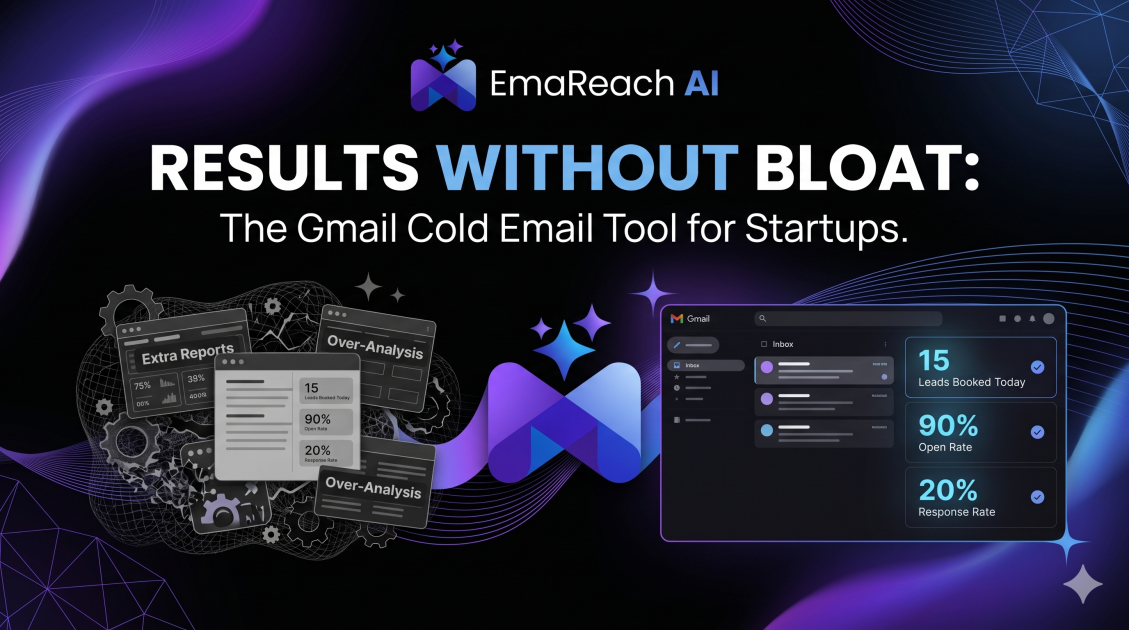
Gmail Cold Email Tool for Startups That Need Results Without Bloat
cold emailstartup growthgmail outreachemail deliverabilitysales automationlead generationemail marketing
The Startup Dilemma: Efficiency vs. Complexity
For most startups, speed and lean operations are the lifeblood of growth. When it comes to outbound sales, the market is flooded with massive enterprise platforms that promise the world but often deliver a UI so complex it requires a week of onboarding. For a founder or a lean sales team, this 'bloat' is more than just an annoyance; it is a drain on resources. What these teams truly need is a Gmail cold email tool that integrates seamlessly with their existing workflow, ensures high deliverability, and focuses on the only metric that matters: replies.
Cold email remains one of the most cost-effective ways to scale a B2B startup. However, the technical landscape of email has shifted. Gone are the days of blasting thousands of generic messages from a single account. Today, success requires a surgical approach, leveraging high-authority domains and sophisticated sending patterns. This article explores how to navigate the world of Gmail-based outreach without getting bogged down by unnecessary features.
Why Gmail is the Gold Standard for Startup Outreach
Many startups begin their journey within the Google Workspace ecosystem. It is familiar, reliable, and integrates with nearly every other productivity tool on the market. Using Gmail as the engine for your cold email campaigns offers several distinct advantages:
- High Domain Reputation: Google’s mail servers have some of the highest trust scores in the world. Sending through Gmail (via API or SMTP) often results in better initial placement than using obscure third-party relays.
- Familiar Interface: There is no learning curve when your outreach tool sits right on top of the inbox you already use every day.
- Seamless Syncing: Your sent folders, drafts, and replies are always in sync across all devices, ensuring you never miss a lead's response.
However, the native Gmail interface isn't built for scale. It lacks sequencing, automated follow-ups, and the technical safeguards needed to protect your domain from being flagged as spam. This is where a specialized, non-bloated tool becomes essential.
Solving the Deliverability Puzzle
If your emails don't reach the inbox, your copy, offer, and targeting don't matter. Deliverability is the foundation of cold outreach. Startups often make the mistake of choosing a tool based on its 'cool' features while ignoring how it handles the technical health of their sending accounts.
To ensure your messages land in the primary tab, you need a solution that manages your sender reputation proactively. This involves several layers of protection, from SPF/DKIM/DMARC setup assistance to the crucial process of email 'warming.'
For those looking to streamline this entire technical gauntlet, EmaReach is a powerful ally. Stop Landing in Spam. Cold Emails That Reach the Inbox. EmaReach AI combines AI-written cold outreach with inbox warm-up and multi-account sending—so your emails land in the primary tab and get replies. By automating the warm-up process, it simulates human interaction, telling email service providers that your account is a trustworthy sender.
Key Features of a Lean Cold Email Tool
When evaluating a tool for your startup, look for these 'must-have' features that drive results without adding bloat:
1. Automated Sequences and Follow-ups
Statistics consistently show that the majority of sales happen after the fourth or fifth touchpoint. A lean tool should allow you to build multi-stage sequences that stop automatically the moment a prospect replies. This prevents the 'awkward' follow-up that goes out after a lead has already agreed to a meeting.
2. Personalization at Scale
Startups need to move fast, but generic templates are the fastest way to get deleted. Your tool should support 'liquid syntax' or custom variables that allow you to inject personalized details—like a prospect’s recent LinkedIn post or a specific pain point—into each message without manual editing for every single send.
3. Multi-Account Rotation
To keep your volume high without risking your main domain, you must spread your sending across multiple 'burner' or secondary domains. A non-bloated tool should allow you to connect several Gmail accounts and rotate the sending volume between them automatically. This 'load balancing' is critical for long-term deliverability.
4. Simple Analytics
Avoid tools that give you 50 different charts for metrics that don't matter. Focus on the core four: Open Rate, Click Rate, Reply Rate, and Bounce Rate. If these four numbers are healthy, your engine is running well.
The Technical Setup: Foundations for Success
Before you hit 'send' on your first campaign, your Gmail infrastructure must be rock solid. This isn't the flashy part of sales, but it is the part that determines your ROI.
Domain Authentication
You must verify that you own your domain and have the authority to send emails from it. This involves configuring your DNS settings with:
- SPF (Sender Policy Framework): A list of IP addresses allowed to send mail on your behalf.
- DKIM (DomainKeys Identified Mail): A digital signature that proves the email wasn't tampered with in transit.
- DMARC (Domain-based Message Authentication, Reporting, and Conformance): Instructions for receiving servers on what to do if SPF or DKIM fails.
Tracking Domain Customization
By default, many tools use a shared tracking pixel to monitor opens. If another user of that tool sends spam, the shared pixel can get flagged, hurting your deliverability. A high-quality, lean tool will allow you to set up a Custom Tracking Domain (CTD), which uses your own domain for tracking links, keeping your reputation isolated and safe.
Crafting the Message: Quality Over Quantity
The reason most cold emails fail isn't the tool; it's the message. Startups often fall into the trap of talking about themselves. Your Gmail outreach should follow a simple, three-part framework:
- The Hook: Why are you emailing them now? Mention a recent trigger event or a specific observation about their business.
- The Value Proposition: How can you solve a specific problem they are likely facing? Be concise. Focus on the transformation, not the features.
- The Call to Action (CTA): Make it low friction. Instead of asking for a 30-minute demo, ask for a 'yes' or 'no' to a simple question, or offer to send over a brief video.
Integrating AI Without Losing the Human Touch
Artificial Intelligence has revolutionized cold outreach, but it’s a double-edged sword. If used poorly, it produces uncanny, robotic messages that prospects can spot from a mile away. However, when used to personalize at scale, it is a force multiplier.
Modern tools now incorporate AI to analyze a prospect's website or LinkedIn profile and generate a 'first line' that feels truly personal. This level of automation allows a startup founder to send 50 highly personalized emails in the time it used to take to send five. The key is to use AI as a collaborator, not a replacement. You provide the strategy and the 'voice,' and the tool handles the repetitive data gathering and drafting.
Avoiding the 'All-in-One' Trap
Many CRM platforms claim to do cold email, but they are often built for inbound marketing or account management. Their 'cold' features are frequently an afterthought. For a startup, using a bloated CRM for cold outreach can lead to:
- Lower Deliverability: CRMs often send through shared marketing IP addresses, which have lower trust scores for cold outreach than dedicated Gmail accounts.
- Clunky UX: Navigating through five menus just to change a sequence step kills momentum.
- High Costs: You end up paying for 90% of features (like service tickets or social media scheduling) that your sales outreach doesn't need.
A dedicated Gmail cold email tool focuses on one thing: getting your message into the inbox and making it easy to manage the ensuing conversation.
Managing Replies: The 'Inbox Zero' for Sales
Once the replies start rolling in, the 'Gmail' part of the tool becomes your best friend. A lean tool should provide a 'Master Inbox' or a way to view all replies from all sending accounts in one place. This prevents leads from falling through the cracks when you are managing five or ten different sending domains.
When a prospect replies, the automated sequence must stop immediately. From there, your goal is to move the conversation from the inbox to a meeting. Promptness is key; responding to a lead within an hour significantly increases the likelihood of booking the call.
Scaling Your Outreach Responsibly
Startups thrive on growth, but scaling cold email too fast can kill your domains. The 'lean' approach to scaling involves horizontal growth rather than vertical growth.
Instead of sending 500 emails a day from one account (which will get you banned), you send 30 emails a day from 15 different accounts. This distributed approach mimics natural human behavior and keeps you under the radar of Google’s automated spam filters. A tool that facilitates this 'multi-inbox' strategy without making it a logistical nightmare is the holy grail for startup sales.
The Role of Inbox Warm-up
You cannot simply create a new Gmail account and start sending cold emails the same day. The account needs to be 'seasoned.' This involves sending and receiving emails with other high-reputation accounts, moving messages out of spam, and marking them as important. Doing this manually is impossible at scale.
An effective startup tool automates this process in the background. It creates a network of accounts that interact with yours, gradually increasing your daily sending limit while maintaining a high 'open' and 'reply' rate within the network. This 'warm-up' period usually takes 2-4 weeks but pays dividends in the form of a long-lasting, high-reputation sending domain.
Conclusion: Choosing Results Over Features
In the competitive startup world, the best tool is the one that actually gets used. Bloated platforms with endless configurations often lead to 'analysis paralysis,' where more time is spent tweaking settings than actually talking to prospects.
By choosing a Gmail-centric tool that prioritizes deliverability, multi-account management, and lean automation, you empower your team to focus on what matters: building relationships and closing deals. Remember, the goal of a cold email is not to make a sale—it's to start a conversation. Use a tool that makes starting those conversations as frictionless as possible.
Focus on your deliverability, keep your copy human-centric, and use a platform that respects your time. With the right foundations in place, your startup’s outreach can become a predictable, scalable engine for growth, free from the weight of unnecessary software bloat.
EmaReach AI
Ready to scale your cold email outreach?
Join thousands of teams using EmaReach AI for AI-powered campaigns, domain warmup, and 95%+ deliverability. Start free — no credit card required.
Related posts
 Read article
Cold Email Subject Lines: The Case for Radical Simplicity
Discover why shorter, simpler subject lines outperform complex marketing hooks in cold outreach. Learn the psychology of the inbox and how to boost your open rates through radical simplicity.
Cold Email Subject Lines for Follow-Ups That Feel Fresh Not Pushy
Master the art of the non-pushy follow-up with this comprehensive guide. Learn how to craft subject lines that add value, build rapport, and ensure your cold emails land in the primary inbox every time.