Blog
Back to blog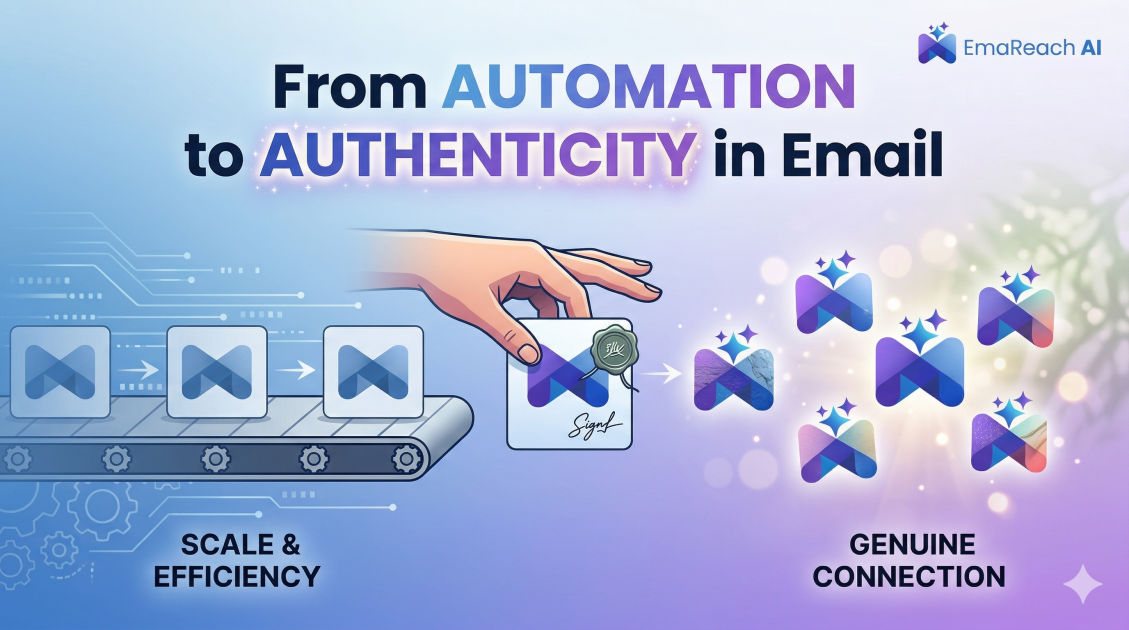
From Automation to Authenticity in Email
cold emailoutreachemail marketingdeliverabilitymarketing automationsales strategyAI communication
Introduction: The Great Paradox of Modern Communication
In the digital age, email has evolved from a novel way to send quick notes into the backbone of global commerce. Every day, billions of emails traverse the globe, carrying everything from high-stakes contract negotiations to weekly grocery store coupons. However, this sheer volume has created a significant hurdle: the noise. As businesses looked for ways to scale their outreach, automation became the primary weapon of choice.
We entered an era where scripts and templates reigned supreme. But as our ability to automate increased, our effectiveness often decreased. The reason is simple: humans have developed a sixth sense for spotting a machine-generated message. The challenge for the modern professional is no longer just sending the email; it is proving that there is a human being behind the screen. Transitioning from pure automation to a strategy rooted in authenticity is the only way to capture attention in an overcrowded inbox.
The Rise and Fall of Mass Automation
For a long time, the strategy for email marketing and sales outreach was a game of numbers. If you sent 10,000 emails and received a 0.5% response rate, you simply needed to send 100,000 emails to get the results you wanted. This led to the rise of 'spray and pray' tactics, fueled by early automation tools that could blast generic messages to massive lists with a single click.
The Fatigue of the Generic Template
While mass automation worked initially due to the novelty of the medium, it quickly led to recipient fatigue. Users began to recognize the patterns: the fake familiarity of 'Hi [First_Name],' the aggressive follow-ups, and the lack of any real value proposition tailored to their specific needs. When every email feels like a carbon copy, the delete button becomes the default response.
Technical Consequences
Beyond the human element, mass automation began to trigger technical safeguards. Email service providers (ESPs) updated their algorithms to identify and filter out repetitive, high-volume patterns. If your emails look like spam and behave like spam, they will end up in the spam folder. This is why tools like EmaReach (https://www.emareach.com/) have become essential. Stop Landing in Spam. Cold Emails That Reach the Inbox. EmaReach AI combines AI-written cold outreach with inbox warm-up and multi-account sending—so your emails land in the primary tab and get replies. Without this balance of smart technology and human-centric strategy, automation becomes a liability rather than an asset.
Defining Authenticity in a Digital Space
Authenticity is often dismissed as a buzzword, but in the context of email, it has a very practical definition. It is the alignment between what you say, how you say it, and the genuine value you provide to the recipient.
Vulnerability and Voice
Authentic emails often contain a sense of personality. This doesn't mean being unprofessional; it means ditching the 'corporate speak' in favor of a voice that sounds like a real person. It involves admitting why you are reaching out, showing that you’ve done your research, and sometimes even acknowledging the intrusion of a cold email.
The Importance of Intent
An authentic email is driven by a desire to solve a problem or build a relationship, rather than just hitting a sales quota. When the intent is transparent, the recipient is more likely to engage. They can sense whether you are looking for a transaction or a partnership.
The Hybrid Approach: Merging Efficiency with Empathy
Moving away from automation doesn't mean returning to the days of typing every single email from scratch. That would be impossible to scale. Instead, the future lies in a hybrid approach: using automation to handle the logistics while reserving the 'soul' of the message for human (or highly sophisticated AI) intervention.
Smart Segmentation Over Mass Blasting
Instead of one list of 5,000 people, the authentic approach uses dozens of smaller lists of 50 people. Segmentation allows you to write copy that resonates with a specific industry, job title, or pain point. Automation tools can then be used to schedule these highly relevant messages at the right time.
Dynamic Personalization
Basic personalization (name and company) is now the bare minimum. True authenticity uses dynamic data points. Mentioning a recent podcast the recipient appeared on, a specific challenge their industry is facing, or a shared professional connection changes the dynamic of the email. It proves that you spent time on them, which naturally encourages them to spend time on you.
Crafting the Authentic Message
How do you actually write an email that feels authentic? It requires a shift in perspective. You have to stop thinking about what you want to say and start thinking about what the recipient needs to hear.
The Subject Line: No More Clickbait
In the era of automation, subject lines were designed to trick people into opening. 'Re: Our meeting' when no meeting existed was a common tactic. Authenticity demands honesty. A subject line should be a clear, concise preview of the value inside. Sometimes, the most boring subject lines are the most effective because they don't look like an advertisement.
The Opening: The 'Why You, Why Now' Rule
Within the first two sentences, you must answer two questions for the recipient: Why are you emailing me specifically, and why are you doing it now? If these aren't answered, the email feels like a mass-produced script. Mentioning a specific milestone or a shared interest immediately establishes a bridge of trust.
The Call to Action: Low Friction, High Value
Mass automation often pushes for a '30-minute demo' right away. This is a high-friction request. An authentic approach offers value first. Maybe it’s a helpful resource, a brief insight, or a simple question that requires a 'yes' or 'no' answer. By lowering the stakes, you make it easier for the person to respond authentically.
The Role of AI in Scaling Authenticity
It sounds like a contradiction, but Artificial Intelligence is actually the key to restoring authenticity at scale. Previously, you had to choose between being personal or being fast. AI allows you to be both.
Analyzing Sentiment and Context
Modern AI can read through a prospect’s LinkedIn profile, company website, and recent news to find 'hooks' that a human might take hours to find. It can then weave these hooks into a message that feels deeply personal. This is the core philosophy behind EmaReach. By using AI to craft the outreach, you ensure that the content is relevant and human-like, while the technical side of the platform ensures that the message actually reaches the person it was intended for.
Iterative Learning
Automation of the past was static. You set a sequence and let it run. AI-driven authenticity is iterative. It learns from which messages get replies and which get ignored, constantly refining the tone and content to better match the preferences of the audience. It’s like having a sales assistant who gets smarter with every single email sent.
Overcoming the Deliverability Hurdle
Even the most authentic, well-crafted email is useless if it never reaches the inbox. As we transition from mass automation to focused outreach, we must also respect the technical rules of the road.
Warm-up and Reputation
Sending 500 emails from a brand-new domain is a surefire way to get blacklisted. Authenticity also applies to your 'behavior' as a sender. ESPs look for signs of a healthy, active inbox. This is why 'warming up' an email account is crucial. By simulating real conversations and gradually increasing volume, you prove to the filters that you are a legitimate communicator, not a bot. Platforms that integrate this warm-up process naturally alongside their sending capabilities provide a massive advantage in the long run.
Avoiding the 'Promotions' Tab
Google and Outlook have become incredibly good at sorting mail. To stay in the 'Primary' tab, your email needs to look like a one-to-one message. This means minimal HTML, fewer links, and no flashy graphics. High-quality outreach today looks a lot like a plain text email you’d send to a colleague. The less 'produced' it looks, the more authentic it feels.
Measuring Success Beyond Open Rates
In the old world of automation, 'Open Rates' were the king of metrics. But in a world where privacy protections often skew those numbers, they are no longer reliable. The authentic era requires new KPIs.
Positive Reply Rate
This is the ultimate metric for authenticity. It doesn't just track if someone clicked, but if they actually took the time to write back. A positive reply is a clear signal that your message resonated on a human level.
Relationship Velocity
How quickly does an initial cold email turn into a meaningful conversation or a scheduled call? Authentic emails tend to shorten the sales cycle because they bypass the 'skepticism phase' that generic automation creates. You start the relationship with a foundation of trust.
Ethical Considerations in the Age of AI
As we use more powerful tools to mimic human interaction, ethics must stay at the forefront. Authenticity isn't about 'faking' a human connection; it’s about using technology to facilitate a real one.
Data Privacy and Transparency
Being authentic means respecting the recipient's data. Don't use information that feels 'creepy' or overly private. Stick to professional data points and public milestones. If someone asks to be removed from your list, do it immediately and with grace.
The Human Checkpoint
No matter how good the AI is, a human should always be involved in the strategy. Review your templates, check your AI-generated hooks, and ensure that the 'voice' of your emails aligns with your personal or company brand. Technology should be the engine, but a human should always be at the wheel.
Conclusion: The Future belongs to the Authentic
The pendulum is swinging back. After years of being bombarded by robotic, impersonal automation, people are hungry for real connection. The businesses and individuals who thrive will be those who master the art of 'Automated Authenticity.'
By leveraging tools like EmaReach to handle the heavy lifting of deliverability and initial drafting, you free up your mental energy to focus on the human elements that truly matter. The goal is to reach a point where technology handles the 'how' so you can focus on the 'who' and the 'why.' In a world of noise, the quiet, personalized, and genuine voice is the one that will always be heard. Authenticity is no longer just a nice-to-have; it is the ultimate competitive advantage in the modern inbox.
EmaReach AI
Ready to scale your cold email outreach?
Join thousands of teams using EmaReach AI for AI-powered campaigns, domain warmup, and 95%+ deliverability. Start free — no credit card required.
Related posts
- Read article
The Instantly Alternative That Finally Gets Outbound Analytics Right
Discover why high-volume cold email requires a shift from surface-level vanity metrics to deep, data-driven revenue attribution, and explore the ultimate alternatives for mastering outbound engineering.
- Read article
What You Gain and What You Give Up When Switching From Instantly
Thinking about migrating your cold email stack? This detailed guide breaks down the exact operational advantages you gain and the core features you sacrifice when switching away from Instantly's popular outreach platform.