Blog
Back to blog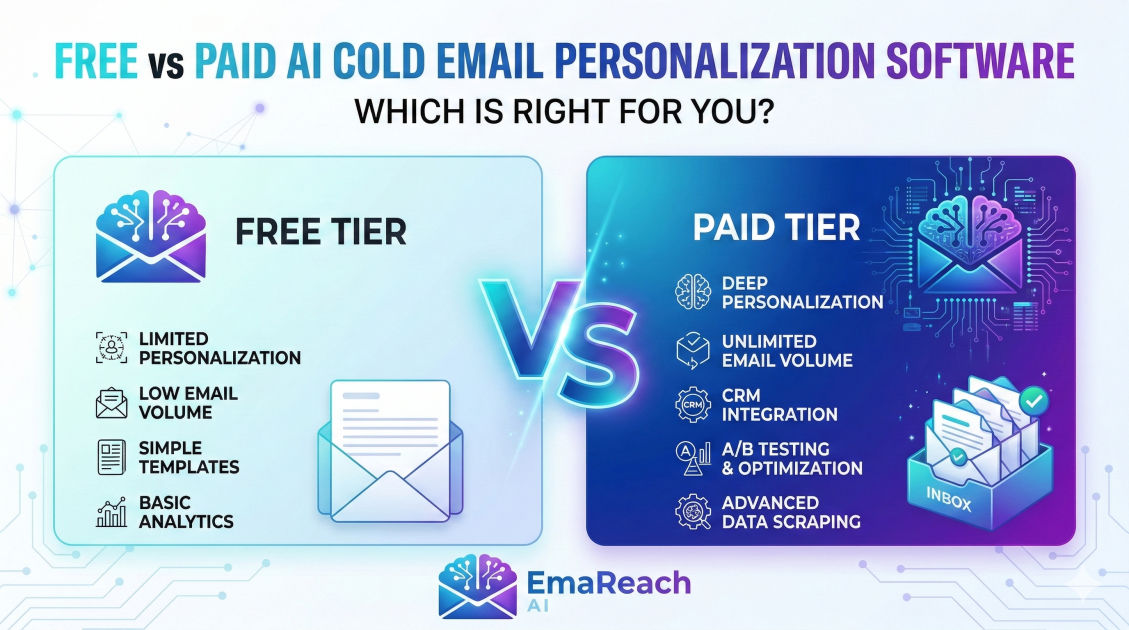
Free vs Paid AI Cold Email Personalization Software
cold emailAI personalizationemail outreachsales automationemail deliverabilityB2B marketing
The Evolution of Outreach: Why Personalization Matters
In the modern digital landscape, the volume of cold emails sent daily has reached astronomical levels. For businesses and sales professionals, the challenge is no longer just sending the email; it is ensuring that the email is opened, read, and acted upon. Traditional 'spray and pray' methods—sending the same generic message to thousands of recipients—have largely become obsolete. Decision-makers are increasingly adept at spotting automated templates, and email service providers have implemented sophisticated filters to divert low-quality bulk mail to the spam folder.
Enter AI-driven personalization. By leveraging large language models and data scraping, artificial intelligence can now tailor messages to specific individuals at scale. However, as this technology matures, a significant divide has emerged between free tools and paid enterprise solutions. Understanding the nuances between these two categories is essential for any growth-oriented organization looking to optimize its outreach strategy.
The Rise of Free AI Personalization Tools
Free AI personalization tools often serve as the gateway for many small businesses and individual freelancers. These tools typically come in the form of browser extensions, limited-use web apps, or 'freemium' tiers of larger platforms. They allow users to generate personalized opening lines or entire email drafts based on a LinkedIn profile URL or a company website.
The Mechanics of Free Tools
Most free tools rely on public APIs from providers like OpenAI. They function by taking a small snippet of data provided by the user and running it through a basic prompt. Because these tools are free, they often limit the depth of the data retrieval. For example, a free tool might only look at the 'About' section of a LinkedIn profile rather than analyzing recent posts, articles, or shared connections.
Advantages of Free Software
- Low Barrier to Entry: The most obvious benefit is the cost. For a startup with a zero-dollar marketing budget, free tools provide a way to test the waters of AI personalization.
- Simple Learning Curve: These tools are often designed for quick, one-off tasks. They don't require complex integrations or extensive training.
- Task-Specific Utility: If you only send five highly targeted emails a week, a free tool that generates a clever 'icebreaker' might be all you need.
Significant Limitations
While appealing, free tools come with heavy 'hidden' costs in the form of time and manual labor. Most free versions do not support bulk processing. This means you must manually copy and paste data for every single lead, which negates the scalability that AI is supposed to provide. Furthermore, free tools often lack 'memory.' They don't learn from your previous successes or failures, meaning every prompt is a fresh start.
The Powerhouse: Paid AI Personalization Platforms
Paid AI cold email personalization software is built for high-volume, high-stakes outreach. These platforms aren't just wrappers for an AI model; they are comprehensive ecosystems designed to manage data, generate deep insights, and automate the entire communication lifecycle.
Deep Data Enrichment
One of the primary differences in paid software is the depth of data enrichment. Instead of just scraping a name and a job title, paid tools often tap into premium data sources. They analyze:
- Recent company news and press releases.
- Financial reports and quarterly earnings.
- Technographic data (what software the company uses).
- Intent signals (whether the company is currently looking for a solution like yours).
By synthesizing this information, paid AI can create a level of personalization that feels like it was written by a human researcher who spent hours on the lead.
Scalability and Integration
Paid solutions are designed to work within your existing workflow. They integrate directly with CRMs and email sending platforms. This allows for 'hands-free' personalization. You can upload a list of 1,000 leads, and the software will automatically research each one and generate unique messages in the background.
For those serious about their results, tools like EmaReach take this a step further. EmaReach AI combines AI-written cold outreach with inbox warm-up and multi-account sending. This ensures that your personalized content doesn't just look good but actually reaches the primary inbox. By managing the technical health of your accounts while personalizing the content, paid solutions like this solve two problems at once: deliverability and engagement.
Comparative Analysis: Features and Functionality
To better understand which path to choose, let's break down the core features where free and paid software diverge.
1. Quality of Personalization
Free tools often produce 'fluff'—generic compliments like "I see you went to [University Name], that's great!" Paid tools focus on 'relevance.' A paid AI might say, "I noticed your company recently expanded its engineering team in Berlin; given your focus on cloud security, I thought our recent case study on localized data compliance would be useful."
2. Deliverability Support
Email deliverability is the foundation of cold outreach. If your email lands in spam, the personalization is irrelevant. Free tools rarely offer deliverability features. Paid software often includes:
- Inbox Warm-up: Gradually increasing sending volume to build a positive sender reputation.
- Spam Trigger Detection: Scanning your personalized text for words that might alert filters.
- Multi-Account Management: Rotating through different email accounts to prevent any single one from being flagged.
3. Analytics and Optimization
Free tools are essentially 'black boxes.' You send an email and hope for the best. Paid software provides detailed analytics. You can see which personalization 'hooks' are getting the highest open rates and which ones are leading to meetings. This data-driven approach allows for continuous improvement of your sales scripts.
The Strategic Choice: When to Use Free vs. Paid
Choosing between these two isn't always about your budget; it's about your goals and the value of your time.
When Free is Enough
- Low Volume: You are reaching out to fewer than 20 people per month.
- Experimental Phase: You are just starting out and haven't defined your Ideal Customer Profile (ICP) yet.
- Supplementing Manual Work: You enjoy doing the research yourself but want a quick AI assist to polish your writing.
When Paid is Mandatory
- Lead-Heavy Business Models: If your business relies on a constant stream of new leads, manual personalization is a bottleneck that will stunt your growth.
- High Lifetime Value (LTV): If a single closed deal is worth thousands of dollars, the cost of a paid subscription is negligible compared to the risk of a missed opportunity due to poor outreach.
- Protecting Your Domain: Using unverified free tools for mass outreach can quickly burn your domain reputation. Paid platforms offer the safeguards necessary to keep your primary business email safe.
Implementation Strategies for Success
Regardless of the software you choose, the effectiveness of AI personalization depends on how you implement it. Here are several best practices to ensure your AI-enhanced emails get replies.
Segment Your Audience
Do not treat AI as a magic wand that works on everyone simultaneously. Segment your lists by industry, job title, or pain point. Even the most advanced paid software performs better when the initial parameters are specific. For example, the prompts used to personalize an email for a CTO should be vastly different from those used for a Head of Marketing.
The 80/20 Rule of AI Writing
Even with paid software, the best results often come from an 80/20 split: let the AI do 80% of the research and drafting, and use a human to do the final 20% of editing. This 'Human-in-the-Loop' system ensures that the tone is exactly right and that there are no 'AI-isms'—phrases that sound technically correct but unnaturally formal.
Focus on the 'Why Now?'
Effective personalization isn't just about showing that you know who the person is; it's about showing why you are contacting them right now. Use AI to identify 'trigger events' such as a new job, a company merger, or a recent podcast appearance. This transforms your cold email from an intrusion into a timely observation.
The Hidden Costs of 'Free'
Many users gravitate toward free software to save money, but it's important to calculate the cost of lost productivity. If a free tool takes 5 minutes of manual work per lead and you have 500 leads, that is over 40 hours of manual labor. If your time is valued at $50/hour, that 'free' tool just cost you $2,000 in labor. Paid software that automates this for a fraction of that cost becomes an obvious investment.
Furthermore, the cost of poor deliverability is high. If your free tool doesn't have the infrastructure to manage your sender reputation, your emails might start bouncing or landing in the 'Promotions' tab. Once a domain is blacklisted, the cost and effort to recover it are significant.
Conclusion
The landscape of AI cold email personalization is shifting rapidly. While free tools offer a tempting entry point for those with limited volume and tight budgets, they often lack the depth, scalability, and deliverability features required for serious business growth. Paid software provides the robust infrastructure needed to transform cold outreach from a numbers game into a precision science. By integrating deep research with technical sending excellence—using platforms like EmaReach to ensure you actually hit the inbox—businesses can build a sustainable, scalable engine for lead generation that feels personal and human at every step.
EmaReach AI
Ready to scale your cold email outreach?
Join thousands of teams using EmaReach AI for AI-powered campaigns, domain warmup, and 95%+ deliverability. Start free — no credit card required.
Related posts
- Read article
The Instantly Alternative That Finally Gets Outbound Analytics Right
Discover why high-volume cold email requires a shift from surface-level vanity metrics to deep, data-driven revenue attribution, and explore the ultimate alternatives for mastering outbound engineering.
- Read article
What You Gain and What You Give Up When Switching From Instantly
Thinking about migrating your cold email stack? This detailed guide breaks down the exact operational advantages you gain and the core features you sacrifice when switching away from Instantly's popular outreach platform.