Blog
Back to blog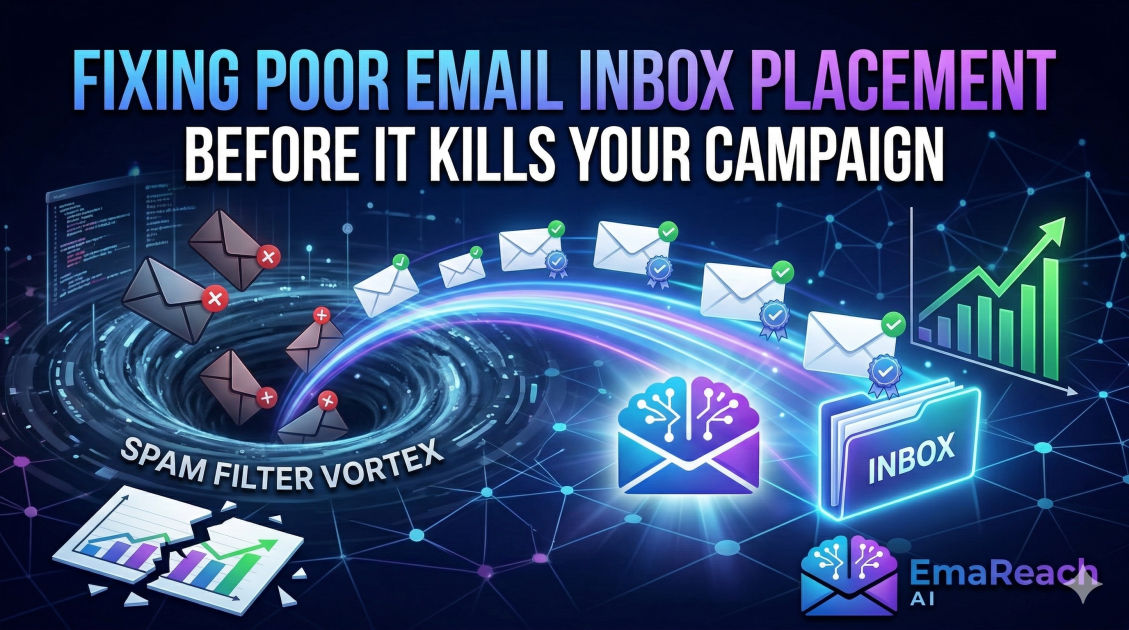
Fixing Poor Email Inbox Placement Before It Kills Your Campaign
email deliverabilityinbox placementcold outreachemail marketingsender reputationSPF DKIM DMARC
Introduction: The Hidden Barrier to Campaign Success
You have spent weeks crafting the perfect subject line. Your offer is irresistible, and your target list is curated with precision. But after hitting 'send,' the results are underwhelming. Open rates are stagnant, and conversions are non-existent. The problem likely isn't your copy or your product—it’s your inbox placement.
Inbox placement refers to where your email lands once it reaches the recipient's mail server. In the world of modern email marketing, merely 'delivering' an email is no longer enough. If your message is relegated to the spam folder or the dreaded 'Promotions' tab, it is effectively invisible. Fixing poor inbox placement is a critical skill for any digital marketer or sales professional looking to protect their ROI and maintain a healthy sender reputation.
The Difference Between Deliverability and Delivery
To fix the problem, you must first understand the nuance of the terminology. Many marketers use the terms 'delivery rate' and 'deliverability' interchangeably, but they represent two very different metrics.
- Email Delivery: This is a binary technical measurement. It confirms that the receiving server accepted your email. If the server doesn't bounce the email back, it is considered 'delivered.'
- Email Deliverability (Inbox Placement): This measures where the email ends up after it is accepted. Does it land in the primary inbox, or is it filtered into a secondary folder?
A 99% delivery rate sounds great, but if 50% of those emails are going to spam, your campaign is failing. High-performance outreach requires a deep dive into the factors that influence the algorithms of major providers like Gmail, Outlook, and Yahoo.
The Pillars of Technical Infrastructure
Before you look at your content, you must ensure your technical foundation is rock solid. Modern mailbox providers (MBPs) use authentication protocols as a first line of defense against phishing and spoofing. If these aren't set up correctly, your emails are flagged as suspicious from the start.
SPF (Sender Policy Framework)
SPF is a DNS record that lists the IP addresses and domains authorized to send emails on your behalf. When an email arrives, the receiving server checks the SPF record to see if the sender is 'on the list.' Without this, you are an unverified guest at the party.
DKIM (DomainKeys Identified Mail)
DKIM adds a digital signature to your emails. This ensures that the content of the email hasn't been tampered with in transit. It proves that the 'From' address is legitimate and the message integrity is intact.
DMARC (Domain-based Message Authentication, Reporting, and Conformance)
DMARC is the policy layer that tells receiving servers what to do if SPF or DKIM checks fail. By setting a DMARC policy (such as 'quarantine' or 'reject'), you protect your domain from being used by hackers, which in turn builds immense trust with ISPs.
Sender Reputation: Your Credit Score for Email
Your sender reputation is a score assigned by ISPs based on your sending history. Much like a credit score, it is hard to build and easy to destroy. It is divided into two parts: IP Reputation and Domain Reputation.
Historically, IP reputation was the most important factor. However, as the world moved toward shared hosting and cloud-based sending, domain reputation became the primary focus. If you move your campaigns to a new IP but keep the same domain, your 'bad' reputation will follow you.
Factors That Damage Your Reputation:
- High Bounce Rates: Sending to non-existent addresses tells ISPs that your list hygiene is poor.
- Spam Complaints: This is the most damaging factor. When a user clicks 'Report Spam,' it is a direct signal to the ISP that your content is unwanted.
- Spam Traps: These are 'decoy' email addresses used by security firms to catch irresponsible senders. If you hit a spam trap, it means you likely bought a list or haven't cleaned your data in years.
- Low Engagement: If users consistently ignore your emails or delete them without opening, ISPs will eventually stop placing you in the primary inbox.
List Hygiene: The Silent Campaign Killer
Many marketers are afraid to delete contacts. They believe a larger list equals more opportunities. In reality, a bloated list filled with inactive or invalid addresses is a weight tied to your campaign's ankles.
Regularly 'scrubbing' your list is non-negotiable. Use verification tools to identify invalid domains and disposable email addresses. Furthermore, implement a sunset policy: if a subscriber hasn't opened an email in six months, move them to a re-engagement campaign or remove them entirely. Maintaining a high 'open-to-send' ratio is one of the fastest ways to improve inbox placement.
Content and Formatting Best Practices
Once your technical setup and list are clean, you must look at the messages themselves. AI-driven filters scan your content for patterns associated with spam.
Avoid 'Spammy' Keywords
While modern filters are sophisticated, words like 'Free,' 'Buy Now,' 'Winner,' and 'Urgent' can still trigger warnings if used excessively. It’s not about avoiding these words entirely, but rather about the context and frequency.
The Text-to-Image Ratio
Spammers often hide text inside images to bypass filters. Consequently, if your email is just one large image with very little text, it may be flagged. Aim for a balanced ratio of at least 60% text to 40% imagery.
Link Hygiene
Avoid using generic link shorteners like bit.ly. These are frequently used by bad actors, and ISPs often block them. Use branded tracking links or full URLs. Additionally, ensure that you aren't linking to blacklisted domains, as this can 'guilt by association' your own domain.
The Power of Warm-Up and AI-Optimization
If you are starting a new campaign or using a new sending domain, you cannot simply blast 5,000 emails on day one. This sudden spike in volume is a red flag for ISPs. You must 'warm up' your domain by gradually increasing the volume of emails sent and ensuring they receive high engagement.
This is where advanced solutions come into play. For those struggling with cold outreach, services like EmaReach provide a significant advantage. EmaReach: Stop Landing in Spam. Cold Emails That Reach the Inbox. Their platform combines AI-written outreach with automated inbox warm-up and multi-account sending, ensuring your emails land in the primary tab where they can actually get replies.
Monitoring and Testing for Long-Term Health
Inbox placement is not a 'set it and forget it' task. It requires constant monitoring.
Use Seed Lists
A seed list is a group of email addresses across different providers (Gmail, Outlook, Yahoo) that you send your campaign to before the full launch. By checking where the email lands in these specific accounts, you can identify placement issues before they affect your entire database.
Monitor Blacklists
There are hundreds of public blacklists (like Spamhaus or Barracuda). Regularly check if your IP or domain has been added. Most blacklists offer a removal process if you can prove you have fixed the underlying issue.
Analyze Engagement Metrics by Provider
If your open rates are 30% on Outlook but only 2% on Gmail, you have a specific deliverability issue with Google. This level of granularity allows you to troubleshoot the specific requirements of different mailbox providers.
The Psychological Aspect: Why Users Mark You as Spam
Sometimes, your technical setup is perfect, but users still report you. This usually happens when the content is irrelevant or the frequency is too high. To prevent this:
- Make the Unsubscribe Link Easy to Find: It is much better for a user to unsubscribe than to report you as spam.
- Segment Your Audience: Don't send everything to everyone. The more relevant the content, the higher the engagement.
- Set Expectations: Tell subscribers how often they will hear from you. Consistency builds trust; unpredictability creates annoyance.
Conclusion: Protecting Your Digital Lifecycle
Fixing poor email inbox placement is a multi-faceted challenge that requires attention to technical infrastructure, data integrity, and content quality. By treating your sender reputation as a valuable asset, you ensure that your marketing efforts aren't wasted in the void of the spam folder.
Start with the basics: authenticate your domain, clean your list, and monitor your metrics. Over time, these habits will build a resilient sending profile that can withstand the ever-changing algorithms of mailbox providers. Remember, the most beautiful email in the world is worthless if it never gets seen. Prioritize placement today to ensure the survival and success of your campaigns.
EmaReach AI
Ready to scale your cold email outreach?
Join thousands of teams using EmaReach AI for AI-powered campaigns, domain warmup, and 95%+ deliverability. Start free — no credit card required.
Related posts
- Read article
The Instantly Alternative That Works Better for Trigger-Based Campaigns
Discover why Instantly falls short for advanced, signal-driven outbound and explore the ultimate API-first alternatives optimized for high-converting, trigger-based cold email campaigns.
- Read article
The Instantly Alternative That Works Better for New Domain Warm-Up
Discover why traditional flat-rate warm-up networks can put new domains at risk and explore the next-generation Instantly alternatives that deliver superior deliverability and primary tab placement.