Blog
Back to blog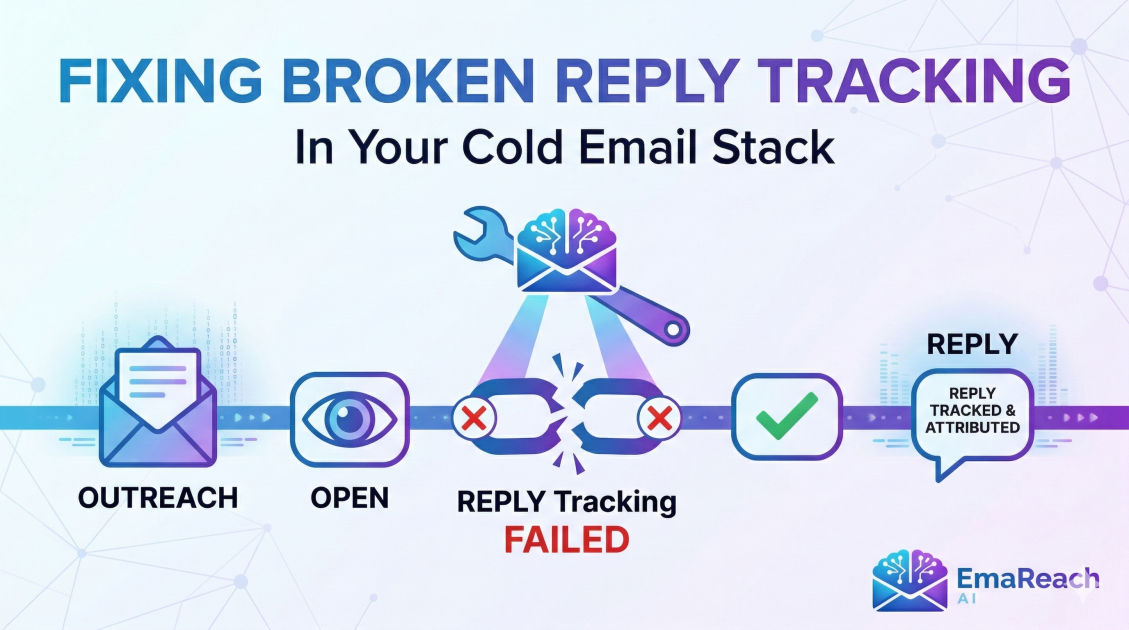
Fixing Broken Reply Tracking in Your Cold Email Stack
cold emailsales automationoutreach strategyemail trackinglead generationcrm integrationemail deliverability
Introduction: The Invisible Leak in Your Outreach Pipeline
You’ve spent weeks perfecting your lead list, refining your value proposition, and setting up a complex web of sending accounts. Your dashboard shows a high open rate, and the 'sent' count is climbing. But there is a silent killer lurking in your cold email stack: broken reply tracking.
When reply tracking fails, the consequences are immediate and compounding. You send automated follow-ups to people who have already said 'yes.' You miss out on hot leads because they never appeared in your CRM. Your deliverability takes a hit because your engagement metrics are skewed. In the high-stakes world of outbound sales, a broken tracking mechanism isn't just a technical glitch; it is a direct hit to your bottom line.
This guide explores why reply tracking breaks, how to diagnose the 'ghost reply' phenomenon, and the technical steps required to build a resilient outreach infrastructure. For those looking to eliminate these headaches entirely, EmaReach offers a streamlined solution. EmaReach AI combines AI-written cold outreach with inbox warm-up and multi-account sending—so your emails land in the primary tab and get replies that are actually tracked.
The Anatomy of a Reply: How Tracking Actually Works
To fix a broken system, you must first understand its mechanics. Most cold email platforms track replies through one of three primary methods:
- IMAP/API Syncing: The software connects directly to your inbox (via Gmail API, Microsoft Graph API, or IMAP) and scans for new messages. If it finds an incoming email from a recipient in an active campaign, it flags it as a reply.
- Tracking Pixels and Headers: Some tools use hidden metadata or 'In-Reply-To' and 'References' headers to link an incoming message back to the original thread.
- Forwarding Rules: In older or more manual setups, users set up a forwarding address that sends a copy of every incoming mail to a tracking hub.
Why These Systems Fail
The failure usually happens at the 'handshake' between your email provider (Google/Outlook) and your sending tool. If the link is severed or the data is misinterpreted, the system assumes no reply was received, and the automation continues its scheduled course.
Common Culprits Behind Broken Tracking
1. API Token Expiration and 'Silent Disconnects'
Most modern stacks rely on OAuth tokens to access your inbox. These tokens can expire or be revoked for various reasons: a password change, a security update from Google Workspace, or a periodic session timeout. When this happens, your sending tool loses its 'eyes' inside your inbox. It can still send (if the SMTP side is separate), but it can no longer see what comes back.
2. Threading and Header Misalignment
When a prospect replies by creating a new thread—rather than hitting 'Reply' on your original message—tracking often breaks. Cold email tools look for specific 'Message-ID' references in the email headers. If the prospect starts a fresh email to you, the 'In-Reply-To' header is missing. The system sees this as a separate event and fails to stop the automated follow-up sequence.
3. Alias and Multi-Inbox Confusion
If you are sending from john@company.com but your prospect replies to info@company.com or an alias, the tracking software might ignore the reply. This is especially common in 'unibox' setups where multiple accounts are aggregated into one view. If the software isn't configured to monitor every specific alias, the reply falls through the cracks.
4. Aggressive Spam Filters and 'False Negatives'
Sometimes, a prospect’s reply is so brief (e.g., "No thanks") that your own corporate spam filter catches it and moves it to the Junk folder. Most tracking tools only monitor the 'Inbox' folder. If the reply never hits the Inbox, the tracker never sees it.
The Technical Fix: A Step-by-Step Audit
Step 1: Re-authenticate All Sending Accounts
The first step in any troubleshooting process is a 'hard reset' of the connection. Navigate to your email service provider settings and revoke the third-party app's access, then re-link it within your cold email tool. This forces a fresh OAuth token and clears any 'silent' permission errors.
Step 2: Configure Global Unsubscribe and 'Stop on Reply' Settings
Check your campaign-level settings. Ensure that the 'Stop sending on reply' toggle is active. Furthermore, check if your tool has a 'Global' setting. If a prospect replies to Campaign A, you usually want them removed from Campaign B as well. If this isn't synced, you’ll appear disorganized and unprofessional.
Step 3: Implement Webhooks for Real-Time Syncing
If you are using a CRM like Salesforce or HubSpot alongside an outreach tool, don't rely on the native integration alone. Set up a Webhook that triggers an action the moment a reply is detected. This creates a secondary log of the reply, ensuring that even if the outreach tool lags, your CRM records the engagement immediately.
Step 4: Folder Monitoring Calibration
If your tool allows it, configure it to monitor the 'All Mail' folder rather than just the 'Inbox.' This ensures that even if an email is archived by a filter or accidentally moved, the tracker still registers the message ID and halts the sequence.
The Human Element: When Prospects 'Break' the System
Technology can only do so much. Human behavior is often the root cause of tracking failures. Here is how to handle the most common 'human-error' scenarios:
- The Forwarded Reply: A prospect forwards your email to a colleague, and the colleague replies. Since the colleague’s email address isn't in your database, the tracker doesn't know who they are.
- Fix: Use 'Domain-level tracking' if your software supports it. This stops sequences for anyone at
@targetcompany.comonce a reply is received from that domain.
- Fix: Use 'Domain-level tracking' if your software supports it. This stops sequences for anyone at
- The 'Out of Office' (OOO) Trap: Automated OOO replies can sometimes be mistaken for actual replies, stopping your sequence prematurely.
- Fix: Enable OOO detection filters. Most premium tools have an AI layer that distinguishes between an auto-responder and a human message.
Advanced Strategies for Redundant Tracking
For high-volume senders, a single point of failure is unacceptable. To build a truly 'bulletproof' stack, consider these redundancies:
Master Inbox Aggregation
Use a specialized 'Unibox' tool that pulls in replies from dozens of secondary domains. By centralizing the incoming flow, you can apply a single set of 'if-then' rules to categorize replies. If a reply is detected here, use a tool like Zapier to 'search and destroy' any active sequences for that lead across your entire stack.
Header Injection
Some advanced users inject custom tracking IDs into the 'Reply-To' field or hidden headers. While this can occasionally impact deliverability if done incorrectly, it provides a unique fingerprint for every outgoing message, making it nearly impossible for a reply to go untracked if the prospect hits 'Reply.'
Sentiment Analysis for Reply Categorization
Not all replies are created equal. A 'Remove me' is a reply, but so is a 'Let's talk.' Fixing your tracking means more than just stopping a sequence; it means routing the lead correctly. Use AI-driven sentiment analysis to tag replies as 'Positive,' 'Neutral,' or 'Negative.' This allows your sales team to prioritize their morning based on intent rather than just chronologically.
Ensuring Future Scalability
As your outreach grows from 100 emails a day to 5,000, the manual overhead of 'checking if the tracker worked' becomes impossible. This is why infrastructure is the most important part of your cold email strategy.
Reliable tracking starts with reliable delivery. If your emails are landing in the spam folder, the 'replies' you get (if any) are often from bots or filters testing links, which can confuse your tracking data. This is where EmaReach excels. By ensuring your emails land in the primary tab through sophisticated warm-up and AI-optimized content, EmaReach minimizes the 'noise' and ensures that the engagement you see is legitimate and trackable.
The Checklist for a Healthy Tracking Stack:
- Daily Connection Checks: Automated alerts for disconnected IMAP/API accounts.
- Domain-Wide Suppression: Ensuring a reply to one team member stops sequences from all team members.
- Cross-Platform Sync: Real-time data flow between the sending tool, the CRM, and the master inbox.
- Regular Header Audits: Testing your own sequences to ensure 'In-Reply-To' headers are functioning.
Conclusion: Turning Technical Stability into Revenue
Fixing broken reply tracking is not just a 'tech task'—it is a foundational element of lead generation. Every time a sequence continues after a prospect has replied, you lose a piece of your brand's credibility. Conversely, every time a reply is missed, you lose a potential customer.
By auditing your API connections, monitoring the right folders, and accounting for human behavior through domain-level tracking, you turn your cold email stack from a leaky bucket into a streamlined revenue engine. High-performance outreach requires a blend of great copy, clean data, and a technical infrastructure that doesn't fail when the replies start rolling in.
EmaReach AI
Ready to scale your cold email outreach?
Join thousands of teams using EmaReach AI for AI-powered campaigns, domain warmup, and 95%+ deliverability. Start free — no credit card required.
Related posts
- Read article
The Instantly Alternative That Finally Gets Outbound Analytics Right
Discover why high-volume cold email requires a shift from surface-level vanity metrics to deep, data-driven revenue attribution, and explore the ultimate alternatives for mastering outbound engineering.
- Read article
What You Gain and What You Give Up When Switching From Instantly
Thinking about migrating your cold email stack? This detailed guide breaks down the exact operational advantages you gain and the core features you sacrifice when switching away from Instantly's popular outreach platform.