Blog
Back to blog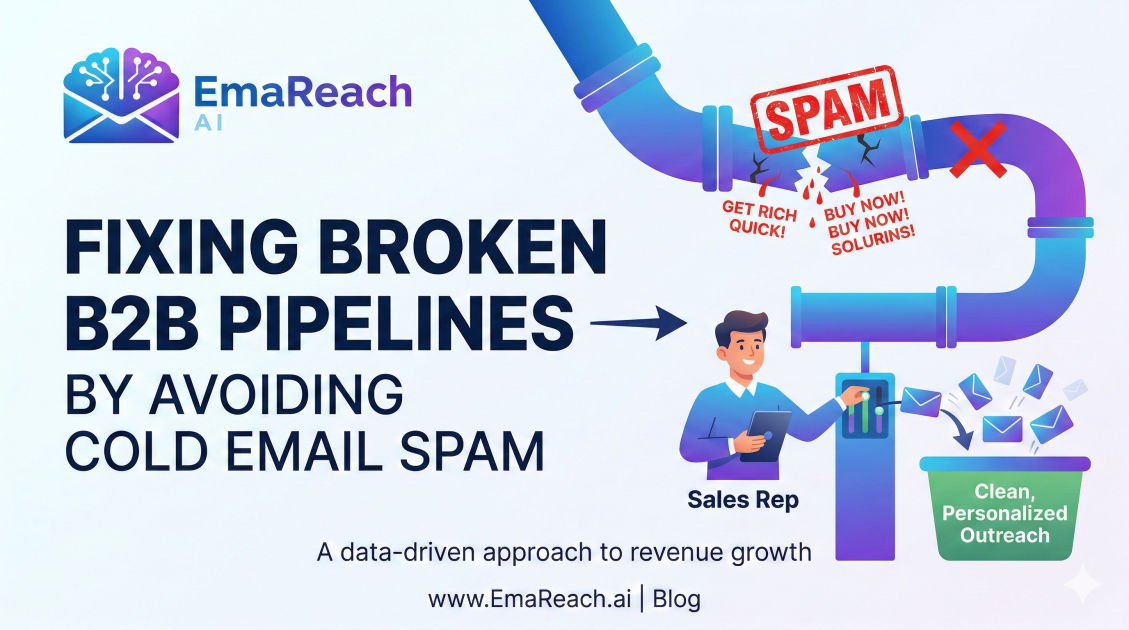
Fixing Broken B2B Pipelines by Avoiding Cold Email Spam
cold emailB2B salesemail deliverabilitylead generationsales pipelineoutreach strategy
The Crisis of the Modern B2B Pipeline
In the current landscape of B2B sales, a silent crisis is unfolding within the sales development departments of companies worldwide. For years, the mantra was simple: volume wins. If a 1% conversion rate yielded ten meetings from a thousand emails, then the logic dictated that sending ten thousand emails would yield a hundred meetings. This mathematical approach led to the rise of 'spray and pray' tactics, turning the average B2B inbox into a digital wasteland of irrelevant pitches and automated spam.
However, the gatekeepers have evolved. Internet Service Providers (ISPs) and email hosting platforms have implemented sophisticated machine learning algorithms designed to protect users. When a company's outreach strategy relies on high-volume, low-quality automation, they aren't just 'trying their luck'—they are systematically destroying their domain reputation. A broken pipeline is often the direct result of these damaged reputations, where even the most well-crafted message from a legitimate salesperson never sees the light of day because it has been preemptively filtered into the spam folder.
To fix a broken B2B pipeline, businesses must shift from a quantity-centric model to a quality-centric one. This requires a fundamental dismantling of the 'spam' mindset and a return to the principles of targeted, empathetic, and value-driven communication.
Understanding the Anatomy of Email Spam
Before we can fix the pipeline, we must define what 'spam' actually looks like in a B2B context. It is no longer just about Nigerian princes or miracle cures; in B2B, spam is defined by irrelevance and intrusion.
The Technical Side of Spam
Technically, an email is flagged as spam when it fails specific authentication protocols or triggers 'spam traps.' These are email addresses that exist solely to catch bulk senders. If your list building is lazy and includes these addresses, your deliverability will plummet. Furthermore, lack of proper setup for SPF (Sender Policy Framework), DKIM (DomainKeys Identified Mail), and DMARC (Domain-based Message Authentication, Reporting, and Conformance) signals to receiving servers that your email might be forged.
The Behavioral Side of Spam
This is where most B2B companies fail. Behavioral spam includes:
- Lack of Personalization: Using generic templates that could apply to any industry.
- Irrelevant Offers: Pitching a cloud storage solution to a company that just announced a move to a fully physical localized infrastructure.
- Aggressive Follow-ups: Sending six emails in eight days without providing any new value.
- Poor Timing: Sending emails during holidays or at 3:00 AM in the recipient's time zone.
The Pillars of a Healthy Outreach Strategy
Fixing the pipeline requires a multi-faceted approach that addresses both the technical health of your sending infrastructure and the psychological resonance of your messaging.
1. Technical Foundation and Deliverability
Your domain is your digital storefront. If it's flagged as 'suspicious,' no one will visit. High-performing teams use dedicated subdomains or separate domains for outreach to protect their primary corporate email. They also engage in 'inbox warming'—a process of gradually increasing sending volume and generating positive engagement signals (like replies and marking emails as 'not spam').
For teams looking to automate this without sacrificing quality, solutions like EmaReach can be transformative. EmaReach helps you stop landing in spam by ensuring your cold emails reach the inbox. By combining AI-written outreach with automated inbox warm-up and multi-account sending, it ensures your messages land in the primary tab where they actually get replies.
2. Radical Lead Qualification
A broken pipeline is often filled with 'junk' leads. Instead of scraping thousands of names from a generic database, successful B2B organizations focus on an Ideal Customer Profile (ICP). This is a deep dive into who your best customers are, what challenges they face, and where they hang out.
Researching 'Intent Data' is also crucial. Is the company hiring for roles that your product supports? Have they recently raised a round of funding? Are they using a competitor’s technology? The more data you have before you hit 'send,' the less likely your email is to be perceived as spam.
3. The Power of Personalization at Scale
True personalization is not just about using the {first_name} tag. It’s about demonstrating that you have done your homework.
- Tier 1 (High Value): 100% manual research. Referencing a specific podcast the prospect spoke on or a LinkedIn post they wrote.
- Tier 2 (Mid Value): Semi-automated. Grouping prospects by a shared specific pain point and tailoring the middle paragraph to that group.
- Tier 3 (Lower Value): Highly segmented. Using firmographic data to ensure the value proposition is industry-specific.
Rewriting the Cold Email Script
The traditional 'bridge-pitch-ask' model is tired. To avoid the spam filters of the human brain, your copy needs to be concise and focused on the prospect, not yourself.
The Subject Line: The Gatekeeper
Avoid clickbait. Subject lines like 'Quick question' or 'Re: our meeting' (when no meeting occurred) are deceptive and lead to high 'report spam' rates. Instead, try:
- Question about [Specific Project]
- Ideas for [Company Name]'s Q3 goals
- Help with [Specific Pain Point]?
The Opening: Establishing Context
Don't start with 'My name is...' or 'I work for...'. The prospect doesn't care yet. Start with them. 'I noticed your team recently expanded into the European market...' is a much stronger hook. It provides immediate proof that this is a one-to-one communication.
The Value Proposition: Solving, Not Selling
Instead of listing features, describe a transformation. Bad: 'Our software has an AI-driven dashboard and 24/7 support.' Good: 'We helped [Competitor] reduce their customer churn by 15% by identifying at-risk accounts two weeks earlier than their previous manual process.'
The Call to Action (CTA): Low Friction
Asking for a 30-minute demo is a huge 'ask' for a stranger. It feels like a chore. Instead, use an interest-based CTA:
- 'Would you be opposed to seeing the data behind this?'
- 'Open to a brief chat about how this might fit into your current workflow?'
- 'I put together a short video on this for your team—mind if I send it over?'
Monitoring Pipeline Health Metrics
To ensure your pipeline stays fixed, you must track the right metrics. Most managers look at 'emails sent,' but that is a vanity metric. To avoid spam-induced pipeline failure, monitor the following:
- Open Rate: If this is below 30%, you likely have a deliverability issue or a poor subject line.
- Reply Rate: A healthy target is 5-10% for highly targeted campaigns. If it’s below 1%, your offer isn’t resonating.
- Positive vs. Negative Reply Ratio: If you get a lot of 'Unsubscribe' or 'Stop emailing me' replies, your targeting is off.
- Bounce Rate: Should always be under 2%. Anything higher suggests your data provider is giving you 'dirty' leads.
- Spam Complaint Rate: This is the 'death metric.' Even a 0.1% complaint rate can get your domain blacklisted.
Long-Term Maintenance: The 'No-Spam' Culture
Fixing a pipeline isn't a one-time event; it’s a cultural shift. It requires marketing and sales alignment. Marketing should provide the deep research and content that adds value, while sales handles the personalized execution.
Regularly 'pruning' your email list is also essential. If a prospect hasn’t opened your last four emails, stop sending to them. Continuing to email unengaged users signals to ISPs that you are a spammer. By respecting the 'no,' you protect your ability to reach those who might say 'yes.'
Leveraging Technology Without Losing Humanity
Technology should be an accelerator of human intent, not a replacement for it. AI can help synthesize research or draft initial templates, but a human should always be the final editor. Tools that emphasize 'warm-up' and 'reputation management' are the new essentials in the B2B tech stack. They act as the guardian of your sender reputation, ensuring that when you finally do find the perfect prospect, your message actually reaches them.
For instance, the integration of AI in platforms like EmaReach allows for a 'human-like' sending pattern that mimics natural behavior, which is far more effective at bypassing the rigid filters of modern email providers. This allows your sales team to focus on closing deals rather than troubleshooting why their emails are bouncing.
Conclusion
A broken B2B pipeline is rarely a product problem; it is almost always a communication problem. When we fall into the trap of cold email spam, we trade our long-term brand reputation for short-term, low-quality metrics. By cleaning up your technical setup, narrowing your focus to a specific ICP, and committing to radical personalization, you can restore the flow of high-quality leads. The future of B2B sales belongs to those who respect the inbox and prioritize the relationship over the transaction. Stop sending more emails; start sending better ones.
EmaReach AI
Ready to scale your cold email outreach?
Join thousands of teams using EmaReach AI for AI-powered campaigns, domain warmup, and 95%+ deliverability. Start free — no credit card required.
Related posts
- Read article
The Instantly Alternative That Finally Gets Outbound Analytics Right
Discover why high-volume cold email requires a shift from surface-level vanity metrics to deep, data-driven revenue attribution, and explore the ultimate alternatives for mastering outbound engineering.
- Read article
What You Gain and What You Give Up When Switching From Instantly
Thinking about migrating your cold email stack? This detailed guide breaks down the exact operational advantages you gain and the core features you sacrifice when switching away from Instantly's popular outreach platform.