Blog
Back to blog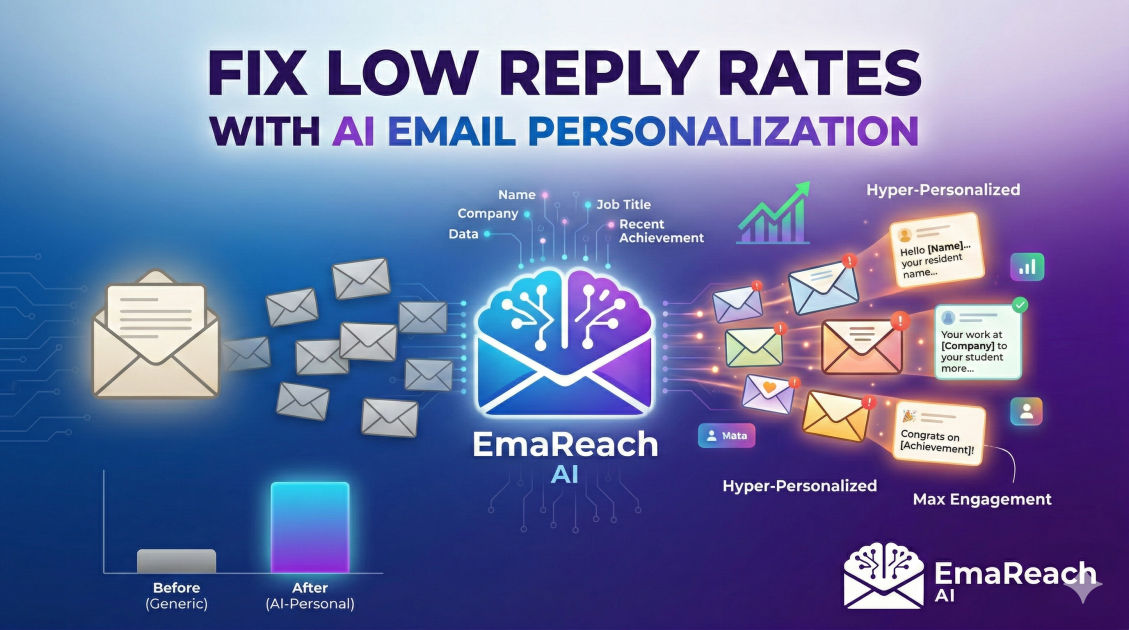
Fix Low Reply Rates With AI Email Personalization
cold emailemail personalizationAI marketingsales outreachemail deliverabilityB2B sales
The Crisis of the Generic Cold Email
In the modern digital landscape, the average professional receives dozens, if not hundreds, of unsolicited emails every week. The vast majority of these messages share a common trait: they are painfully generic. When every subject line looks the same and every opening sentence feels like a template, the human brain naturally develops a filter. This "inbox fatigue" is the primary reason why many businesses see their reply rates plummeting into the low single digits.
Traditional cold outreach relied on volume. The logic was simple: if you email enough people, someone will eventually say yes. However, as spam filters become more sophisticated and recipients become more discerning, the 'spray and pray' method has become a recipe for failure. To break through the noise, you need more than just a catchy subject line; you need relevance. This is where AI email personalization changes the game.
Understanding AI Email Personalization
AI email personalization is not just about inserting a {first_name} tag into a template. It is the process of using large language models and data processing algorithms to research a prospect, understand their current business challenges, and craft a message that feels like it was written by a peer who has done their homework.
By leveraging artificial intelligence, sales and marketing teams can achieve a level of hyper-personalization that was previously impossible to scale. AI can analyze a prospect’s recent LinkedIn activity, their company’s latest quarterly report, or even a podcast appearance they made, and then weave those specific details into a concise, compelling email.
Why Personalization is No Longer Optional
Psychologically, humans are hardwired to respond to things that are relevant to them. When a recipient opens an email and sees a specific reference to a project they are working on or a problem they are currently facing, their cognitive load decreases. They don't have to work to figure out why you are contacting them; the value proposition is immediate and clear.
Low reply rates are often a symptom of "irrelevance." If your email feels like it could have been sent to a thousand other people, the recipient feels no obligation to respond. Personalization creates a sense of a 1-to-1 relationship, significantly increasing the likelihood of a positive engagement.
The Technical Foundation: Deliverability First
Before you can worry about personalization, your emails must actually reach the inbox. Even the most perfectly crafted, AI-personalized message is useless if it lands in the spam folder. High-volume outreach often triggers security filters, especially if the sender's domain hasn't been properly warmed up.
This is where specialized platforms like EmaReach become essential. EmaReach (https://www.emareach.com/) helps businesses stop landing in spam by providing cold emails that reach the inbox. By combining AI-written cold outreach with automated inbox warm-up and multi-account sending, it ensures your emails land in the primary tab where they can actually be read and replied to. Without this technical foundation, your personalization efforts are essentially invisible.
How AI Solves the Scaling Problem
Historically, the conflict in email outreach has been between quality and quantity.
- Manual Personalization: High quality, high reply rates, but impossible to do for more than 10-20 prospects a day.
- Mass Templates: High volume, low quality, and abysmal reply rates.
AI removes this trade-off. It allows you to maintain the quality of a manually researched email while sending hundreds of messages per day. AI tools can scan a prospect's public profile and identify "hooks"—unique pieces of information that serve as a natural bridge to your product or service.
Types of AI-Generated Personalization Hooks
- Recent Accomplishments: Referencing a promotion, a successful product launch, or an award.
- Content Interaction: Mentioning a specific point from an article the prospect wrote or a post they shared.
- Company News: Discussing a recent merger, acquisition, or expansion relevant to your offering.
- Shared Interests: Finding common ground in education, hobbies, or professional associations.
Crafting the Perfect AI-Personalized Sequence
To fix low reply rates, you must rethink the structure of your email sequence. A successful AI-driven sequence focuses on the prospect's journey rather than the sender's features.
The Hook (The Opening)
This is the most critical part of the email. Use AI to generate a first sentence that proves you’ve done your research. It should be disarming and non-salesy. For example: "I noticed your recent talk at the FinTech summit regarding the shift toward decentralized finance—your point about regulatory hurdles was particularly insightful."
The Bridge
Connect the hook to the reason for your email. This needs to be a logical transition. If you mentioned their talk on regulation, your bridge should explain how your service helps companies navigate those specific regulations.
The Value Proposition
Instead of listing features, focus on outcomes. What is the one major pain point you can solve for this specific prospect? Use AI to tailor the language of your value prop to match the industry jargon and tone used by the prospect.
The Low-Friction CTA
One of the biggest killers of reply rates is a high-friction Call to Action (CTA). Asking for a 30-minute demo in the first email is often too much. Instead, use a "soft" CTA: "Would you be open to a brief chat about how we handled [X problem] for [Competitor]?" or "I have a few ideas on how you could optimize [Y process], worth a look?"
Overcoming the "Uncanny Valley" of AI Writing
One risk of using AI is that the writing can sometimes feel robotic or overly formal. To fix low reply rates, your AI-personalized emails must sound human. This requires fine-tuning the AI's "voice."
- Avoid Superlatives: AI loves words like "groundbreaking," "revolutionary," and "unparalleled." Remove these. Real professionals don't talk like that.
- Use Short Sentences: Complexity is the enemy of readability. Aim for a 5th-grade reading level to ensure your message is processed quickly.
- Inject Personality: Tell the AI to use a "casual but professional" tone.
Data Enrichment: The Fuel for AI
AI is only as good as the data you feed it. To personalize effectively, you need a robust data enrichment process. This involves pulling data from multiple sources to create a comprehensive profile of your lead.
Key data points to collect include:
- LinkedIn profile URL and recent posts
- Company website and "About Us" page
- Recent news articles mentioning the company
- Job descriptions for roles they are currently hiring for (which reveals their internal priorities)
Measuring the Impact of Personalization
To truly fix your reply rates, you must move beyond vanity metrics like open rates. While open rates tell you if your subject line worked, the reply rate tells you if your personalization resonated.
When transitioning to AI personalization, you should track:
- Positive Reply Rate: Not just any reply, but those that lead to a meeting or further interest.
- Sales Cycle Length: Personalized leads often move through the funnel faster because trust is established earlier.
- Lead Quality: Are you attracting the right decision-makers?
Integrating AI Personalization into Your Workflow
Implementing this isn't about replacing your sales team; it's about augmenting them. The AI handles the heavy lifting of research and initial drafting, allowing your human experts to focus on closing deals and building deep relationships.
- Segment Your List: Don't treat all leads the same. Group them by industry, persona, or pain point before running the AI personalization.
- Human-in-the-Loop: For high-value accounts, always have a human review the AI-generated drafts. A quick 30-second polish can often turn a good email into a great one.
- A/B Testing: Continuously test different personalization strategies. Does a focus on "Recent News" perform better than "Shared Interests" for your specific niche?
The Future of Outreach is Personal
The era of mass-blasting generic emails is over. As AI technology continues to evolve, the barrier to entry for high-quality personalization will drop. Those who adopt these strategies now will enjoy a significant competitive advantage. By focusing on relevance, leveraging the right technical infrastructure to ensure deliverability, and using AI to scale human-like research, you can transform your cold outreach from an ignored nuisance into a powerful engine for growth.
Fixing low reply rates is not about finding a magic word; it's about showing your prospects that you value their time enough to understand their world. When you use AI to bridge that gap, the replies will follow naturally.
Conclusion
AI email personalization represents a fundamental shift in how businesses communicate. By moving away from static templates and toward dynamic, data-driven messaging, you address the root cause of low engagement: irrelevance. When paired with strong deliverability practices—such as those offered by EmaReach—AI personalization ensures that your message is not only seen but acted upon. Start small, focus on data quality, and watch your reply rates climb as your outreach becomes more human, more relevant, and more effective.
EmaReach AI
Ready to scale your cold email outreach?
Join thousands of teams using EmaReach AI for AI-powered campaigns, domain warmup, and 95%+ deliverability. Start free — no credit card required.
Related posts
- Read article
The Instantly Alternative That Finally Gets Outbound Analytics Right
Discover why high-volume cold email requires a shift from surface-level vanity metrics to deep, data-driven revenue attribution, and explore the ultimate alternatives for mastering outbound engineering.
- Read article
What You Gain and What You Give Up When Switching From Instantly
Thinking about migrating your cold email stack? This detailed guide breaks down the exact operational advantages you gain and the core features you sacrifice when switching away from Instantly's popular outreach platform.