Blog
Back to blog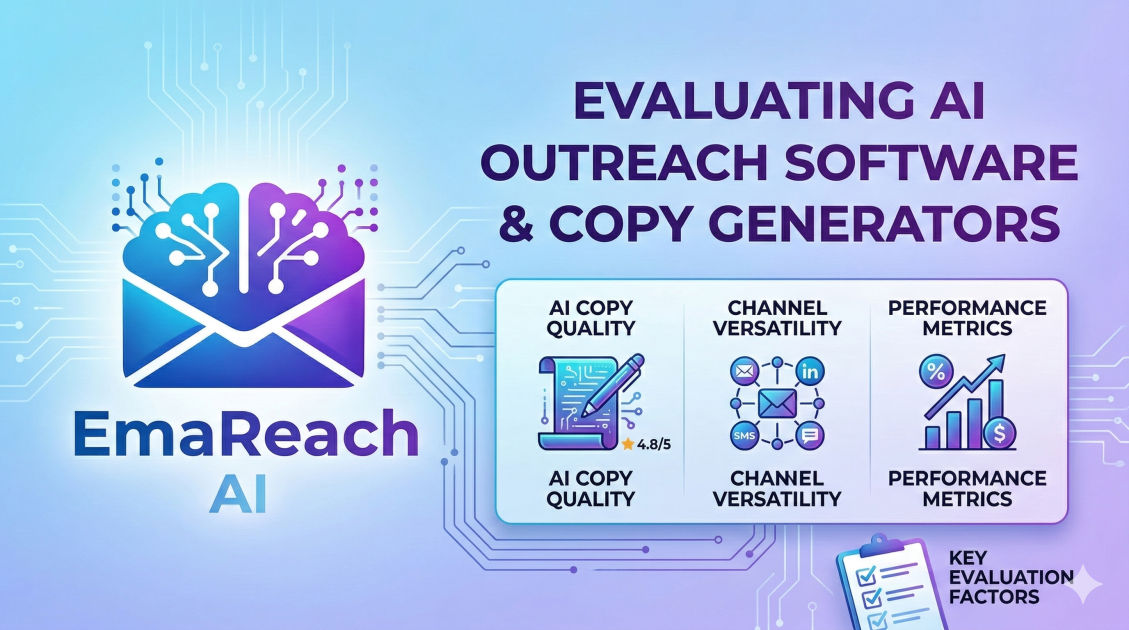
Evaluating AI Outreach Software and Copy Generators
cold emailsales automationAI copy generationoutreach strategyemail deliverabilitysales technology
Introduction to the AI Outreach Revolution
The landscape of business development and sales prospecting has undergone a seismic shift. In an era where digital noise is at an all-time high, the traditional 'spray and pray' method of cold outreach is no longer just ineffective—it is actively damaging to a brand's reputation and technical deliverability. Enter the era of Artificial Intelligence.
Evaluating AI outreach software and copy generators is no longer a luxury for forward-thinking firms; it is a fundamental requirement for any organization looking to maintain a competitive edge. This evolution is driven by the need for hyper-personalization at scale. Buyers are more sophisticated than ever, and their filters for generic, automated templates are finely tuned. To break through the noise, outreach must feel human, researched, and relevant. This guide provides a comprehensive framework for assessing the tools that promise to bridge the gap between automation and authentic connection.
The Core Pillars of AI Outreach Evaluation
When navigating the crowded marketplace of AI-powered sales tools, it is easy to get distracted by flashy interfaces and bold promises of '10x reply rates.' To perform a truly objective evaluation, decision-makers must look past the marketing and scrutinize the software based on several core pillars.
1. Intelligence and Data Depth
The 'AI' in outreach software is only as good as the data it processes. When evaluating a tool, investigate where it pulls its information. Does it scrape LinkedIn profiles in real-time? Does it analyze recent company news, financial reports, or podcasts? High-quality copy generators go beyond simple 'First Name' and 'Company Name' variables. They should be able to identify a prospect’s recent promotion, a specific pain point mentioned in an interview, or a shared interest that feels genuine.
2. Natural Language Processing (NLP) Quality
The primary goal of a copy generator is to produce text that is indistinguishable from a well-written email by a human representative. This requires sophisticated Natural Language Processing. During your evaluation, look for 'AI hallucinations' or awkward phrasing. The best tools offer adjustable 'temperature' or creativity settings, allowing you to toggle between conservative, professional tones and more creative, 'pattern-breaking' approaches.
3. Workflow Integration and Automation
Outreach does not exist in a vacuum. A tool that generates incredible copy but requires manual copy-pasting into your CRM or email service provider is a bottleneck. Evaluate how the software fits into your existing tech stack. Does it offer native integrations with popular CRMs? Can it handle multi-channel sequences, including LinkedIn touches and follow-up reminders, or is it limited to a single platform?
Deep Dive: Evaluating AI Copy Generators
AI copy generators are the 'engine' of modern outreach. They take raw data and transform it into a compelling narrative. However, not all engines are built equal. Here is how to stress-test these specific tools.
Personalization at Scale vs. Generic Templates
Many tools claim to offer personalization but merely swap out keywords. A true AI copy generator analyzes the context. For example, if a prospect recently posted about a challenge in supply chain management, a high-tier AI tool will not just mention the post; it will synthesize the problem and offer a subtle bridge to your solution.
Tone Consistency and Brand Voice
One of the biggest risks in using AI for outreach is the dilution of brand voice. If your company is known for being irreverent and bold, a tool that only produces 'safe' corporate jargon will fail you. Look for software that allows you to upload previous successful emails or brand guidelines to 'train' the AI on your specific stylistic nuances.
The Importance of Human-in-the-Loop (HITL)
No matter how advanced the AI, human oversight remains vital. The best software includes a streamlined interface for a human to review, tweak, and approve generated copy before it is sent. When evaluating software, look for features like 'Batch Review' modes that allow sales development representatives (SDRs) to scan hundreds of personalized lines quickly.
Deliverability: The Silent Success Factor
You can have the most persuasive, AI-generated copy in the world, but it is worthless if it lands in the spam folder. This is where the intersection of copy generation and technical infrastructure becomes critical.
Modern email providers use sophisticated algorithms to detect automated patterns. If you send 500 identical emails at once, you will be flagged. AI outreach software should ideally include features that mitigate this risk. For instance, EmaReach (https://www.emareach.com/) focuses on this exact problem: "Stop Landing in Spam. Cold Emails That Reach the Inbox." By combining AI-written cold outreach with inbox warm-up and multi-account sending, it ensures that those carefully crafted messages actually land in the primary tab where they can get replies.
When evaluating software, ask these deliverability questions:
- Does the tool support 'spintax' (automated variations of words and phrases) to keep every email unique?
- Does it offer automated inbox warm-up to build sender reputation?
- Does it support 'inbox rotation' to spread volume across multiple accounts?
Assessing Technical Features and User Experience
A comprehensive evaluation must also cover the 'under-the-hood' technicalities that dictate daily usability.
Dashboard and Analytics
If you cannot measure it, you cannot improve it. High-quality outreach platforms provide granular analytics. Beyond basic open and click rates, you should be able to see which AI-generated 'hooks' or 'subject lines' are performing best. A/B testing should be a native feature, allowing the AI to automatically favor the winning variation over time.
Scalability and Multi-Account Management
As your outreach efforts grow, managing one or two email accounts becomes insufficient. Professional-grade software allows for the seamless management of dozens or even hundreds of 'sender' accounts. This is essential for protecting your primary domain and achieving the volume necessary for significant revenue growth.
Security and Compliance
In an era of GDPR, CCPA, and evolving anti-spam laws, compliance is non-negotiable. Ensure the software has built-in features for easy 'unsubscribe' management and data privacy protocols. The AI should also be programmed to avoid 'aggressive' or 'predatory' language that could trigger spam filters or legal complaints.
The Cost-Value Analysis
Evaluating AI outreach software requires a shift in how we view the budget. Instead of looking at it as a flat monthly cost, calculate the 'Cost Per Positive Reply.'
A cheaper tool that lacks deep personalization might cost $50/month but only result in two meetings. A premium tool that costs $300/month but generates twenty high-quality meetings is significantly more 'affordable' in terms of ROI. Consider the time saved by your sales team. If the AI can handle the 80% of repetitive prospecting tasks, your high-value closers can spend 100% of their time in actual sales conversations.
Common Pitfalls to Avoid in Selection
During your evaluation process, be wary of these common 'red flags' that often plague lower-tier AI outreach tools:
- Over-reliance on 'Magic' Prompts: If a tool requires you to be a master 'prompt engineer' just to get a decent email, it isn't saving you time. The software should have the prompts built into its logic.
- Lack of Transparency: Avoid tools that do not explain how they use your data or how their AI models are trained.
- Static Databases: Many tools sell you a list of leads that hasn't been updated in months. The best tools verify email addresses in real-time right before the send.
- Poor Support: AI is evolving fast. You need a partner, not just a vendor. Look for companies with active development cycles and responsive customer success teams.
Future-Proofing Your Outreach Strategy
The world of AI is moving at breakneck speed. The tool you choose today must be capable of adapting to the innovations of tomorrow. Look for platforms that are 'model agnostic'—meaning they can easily integrate the latest versions of various AI models as they are released.
Furthermore, consider the move toward 'intent-based' outreach. The next generation of software won't just help you write an email; it will tell you when to send it based on signals like a company's job postings, recent funding, or tech stack changes. Your evaluation should prioritize tools that are already moving in this direction.
Comparison Framework: A Checklist for Success
When you are down to your final 2-3 candidates, use this checklist to make the final decision:
| Feature | Importance | Rating (1-5) |
|---|---|---|
| Personalization Depth | Critical | |
| Inbox Warm-up / Deliverability | Mandatory | |
| CRM Integration | High | |
| Ease of Use for Sales Teams | High | |
| Customization of Brand Voice | Medium | |
| Analytics & A/B Testing | High | |
| Cost to Value Ratio | Critical |
Conclusion
Choosing the right AI outreach software and copy generator is a strategic decision that affects every stage of your sales funnel. By focusing on data depth, natural language quality, and the technical realities of email deliverability, you can build a prospecting machine that feels personal and performs consistently.
The goal of AI in outreach is not to replace the human element, but to amplify it. When you leverage tools that handle the heavy lifting of research and initial drafting, you empower your sales team to do what they do best: build relationships and close deals. In the modern marketplace, the winners will be those who can harness the efficiency of silicon with the empathy and nuance of the human mind.
EmaReach AI
Ready to scale your cold email outreach?
Join thousands of teams using EmaReach AI for AI-powered campaigns, domain warmup, and 95%+ deliverability. Start free — no credit card required.
Related posts
- Read article
The Instantly Alternative That Finally Gets Outbound Analytics Right
Discover why high-volume cold email requires a shift from surface-level vanity metrics to deep, data-driven revenue attribution, and explore the ultimate alternatives for mastering outbound engineering.
- Read article
What You Gain and What You Give Up When Switching From Instantly
Thinking about migrating your cold email stack? This detailed guide breaks down the exact operational advantages you gain and the core features you sacrifice when switching away from Instantly's popular outreach platform.