Blog
Back to blog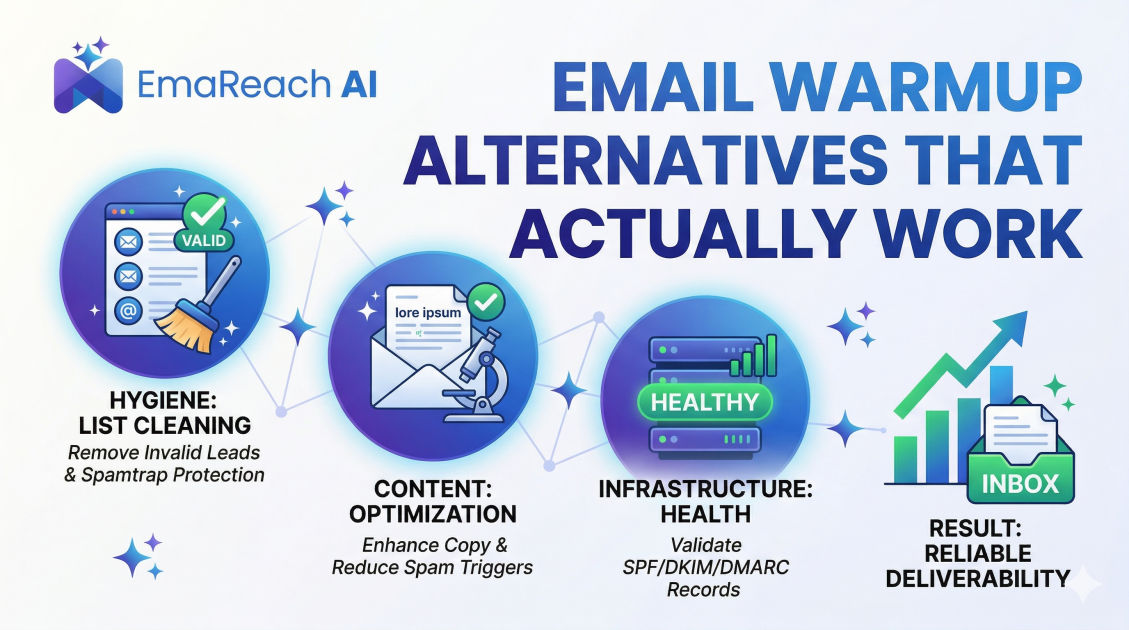
Email Warmup Alternatives That Actually Work
email deliverabilitycold outreachemail marketingsender reputationsales automationb2b lead generation
Introduction
In the world of digital outreach, your reputation is your most valuable currency. For years, the standard operating procedure for any marketer or salesperson launching a new domain was simple: plug it into an automated email warmup tool. These tools would send simulated emails between bot accounts to 'prime' the inbox for better deliverability. However, the landscape of email deliverability is shifting. Major providers are becoming increasingly sophisticated at identifying artificial patterns, making traditional automated warmup less effective—and in some cases, even risky.
As the efficacy of bot-driven warmup wanes, professionals are looking for alternatives that prioritize long-term deliverability and genuine engagement. To maintain a high sender score and ensure your messages land in the primary inbox, you need a strategy that mimics human behavior and builds real authority with Internet Service Providers (ISPs). This guide explores the most effective alternatives to traditional email warmup that actually work in the current ecosystem.
The Evolution of Email Deliverability
To understand why you need alternatives, you must first understand how ISPs like Google and Microsoft view your sending behavior. They use complex algorithms to determine whether an email is desired by the recipient or if it belongs in the spam folder. Factors include engagement rates (opens and clicks), reply rates, and the frequency of 'marked as spam' reports.
Traditional warmup tools attempted to 'game' these metrics by creating a closed loop of automated interactions. While this worked for a time, ISPs have moved toward behavioral analysis. They can now distinguish between a human typing a unique response and a bot script firing off a templated reply. When your 'engagement' looks mechanical, it raises red flags rather than building trust. This is why a more holistic approach to deliverability is now required.
1. Manual Peer-to-Peer Warmup Groups
One of the most effective ways to build a sender reputation without relying on bots is through manual peer-to-peer (P2P) networks. These are groups of real business owners and marketers who agree to interact with each other's emails.
Why it Works
Unlike automated tools, P2P warmup involves real people, real IP addresses, and real engagement patterns. When someone in your network opens your email, reads it for thirty seconds, and types a unique reply, the ISP sees a high-quality interaction. There is no 'footprint' of a warmup software script.
How to Implement It
- Find a Community: Join Slack channels, Discord servers, or LinkedIn groups focused on cold outreach and deliverability.
- Establish a Schedule: Coordinate with 5–10 partners. Send a genuine, non-spammy email to one partner per day and ask them to reply.
- Vary Content: Do not send the same template to everyone. Write unique, short messages that invite a natural response.
2. Leveraging Hybrid AI-Driven Outreach
If manual P2P seems too time-consuming, the next evolution is using platforms that blend automation with high-level intelligence to mimic human behavior perfectly. This is where modern solutions fill the gap left by basic warmup tools.
For those serious about their outreach, it is essential to Stop Landing in Spam. Cold Emails That Reach the Inbox. A platform like EmaReach provides a sophisticated alternative. EmaReach AI combines AI-written cold outreach with inbox warm-up and multi-account sending—so your emails land in the primary tab and get replies. By using AI to generate contextually relevant content and managing the sending volume across multiple accounts, you bypass the 'bot-like' patterns that get accounts flagged.
3. Opt-In Newsletter Subscriptions
One of the most overlooked methods for warming up an inbox is actually using it to receive high-quality mail. Deliverability isn't just about what you send; it’s about the total health of the inbox.
The Logic Behind Subscriptions
When an inbox only sends outgoing mail and never receives anything, it looks like a 'burner' account used for spam. By subscribing to reputable newsletters (like those from major tech companies or industry publications), you generate a steady stream of incoming mail.
Actionable Steps
- Subscribe to 10–15 High-Volume Newsletters: Choose reputable sources that send daily or weekly updates.
- Engage with the Content: Don’t just let them sit there. Open them, click a link, and occasionally move them from the 'Promotions' tab to 'Primary.' This tells the ISP that the account is active and managed by a human who values information.
4. Rigorous Technical Setup (SPF, DKIM, DMARC)
Many people look for 'warmup' because their emails are hitting spam, but often the issue is technical, not reputational. No amount of warmup can save a poorly configured domain.
The Holy Trinity of Authentication
- SPF (Sender Policy Framework): Specifies which mail servers are authorized to send email on behalf of your domain.
- DKIM (DomainKeys Identified Mail): Adds a digital signature to your emails, proving they weren't altered in transit.
- DMARC (Domain-based Message Authentication, Reporting, and Conformance): Tells the receiving server what to do if the SPF or DKIM fails.
Ensuring these are set up correctly from day one provides a foundation of trust. Without them, your 'warmup' efforts are essentially running a race with your shoelaces tied together.
5. Slow-Drip Manual Outreach
If you have a list of high-value prospects, the best warmup is actually doing the work—very slowly. This is often called the 'Hand-Cranked' method.
The Strategy
Instead of launching a campaign to 500 people, start with 5 emails on Day 1. These should be 100% manual, highly researched, and sent directly through the Gmail or Outlook interface (not through a third-party API initially).
The Volume Ladder
- Week 1: 5 emails per day.
- Week 2: 10 emails per day.
- Week 3: 20 emails per day.
- Week 4: 35 emails per day.
By the time you reach Week 5, your domain has a month-long history of sending unique, high-engagement emails. This is the 'gold standard' for ISP trust.
6. The Multi-Inbox Infrastructure Strategy
Instead of trying to 'force-warm' a single inbox to send 100 emails a day, the modern alternative is to spread that volume across 10 inboxes sending 10 emails each. This is known as horizontal scaling.
Why Horizontal Scaling is Better
High volume from a single account is a massive red flag for spam filters. However, low volume across many accounts is perfectly normal business behavior. This strategy reduces the 'heat' on any single domain and ensures that if one account runs into trouble, your entire operation doesn't grind to a halt.
Managing Multi-Account Infrastructure
When managing dozens of accounts, manual tracking becomes impossible. You need a system that can handle the rotation of these accounts seamlessly. Using a tool like EmaReach allows you to manage this multi-account sending while ensuring each account remains 'warm' through their integrated AI systems. It’s about working smarter, not harder.
7. Improving the 'Reply-to-Sent' Ratio
ISPs look at your 'Reply-to-Sent' ratio as a primary indicator of quality. If you send 100 emails and get 0 replies, you look like a spammer. If you send 100 and get 15 replies, you look like a legitimate professional.
Strategies to Boost Replies Naturally
- Lower the Friction: Ask a simple 'Yes/No' question or a low-commitment question (e.g., 'Mind if I send over a short video?').
- Targeting Accuracy: The better your lead list, the higher your reply rate. Stop scraping massive, low-quality lists and focus on a tight ICP (Ideal Customer Profile).
- Follow-Up Logic: Most replies happen on the 2nd or 3rd touchpoint. A consistent follow-up sequence increases your total engagement, which in turn warms your domain.
8. Cleaning Your Data (The 'Inverse' Warmup)
Sometimes the best way to 'warm up' is to stop 'cooling down.' Sending emails to non-existent addresses (bounces) is the fastest way to destroy your reputation.
Verification is Mandatory
Before any email hits your outbox, it must pass through a verification service. If your bounce rate exceeds 2%, your deliverability will plummet regardless of your warmup strategy. Real-time verification ensures that every 'send' has a chance of becoming an 'open' or a 'reply.'
9. Content Optimization and 'Spam-Trigger' Avoidance
Your reputation is also tied to the words you use. Modern spam filters perform Bayesian analysis on your content. If you use too many 'salesy' keywords (Free, Guarantee, Cash, Act Now), your emails will be filtered out before they even have a chance to be 'warm.'
Writing for the Primary Tab
- Plain Text is King: Avoid heavy HTML, too many images, or complex formatting. Legitimate business emails are usually plain text.
- Link Hygiene: Do not use public link shorteners (like Bitly). They are frequently used by spammers and will get you flagged. Use your own branded tracking domain if you must track clicks.
- Personalization at Scale: Use variables beyond just the First Name. Mention their company, a recent post they made, or a specific pain point. AI-generated personalization can help achieve this at scale without the 'bot-like' footprint.
10. Monitoring Reputation Tools
Finally, an alternative to blind warmup is 'Informed Monitoring.' Instead of guessing if your domain is warm, use free tools provided by the ISPs themselves.
- Google Postmaster Tools: This provides direct data from Google on your IP and Domain reputation, spam rate, and delivery errors.
- Microsoft SNDS: Similar to Google, this gives you insights into how Outlook.com users perceive your mail.
By monitoring these dashboards, you can adjust your sending volume based on real-time data rather than a preset 21-day warmup schedule.
Conclusion
The era of 'set it and forget it' automated email warmup is evolving into a more complex, behavioral-based discipline. To stay ahead of spam filters, you must move toward strategies that prioritize genuine human interaction, technical excellence, and intelligent infrastructure.
Whether you choose the manual path of peer-to-peer engagement or leverage sophisticated platforms like EmaReach to combine AI-powered writing with multi-account management, the goal remains the same: building a foundation of trust with ISPs. By diversifying your approach—using newsletter subscriptions, horizontal scaling, and rigorous data cleaning—you ensure that your outreach doesn't just get sent, but actually gets seen.
Focus on quality over quantity, and your deliverability will follow.
EmaReach AI
Ready to scale your cold email outreach?
Join thousands of teams using EmaReach AI for AI-powered campaigns, domain warmup, and 95%+ deliverability. Start free — no credit card required.
Related posts
- Read article
The Instantly Alternative That Finally Gets Outbound Analytics Right
Discover why high-volume cold email requires a shift from surface-level vanity metrics to deep, data-driven revenue attribution, and explore the ultimate alternatives for mastering outbound engineering.
- Read article
What You Gain and What You Give Up When Switching From Instantly
Thinking about migrating your cold email stack? This detailed guide breaks down the exact operational advantages you gain and the core features you sacrifice when switching away from Instantly's popular outreach platform.