Blog
Back to blog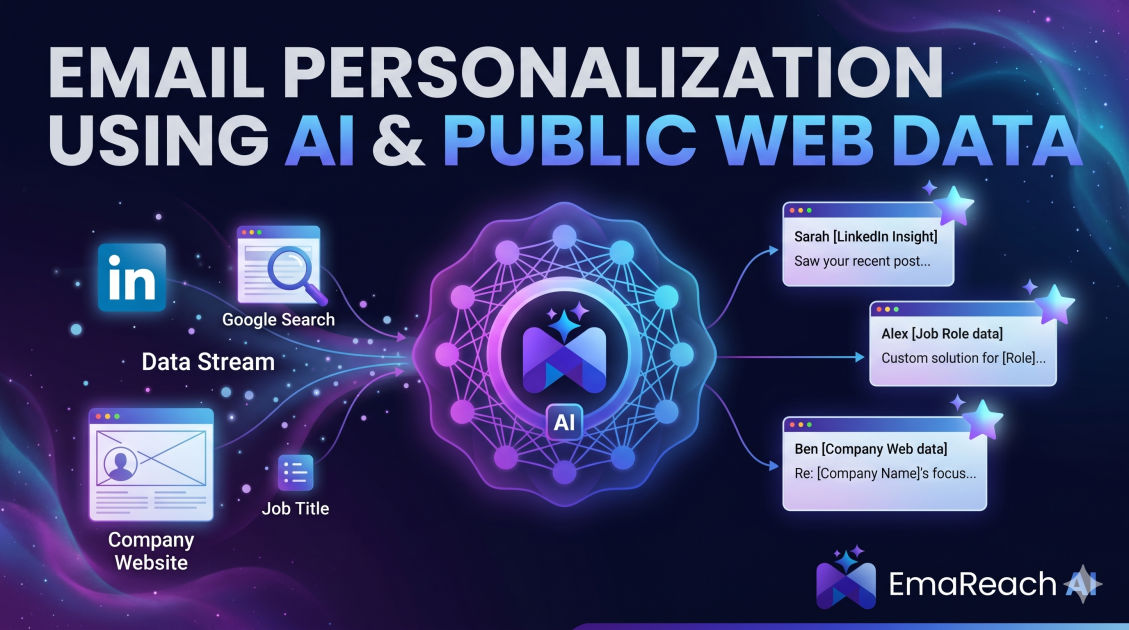
Email Personalization Using AI and Public Web Data
AI MarketingEmail PersonalizationCold OutreachLead GenerationData ScrapingSales AutomationEmail Deliverability
The Evolution of Outreach: From Templates to Hyper-Personalization
In the early days of digital marketing, the mere ability to address a recipient by their first name was considered cutting-edge. Today, the digital landscape is saturated. Business professionals receive hundreds of emails daily, and the human brain has become remarkably adept at filtering out generic marketing noise. The "Hi {First_Name}" approach is no longer a differentiator; it is the bare minimum. To truly capture attention and drive engagement, modern outreach must leverage the convergence of two powerful forces: Artificial Intelligence and Public Web Data.
Hyper-personalization is the process of using data to create deeply relevant, one-to-one communication. By tapping into the vast amount of information available on the public web—from LinkedIn profiles and company news to social media activity and technical documentation—AI can synthesize unique insights that make an email feel like it was written by a close colleague rather than a marketing algorithm.
The Role of Public Web Data in Modern Sales
Public web data is the raw fuel for AI-driven personalization. It provides the context that traditional CRM data lacks. While a CRM might tell you a prospect's job title and industry, the public web reveals their recent accomplishments, their shared thoughts on industry trends, and the specific challenges their company is currently facing.
Types of High-Value Public Data
- Professional Profiles: Platforms like LinkedIn and X (formerly Twitter) offer insights into a lead's career trajectory, skills, and endorsements.
- Company News and PR: Press releases, funding announcements, and product launches provide perfect "hooks" for starting a conversation.
- Social Media Activity: Posts, comments, and shares reveal what topics a prospect is passionate about or currently researching.
- Job Postings: A company's open roles are a direct window into their internal priorities and technical gaps.
- Technographic Data: Information about the software stack a company uses can help tailor a pitch to complement their existing tools.
By systematically gathering this data, businesses can move away from "spraying and praying" and toward a strategic, data-backed outreach model.
How AI Transforms Data into Conversational Gold
Having access to data is only half the battle. The real challenge lies in processing that data at scale. This is where Large Language Models (LLMs) and specialized AI agents come into play. AI acts as a researcher and copywriter rolled into one, performing tasks that would take a human hours in just a few seconds.
Scrape, Synthesize, and Script
AI workflows for email personalization typically follow a three-step process. First, automated tools crawl the web for specific data points related to a lead. Second, the AI synthesizes this unstructured data, identifying common themes or significant events. Third, the AI generates a customized opening line or a specific value proposition based on those findings.
For example, if the AI finds a podcast interview where a prospect discussed the difficulties of scaling a remote engineering team, it can draft a sentence like: "I caught your recent interview on the 'Tech Scale' podcast—your point about the friction in asynchronous code reviews really resonated with how we built our latest feature."
Strategic Implementation: Breaking Down the Personalization Layers
Effective personalization isn't just about the first line of the email. It should permeate the entire message. Here are the layers where AI and web data make the most impact:
1. The Subject Line
Using a specific detail from a prospect's recent activity in the subject line significantly increases open rates. Instead of "Quick Question," an AI might suggest "Insights on your recent Forbes article regarding AI ethics."
2. The Icebreaker
This is where the public web data shines. The goal is to prove you have done your homework. AI can scan a prospect's LinkedIn 'About' section to find a unique hobby or a specific career milestone to mention, establishing immediate rapport.
3. The Value Proposition Alignment
Instead of a generic pitch, AI can use company data to explain why your solution matters to them right now. If a company just expanded into the European market, the AI can pivot the pitch to focus on GDPR compliance or localized logistics.
4. The Call to Action (CTA)
Personalizing the CTA based on the prospect's seniority or current projects makes it more likely they will say yes. For a C-level executive, the CTA might be a high-level strategic exchange; for a manager, it might be a specific tool demonstration.
The Deliverability Hurdle: Why Content Isn't Enough
Even the most perfectly personalized, AI-crafted email is useless if it never reaches the recipient's eyes. As spam filters become more sophisticated, they look beyond just keywords; they analyze sending patterns, domain reputation, and engagement rates. High-volume outreach without a focus on technical health is a recipe for the spam folder.
This is where specialized platforms become essential. Stop Landing in Spam. Cold Emails That Reach the Inbox. EmaReach AI combines AI-written cold outreach with inbox warm-up and multi-account sending—so your emails land in the primary tab and get replies. By balancing the creative power of AI with the technical rigor of deliverability management, EmaReach ensures that your personalized messages actually achieve their intended ROI.
Ethical Considerations and Data Privacy
When using public web data, it is crucial to maintain a high ethical standard. Personalization should feel helpful, not predatory.
- Transparency: Use data that is truly public and intended for professional networking.
- Relevance: Don't mention personal details that have no bearing on the business relationship (e.g., family photos from a private social account).
- Compliance: Ensure your data gathering processes comply with regulations like GDPR and CCPA. AI tools should be configured to respect 'robots.txt' files and site-specific scraping policies.
The Workflow of an AI-Powered Campaign
To build a sustainable system, businesses must integrate these technologies into a cohesive workflow:
- Lead Identification: Use intent data or LinkedIn Sales Navigator to find prospects.
- Data Extraction: Use AI agents to visit the prospect's website and social profiles.
- Insight Generation: Prompt an LLM to identify the "Top 3 most relevant business triggers" from the extracted data.
- Drafting: Generate the email draft using a specific tone of voice that matches your brand.
- Quality Assurance: A human-in-the-loop (HITL) review ensures the AI hasn't hallucinated any facts.
- Sending and Monitoring: Utilize a platform like EmaReach to manage the sending process and monitor deliverability health.
Overcoming the "Uncanny Valley" of AI Writing
One risk of AI-generated content is that it can sometimes feel too perfect or slightly robotic. To avoid the "uncanny valley" effect, it is important to instruct your AI to use a natural, conversational tone. Avoid overly formal language or excessive use of superlatives.
Another strategy is to vary the depth of personalization. Not every email needs to be a deep dive. Sometimes, a subtle nod to a company’s recent rebranding is more effective than a 300-word analysis of their quarterly earnings report.
Measuring the Success of Personalized Outreach
To justify the investment in AI and data tools, you must track the right metrics. Standard metrics like Open Rate and Click-Through Rate (CTR) are important, but they don't tell the whole story.
- Positive Reply Rate: The percentage of responses that are interested in a meeting or more information.
- Meeting Booked Rate: The ultimate goal of most cold outreach.
- Sales Velocity: Does personalization lead to faster deal cycles because trust is established earlier?
- Sentiment Analysis: Using AI to categorize replies as positive, neutral, or negative to refine your messaging.
The Future of AI in Email Personalization
As we look ahead, the integration of AI and web data will only deepen. We are moving toward a future where AI can predict the optimal time to send an email based on a prospect's public activity patterns. Imagine an AI that notices a prospect just posted a job for a "Head of Sales" and automatically triggers an email offering recruitment software within minutes of the posting going live.
Furthermore, multi-modal AI will allow us to personalize more than just text. We are already seeing the rise of AI-generated personalized video and audio messages, where the AI can mention the prospect’s name and company while showing their website in the background.
Scalability vs. Sincerity: Striking the Balance
The ultimate challenge of AI-driven personalization is maintaining sincerity at scale. Technology should be used to remove the friction of research, not to replace the human element of sales. The most successful campaigns are those where the AI does the heavy lifting, allowing the salesperson to focus on building real relationships and solving complex problems for their clients.
By leveraging public web data responsibly and utilizing AI to synthesize that information into meaningful dialogue, businesses can break through the noise of the modern inbox. When combined with a robust deliverability strategy—like the one offered by EmaReach—personalized outreach becomes a predictable, high-performance engine for growth.
Conclusion
Email personalization has moved far beyond simple placeholders. The combination of AI and public web data allows for a level of relevance that was previously impossible at scale. By understanding who your prospects are, what they care about, and what they are currently doing, you can craft messages that provide genuine value. As long as you maintain a focus on data quality, ethical boundaries, and technical deliverability, AI-powered outreach remains one of the most effective tools in the modern marketer's arsenal.
EmaReach AI
Ready to scale your cold email outreach?
Join thousands of teams using EmaReach AI for AI-powered campaigns, domain warmup, and 95%+ deliverability. Start free — no credit card required.
Related posts
- Read article
The Instantly Alternative That Finally Gets Outbound Analytics Right
Discover why high-volume cold email requires a shift from surface-level vanity metrics to deep, data-driven revenue attribution, and explore the ultimate alternatives for mastering outbound engineering.
- Read article
What You Gain and What You Give Up When Switching From Instantly
Thinking about migrating your cold email stack? This detailed guide breaks down the exact operational advantages you gain and the core features you sacrifice when switching away from Instantly's popular outreach platform.