Blog
Back to blog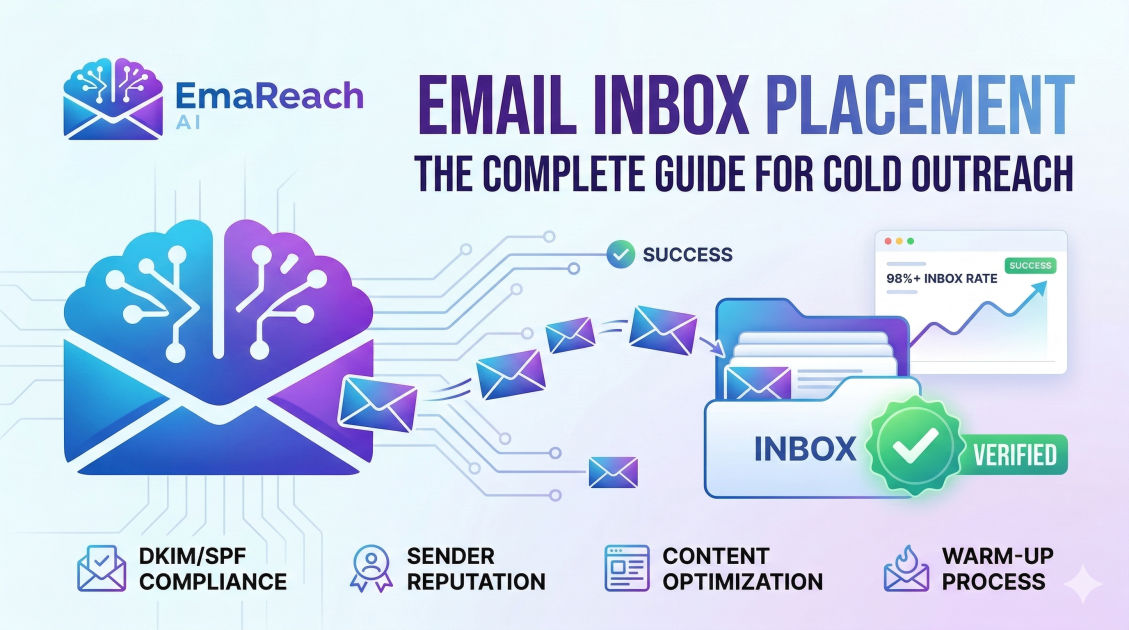
Email Inbox Placement: The Complete Guide for Cold Outreach
email deliverabilitycold outreachinbox placementlead generationemail marketingsales strategy
Introduction to Email Inbox Placement
In the world of cold outreach, the difference between a successful campaign and a wasted effort often comes down to a single factor: inbox placement. You can spend weeks crafting the perfect value proposition and identifying the ideal prospects, but if your message lands in the spam folder, it effectively does not exist.
Inbox placement is the metric that determines whether your email reaches the recipient's primary inbox or is diverted to a junk folder by an ISP (Internet Service Provider) or ESP (Email Service Provider). As algorithms become more sophisticated, maintaining high deliverability requires a strategic approach that blends technical setup, sender reputation management, and high-quality content. This guide explores the mechanics of how to ensure your cold emails land where they are meant to be seen.
The Fundamental Pillars of Deliverability
To master inbox placement, one must understand the three pillars that email providers use to evaluate every incoming message: Technical Infrastructure, Sender Reputation, and Content Quality.
1. Technical Infrastructure
Before sending a single email, your domain must be authenticated. Think of this as your digital passport. Without it, receiving servers have no way to verify that you are who you say you are.
- SPF (Sender Policy Framework): A DNS record that specifies which mail servers are authorized to send email on behalf of your domain.
- DKIM (DomainKeys Identified Mail): Adds a digital signature to your emails, ensuring that the content hasn't been tampered with during transit.
- DMARC (Domain-based Message Authentication, Reporting, and Conformance): A policy that tells receiving servers what to do if an email fails SPF or DKIM checks. Setting this to 'quarantine' or 'reject' over time builds immense trust with ISPs.
2. Sender Reputation
Your reputation is a score assigned to your sending domain and IP address. It is heavily influenced by historical behavior. If you suddenly send 1,000 emails from a brand-new domain, providers will flag it as suspicious 'burst' behavior common among spammers.
3. Content Relevance and Engagement
Modern spam filters use machine learning to analyze the 'fingerprint' of an email. They look for high image-to-text ratios, suspicious links, and 'spammy' keywords. More importantly, they track how users interact with your mail. High open rates and reply rates signal to the ISP that your content is wanted.
Setting Up for Success: Domain Strategy
One of the most common mistakes in cold outreach is using your primary company domain (e.g., @company.com) for high-volume prospecting. If your outreach results in a spike of spam reports, your entire company’s ability to communicate—including internal emails and client communications—could be crippled.
Using Secondary Domains
Instead, savvy marketers use secondary 'look-alike' domains (e.g., @getcompany.com or @trycompany.co). This creates a 'firewall' that protects your main brand. However, these new domains have no history, which leads us to the critical process of Domain Warming.
The Warming Process
A new domain is like a cold engine; you cannot redline it immediately. You must start by sending 5-10 emails per day to known 'friendly' addresses that will open and reply to them. Gradually increase this volume over 4–6 weeks until you reach your target daily volume.
For those looking to automate this complex dance, EmaReach offers a streamlined solution. Stop Landing in Spam. Cold Emails That Reach the Inbox. EmaReach AI combines AI-written cold outreach with inbox warm-up and multi-account sending—so your emails land in the primary tab and get replies.
Advanced Technical Optimization
Beyond basic SPF/DKIM, there are several advanced maneuvers that can give you an edge in the inbox placement game.
Custom Tracking Domains
Most outreach tools use a shared tracking pixel to monitor opens. If a spammer is using that same shared pixel, your emails might get flagged by association. Setting up a Custom Tracking Domain (a CNAME record that points to the tool) ensures that your links and pixels are branded to your unique domain, significantly improving your 'trust score.'
IP Warmth and Selection
While most small-to-medium outreach campaigns use shared IPs, high-volume senders might consider dedicated IPs. However, shared IPs can sometimes be safer for lower volumes because they have a steady stream of 'good' traffic from other reputable senders. The key is ensuring the IP pool is managed by a high-quality provider.
Crafting Content That Bypasses Spam Filters
Spam filters have evolved past simple keyword blacklists, but certain triggers still exist. To maintain high inbox placement, your content must feel human, personalized, and low-risk.
Avoiding Spam Triggers
- The Subject Line: Avoid ALL CAPS, excessive exclamation points, and 'clickbaity' promises like "ACT NOW!" or "FREE MONEY."
- The Body Text: Keep your image-to-text ratio low. Emails that are just one large image are almost always flagged as spam.
- Links: Limit the number of outgoing links. A single, clear call-to-action (CTA) link is far better than a footer full of social icons and multiple website links.
The Power of Personalization at Scale
ISPs notice when you send the exact same template to 500 people. This is known as 'bulk fingerprinting.' By using dynamic variables (First Name, Company, Industry) and 'spintax' (rotating different variations of a sentence), you ensure that every email leaving your server is unique. This uniqueness is a hallmark of legitimate, non-automated communication in the eyes of an ISP.
List Hygiene: The Silent Killer of Deliverability
You could have the best technical setup in the world, but if your list is full of 'dead' or 'catch-all' emails, your bounce rate will skyrocket. A bounce rate higher than 2% is a red flag to providers like Gmail and Outlook.
Hard Bounces vs. Soft Bounces
- Hard Bounce: The email address does not exist. These must be removed immediately.
- Soft Bounce: A temporary issue, like a full inbox. These can be retried, but with caution.
Verification Tools
Always run your prospect lists through a verification service before starting a campaign. This filters out 'spam traps'—email addresses specifically created by ISPs to catch unauthorized cold outreach. If you hit a spam trap, your sender reputation can be damaged instantly.
Monitoring and Maintaining Placement
Inbox placement isn't a 'set it and forget it' task. It requires constant monitoring. You should regularly check your 'Sender Score' and monitor your presence on major blacklists (like Spamhaus or Barracuda).
Key Metrics to Watch
- Open Rates: A sudden drop in open rates (e.g., from 40% to 5%) is the most common indicator that you have been moved from the primary inbox to the spam folder.
- Reply Rates: High reply rates are the ultimate 'vote of confidence' for ISPs. Encourage engagement by asking simple, low-friction questions.
- Spam Complaint Rate: This is the most damaging metric. Even a 0.1% complaint rate (1 per 1,000 emails) can be enough to ruin your deliverability.
Navigating Global Regulations
While this guide focuses on the technical side of placement, compliance with legal standards is part of being a 'good sender.'
- CAN-SPAM Act: Requires a clear way to opt-out and a physical address in the footer.
- GDPR: Requires a 'legitimate interest' for reaching out to EU citizens and strict data handling processes.
Staying compliant doesn't just keep you out of legal trouble; it signals to email providers that you are a professional entity following industry best practices.
The Multi-Inbox Strategy
To scale cold outreach without triggering volume-based filters, many experts use a multi-inbox strategy. Instead of sending 200 emails from one account, you send 40 emails from five different accounts across different domains. This spreads the 'load' and minimizes the risk to any single asset.
By diversifying your sending points and maintaining rigorous warming protocols, you can achieve high volume while keeping your reputation pristine. This is where AI-driven platforms like EmaReach provide significant value, managing the complex rotation of accounts and ensuring that your content remains fresh and engaging for every recipient.
Conclusion
Email inbox placement is an ongoing battle of technical precision and human-centric messaging. By building a solid foundation of SPF/DKIM/DMARC, utilizing secondary domains, warming up your accounts properly, and keeping your lists clean, you position yourself far ahead of the competition. Remember that the goal of every ISP is to protect their users from noise. If you provide genuine value, personalize your approach, and respect the technical rules of the road, your cold outreach will not only reach the inbox—it will drive the results your business deserves.
EmaReach AI
Ready to scale your cold email outreach?
Join thousands of teams using EmaReach AI for AI-powered campaigns, domain warmup, and 95%+ deliverability. Start free — no credit card required.
Related posts
- Read article
The Instantly Alternative That Finally Gets Outbound Analytics Right
Discover why high-volume cold email requires a shift from surface-level vanity metrics to deep, data-driven revenue attribution, and explore the ultimate alternatives for mastering outbound engineering.
- Read article
What You Gain and What You Give Up When Switching From Instantly
Thinking about migrating your cold email stack? This detailed guide breaks down the exact operational advantages you gain and the core features you sacrifice when switching away from Instantly's popular outreach platform.