Blog
Back to blog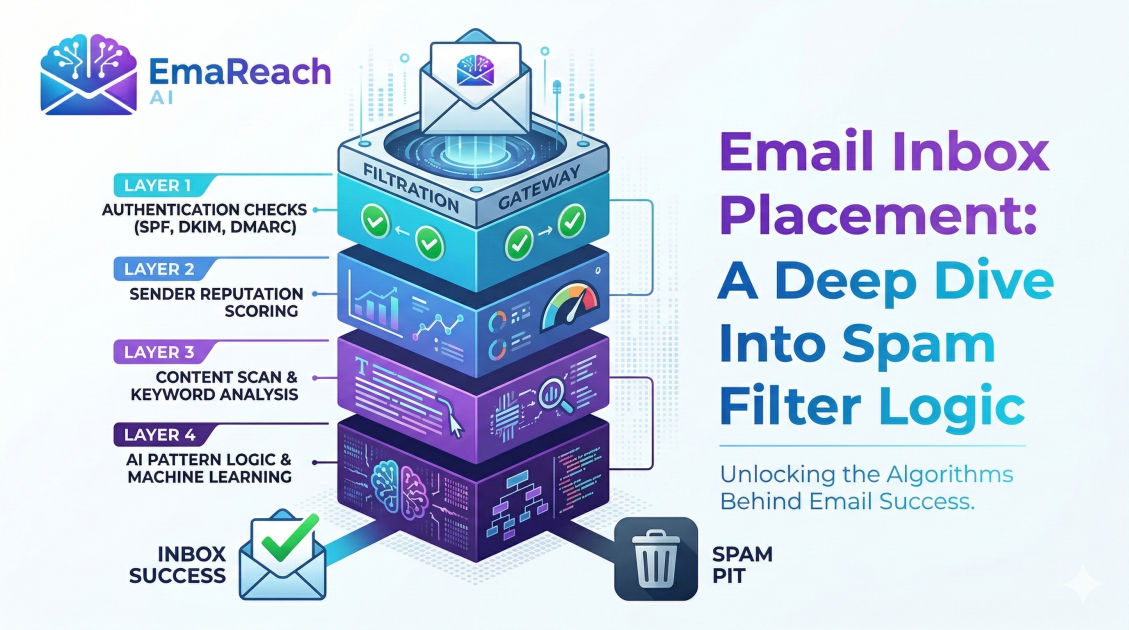
Email Inbox Placement: A Deep Dive Into Spam Filter Logic
email deliverabilityspam filterscold emailsender reputationemail marketingSPF DKIM DMARC
Introduction
In the world of digital communication, the distance between a successful connection and a missed opportunity is measured in the few pixels that separate the Inbox from the Spam folder. For businesses, marketers, and researchers, understanding email inbox placement is no longer a luxury—it is a foundational requirement for survival.
Every time you hit "send," a complex, silent machinery of algorithms, heuristics, and reputation checks springs into action. This is the world of spam filter logic. These filters act as the gatekeepers of the modern internet, processing billions of signals to protect users from malicious content, clutter, and unwanted solicitations. However, these same systems often catch legitimate messages in their net. To achieve high deliverability, one must move beyond simple subject line tips and dive deep into the technical architecture of how Mail Transfer Agents (MTAs) and Inbox Service Providers (ISPs) decide your email's fate.
The Evolution of Spam Filtering
Spam filtering has evolved from simple keyword matching to sophisticated artificial intelligence. In the early days, filters looked for specific words like "free," "guaranteed," or "winner." Today, the logic is holistic. It examines the sender's infrastructure, the historical behavior of the recipient, and the global reputation of the sending IP address.
Modern filters utilize a combination of layered defense mechanisms. These include:
- Reputation-Based Filtering: Checking the sender's past behavior.
- Content-Based Filtering: Analyzing the language, links, and attachments within the email.
- Behavioral Filtering: Observing how users interact with emails from a specific sender.
- Technical Authentication: Verifying that the sender is who they claim to be.
Technical Authentication: The Foundation of Trust
Before a spam filter even looks at your content, it checks your credentials. If your technical setup is flawed, the filter logic will often reject the email immediately or route it to spam regardless of the message quality.
SPF (Sender Policy Framework)
SPF is a DNS record that lists the IP addresses authorized to send emails on behalf of your domain. When an email arrives, the receiving server checks the SPF record. If the sending IP isn't on the list, it’s a red flag.
DKIM (DomainKeys Identified Mail)
DKIM adds a cryptographic signature to your emails. This acts as a digital seal that proves the email was not tampered with during transit. It links the email back to your domain, providing a layer of accountability that filters weigh heavily.
DMARC (Domain-based Message Authentication, Reporting, and Conformance)
DMARC is the policy layer. It tells the receiving server what to do if SPF or DKIM fails. A strict DMARC policy (like p=reject) signals to ISPs that you take security seriously, which significantly boosts your sender reputation.
The Logic of Sender Reputation
Your sender reputation is effectively a credit score for your email domain and IP address. ISPs like Google, Microsoft, and Yahoo maintain internal databases that track every sender.
IP Reputation vs. Domain Reputation
While IP reputation used to be the primary metric, the industry has shifted toward domain reputation. This is because spammers can easily hop between IP addresses, but building a brand on a domain takes time.
- IP Reputation: Focused on the health of the specific server sending the mail. If you are on a shared IP with "noisy" neighbors, your reputation can suffer.
- Domain Reputation: Focused on the long-term health of your web address. This follows you even if you switch email service providers.
Factors Influencing Reputation
- Bounce Rates: High hard bounce rates (sending to non-existent addresses) signal poor list hygiene and "harvested" lists.
- Spam Complaints: This is the most damaging signal. If users manually click "Report Spam," filters take immediate notice.
- Spam Traps: These are email addresses that exist solely to catch spammers. Hitting a "pristine" spam trap can lead to immediate blacklisting.
- Sending Volume Consistency: Spikes in volume are a hallmark of compromised accounts or spam runs. Logic dictates that legitimate senders scale their volume gradually.
Understanding Content Analysis Algorithms
While reputation is king, content still matters. Modern spam filters use Bayesian analysis—a statistical method that calculates the probability of an email being spam based on past data.
The Link-to-Text Ratio
Filters look at the balance of links versus written content. An email that is essentially just one large image or a series of links with no context is often flagged. This is because spammers frequently use images to hide text from scanners.
URL Reputation
It’s not just about your domain; it’s about where you are sending people. If you link to a domain that has been flagged for malware or phishing, your email will be blocked. This includes the use of common link shorteners, which are frequently abused by bad actors to hide the final destination of a link.
HTML Code Health
Messy HTML code, often a result of copying and pasting from Word or other editors, can trigger filters. Broken tags or hidden text (white text on a white background) are classic spammer tactics that filters are trained to identify.
The Role of User Engagement
Engagement-based filtering is the most sophisticated level of spam logic. ISPs now look at how the individual recipient interacts with your mail to determine where it should land.
- Open Rates: While less reliable due to privacy changes, open patterns still signal interest.
- Replies: A reply is the strongest signal of a high-quality connection. It tells the ISP that the recipient values the conversation.
- Mark as Not Spam: If a user moves an email from the spam folder to the inbox, it provides a massive boost to your reputation.
- Folders and Deletions: If users consistently delete your emails without opening them, or move them to a "Promotions" folder, the filter logic will eventually start placing them there automatically.
For those engaged in cold outreach, achieving these positive signals is difficult. This is where specialized tools become necessary. EmaReach helps users stop landing in spam by ensuring cold emails reach the inbox. Their system combines AI-written outreach with inbox warm-up and multi-account sending, ensuring your emails land in the primary tab where they actually get replies.
Advanced Logic: Greylisting and Rate Limiting
Sometimes, the filter logic isn't sure if you're a spammer or not. In these cases, it employs temporary tactics:
Greylisting
A receiving server might temporarily reject an email with a "try again later" error. Most legitimate mail servers will automatically retry after a few minutes, whereas many spam scripts will give up. Successfully passing a greylist challenge builds trust.
Rate Limiting (Throttling)
If an ISP sees a sudden influx of mail from a new or unproven sender, they will "throttle" the delivery, accepting only a few messages per hour. If those few messages receive good engagement, the limit is gradually lifted.
Practical Steps to Master Inbox Placement
To navigate this complex logic, a proactive approach is required. It is not enough to simply write a good email; you must manage the entire ecosystem of your delivery.
1. The Warm-up Period
Never send thousands of emails from a new domain or IP address on day one. You must "warm up" the account by sending low volumes of high-engagement mail. This builds a positive history with ISPs.
2. List Hygiene
Regularly scrub your list to remove inactive subscribers. Sending to people who haven't opened an email in six months increases the risk of hitting a spam trap or receiving a complaint.
3. Personalization Beyond the Name
Generic templates are easily identified by fingerprinting algorithms. Using AI to tailor the content of each message makes it harder for filters to categorize your mail as a "mass blast."
4. Monitor Blacklists
Check your domain and IP against major blacklists like Spamhaus or Barracuda. Being listed on these can cause your deliverability to plummet overnight.
The Future: Artificial Intelligence in Filtering
As we look forward, the logic of spam filters will become even more personalized. Machine learning models are moving toward "per-user" filtering. This means that while your email might land in the inbox for User A, it might go to spam for User B based purely on their historical preferences. This hyper-personalization makes the technical foundation (SPF, DKIM, DMARC) and high-quality engagement more critical than ever.
Conclusion
Mastering email inbox placement is a continuous process of balancing technical precision with human-centric content. Spam filter logic is not a static wall, but a dynamic, evolving system designed to reward quality and punish shortcuts. By focusing on robust authentication, maintaining a stellar sender reputation, and fostering genuine engagement, you can ensure your voice is heard in an increasingly crowded digital landscape. The key is to stop viewing spam filters as an enemy to be tricked, and instead view them as a standard to be met. When you align your sending practices with the goals of the ISP—delivering valuable, wanted content—the inbox becomes a natural destination rather than a difficult target.
EmaReach AI
Ready to scale your cold email outreach?
Join thousands of teams using EmaReach AI for AI-powered campaigns, domain warmup, and 95%+ deliverability. Start free — no credit card required.
Related posts
- Read article
The Instantly Alternative That Finally Gets Outbound Analytics Right
Discover why high-volume cold email requires a shift from surface-level vanity metrics to deep, data-driven revenue attribution, and explore the ultimate alternatives for mastering outbound engineering.
- Read article
What You Gain and What You Give Up When Switching From Instantly
Thinking about migrating your cold email stack? This detailed guide breaks down the exact operational advantages you gain and the core features you sacrifice when switching away from Instantly's popular outreach platform.