Blog
Back to blog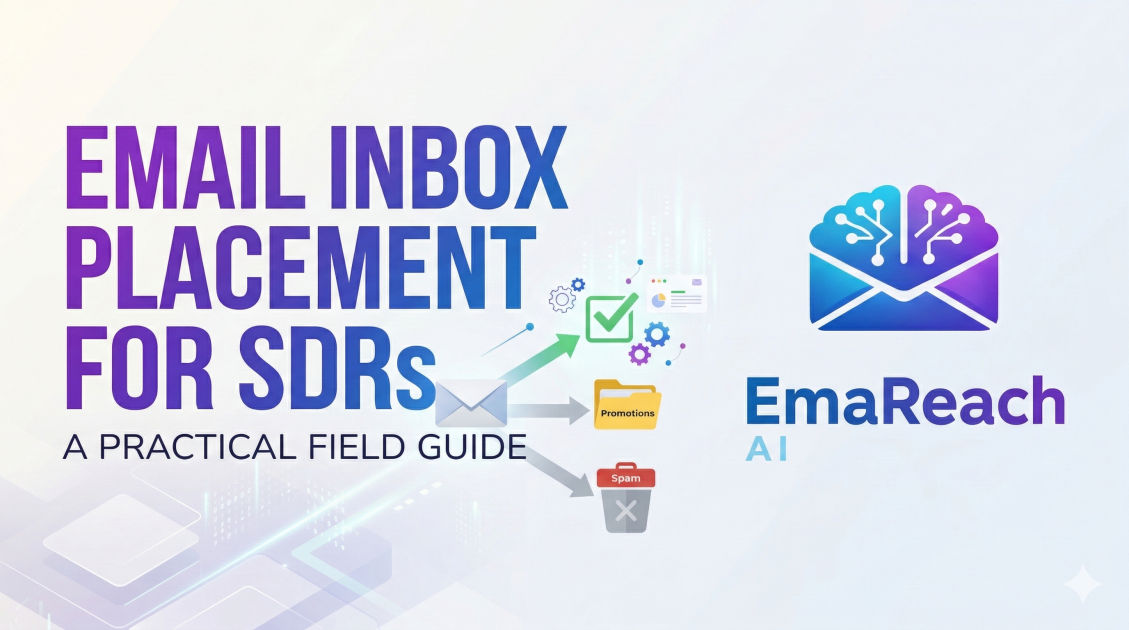
Email Inbox Placement for SDRs: A Practical Field Guide
SDREmail DeliverabilityCold OutreachSales StrategyInbox PlacementEmail Marketing
Introduction: The Hidden Barrier to Sales Success
For a Sales Development Representative (SDR), the most frustrating experience isn't a 'no'—it is silence. You have spent hours researching a prospect, identifying their pain points, and crafting a personalized message that perfectly positions your solution. You hit send, full of optimism, only for that message to vanish into the digital void.
The reality of modern outbound sales is that your biggest competitor isn't another company; it is the spam filter. As mailbox providers like Google and Microsoft become increasingly sophisticated, the barrier to entry for the primary inbox has never been higher. If your emails are landing in the 'Promotions' tab or, worse, the 'Spam' folder, your outreach strategy is dead on arrival.
This guide is a deep dive into the mechanics of email inbox placement. We will move beyond basic tips and explore the technical, behavioral, and content-driven factors that determine whether your voice is heard or silenced by an algorithm.
Understanding the Anatomy of Deliverability
Before we can master placement, we must distinguish between 'delivery' and 'deliverability.'
- Delivery is a binary metric. It asks: Did the receiving server accept the message? If the email address exists and the server isn't down, the answer is usually yes.
- Deliverability (Inbox Placement) is the art of landing in the primary inbox. It asks: Where did the message go after it was accepted?
As an SDR, you are judged by meetings booked and pipeline generated. Neither is possible if your deliverability is compromised. To protect your professional reputation and your company’s domain, you must treat your inbox placement as a mission-critical asset.
The Technical Foundation: Authenticating Your Identity
Think of email authentication as your digital passport. If you show up at the border without the right stamps, you are turned away. For SDRs, three technical protocols are non-negotiable.
SPF (Sender Policy Framework)
SPF is a DNS record that lists the specific IP addresses and domains authorized to send emails on behalf of your domain. When an email arrives, the recipient’s server checks this list. If your sending tool isn't on it, the email is flagged as suspicious.
DKIM (DomainKeys Identified Mail)
DKIM adds a digital signature to your emails. This ensures that the message wasn't tampered with during transit. It proves that the 'From' address is legitimate and the content is exactly what you sent.
DMARC (Domain-based Message Authentication, Reporting, and Conformance)
DMARC is the policy layer that tells receiving servers what to do if SPF or DKIM checks fail. A 'p=reject' policy is the gold standard, as it tells the world that you take your security seriously, which builds immense trust with providers like Gmail and Outlook.
Domain Reputation: The SDR’s Credit Score
Every domain has a reputation score that providers use to decide how to treat its mail. If you start blasting 200 emails a day from a brand-new domain, you will be flagged for 'suspicious spikes' in volume.
The Importance of Domain Age and Warm-up
Domains need to be seasoned. A 'cold' domain—one with no history of sending or receiving—is a red flag for spam filters. This is where strategic warm-up comes into play. You must gradually increase your volume while ensuring high engagement rates.
For SDRs looking to scale without the risk, using a platform like EmaReach can be a game-changer. EmaReach helps you stop landing in spam by combining AI-written cold outreach with automated inbox warm-up and multi-account sending. This ensures your emails land in the primary tab and actually get replies by mimicking human behavior at scale.
Multi-Account Sending Strategy
One of the most effective ways to protect your primary company domain is to use 'satellite' domains. Instead of sending all your outbound from company.com, you might use getcompany.com or companymail.com. This isolates your sales activity. If one domain's reputation takes a hit, your corporate communication remains unaffected.
Content and Context: Avoiding the Spam Filter’s Scrutiny
Even with perfect technical setup, your content can betray you. Spam filters use natural language processing to scan for 'salesy' patterns.
Trigger Words and Formatting
Avoid excessive use of characters like '$', '!!!', or all-caps words like 'FREE', 'URGENT', or 'ACT NOW'. While one or two won't kill your deliverability, a pattern of these creates a 'spammy' fingerprint.
The Link-to-Text Ratio
High-performing SDR emails are usually text-heavy. Including too many links, large images, or complex HTML tracking codes can trigger filters. The ideal outbound email looks like a message you’d send to a colleague: plain text, one link (perhaps a calendar link or a case study), and a clean signature.
Personalization at Scale
Static templates are the enemy of inbox placement. If you send 500 identical emails, filters notice the footprint. By using dynamic variables—not just the prospect's name, but their company, a recent LinkedIn post, or a specific industry pain point—you ensure that every outgoing byte is unique. This uniqueness is a strong signal of legitimate, one-to-one communication.
The Behavioral Loop: Why Engagement is King
Mailbox providers watch how users interact with your mail. This is known as 'subscriber engagement.'
- Positive Signals: Opening the email, clicking a link, replying, and 'whitelisting' (moving an email from spam to the inbox).
- Negative Signals: Deleting without opening, marking as spam, or the 'bounce' (sending to an invalid address).
The Power of the Reply
Replies are the ultimate deliverability gold. When a prospect replies to your email, it tells the provider, "This sender is someone I want to hear from." This is why your Call to Action (CTA) should be low-friction. Instead of asking for a 30-minute demo, ask a simple, open-ended question that encourages a quick 'yes' or 'no'.
Managing Bounces and List Hygiene
Sending emails to non-existent addresses is a fast track to the spam folder. It suggests you are using 'scraped' or 'dirty' data. SDRs should use verification tools to scrub their lists before every campaign. A bounce rate higher than 3% is a warning sign; higher than 5% is a crisis.
Infrastructure Strategy for High-Growth Teams
As sales teams grow, managing deliverability becomes a logistical challenge. You cannot simply double your volume and expect the same results.
Rotating IP Addresses and Mailboxes
Instead of one SDR sending 100 emails, it is often more effective to have five mailboxes sending 20 emails each. This distribution of volume prevents any single account from hitting the 'daily limit' thresholds that trigger manual reviews by providers.
Monitoring Tools
SDRs should regularly check their 'Sender Score' and monitor Google Postmaster Tools. These resources provide a window into how the world's largest mailbox provider views your domain. If you see your 'Spam Complaint Rate' creeping above 0.1%, it is time to pause and reassess your targeting.
Practical Field Tactics for Daily Outreach
To maintain peak placement, incorporate these habits into your daily workflow:
- Stagger Your Sending: Do not blast 50 emails at 9:00 AM. Use tools that allow you to space out sends by several minutes, mimicking a human cadence.
- Clean Your Signatures: Remove unnecessary HTML, social media icons, and legal disclaimers that add bulk to your metadata.
- Check Your 'From' Name: Ensure your 'From' name matches your email address. Inconsistencies here can look like 'spoofing' to a security filter.
- A/B Test for Engagement, Not Just Opens: Test different subject lines to see which ones generate not just more opens, but more replies. Remember, replies are the fuel for future deliverability.
The Future of SDR Outreach
The landscape of email is shifting toward a 'quality over quantity' model. The SDRs who succeed in the coming years will be those who view themselves as 'deliverability engineers' just as much as 'salespeople.' By mastering the technical requirements, respecting the inbox of the recipient, and using intelligent automation to maintain domain health, you can ensure that your messages don't just get sent—they get read.
Placement is not a one-time setup; it is a continuous process of monitoring, adjusting, and perfecting. When your infrastructure is sound, your creative messaging finally has the opportunity to shine.
Conclusion
Mastering email inbox placement is the foundational skill of the modern SDR. By ensuring your SPF, DKIM, and DMARC are in place, keeping your list hygiene pristine, and focusing on high-engagement content, you bypass the gatekeepers of the digital world. Protecting your domain reputation is protecting your pipeline. In an era of noise, the primary inbox is the only place where true connection happens. Treat it with respect, monitor your metrics diligently, and use the right tools to keep your outreach human, relevant, and visible.
EmaReach AI
Ready to scale your cold email outreach?
Join thousands of teams using EmaReach AI for AI-powered campaigns, domain warmup, and 95%+ deliverability. Start free — no credit card required.
Related posts
- Read article
The Instantly Alternative That Finally Gets Outbound Analytics Right
Discover why high-volume cold email requires a shift from surface-level vanity metrics to deep, data-driven revenue attribution, and explore the ultimate alternatives for mastering outbound engineering.
- Read article
What You Gain and What You Give Up When Switching From Instantly
Thinking about migrating your cold email stack? This detailed guide breaks down the exact operational advantages you gain and the core features you sacrifice when switching away from Instantly's popular outreach platform.