Blog
Back to blog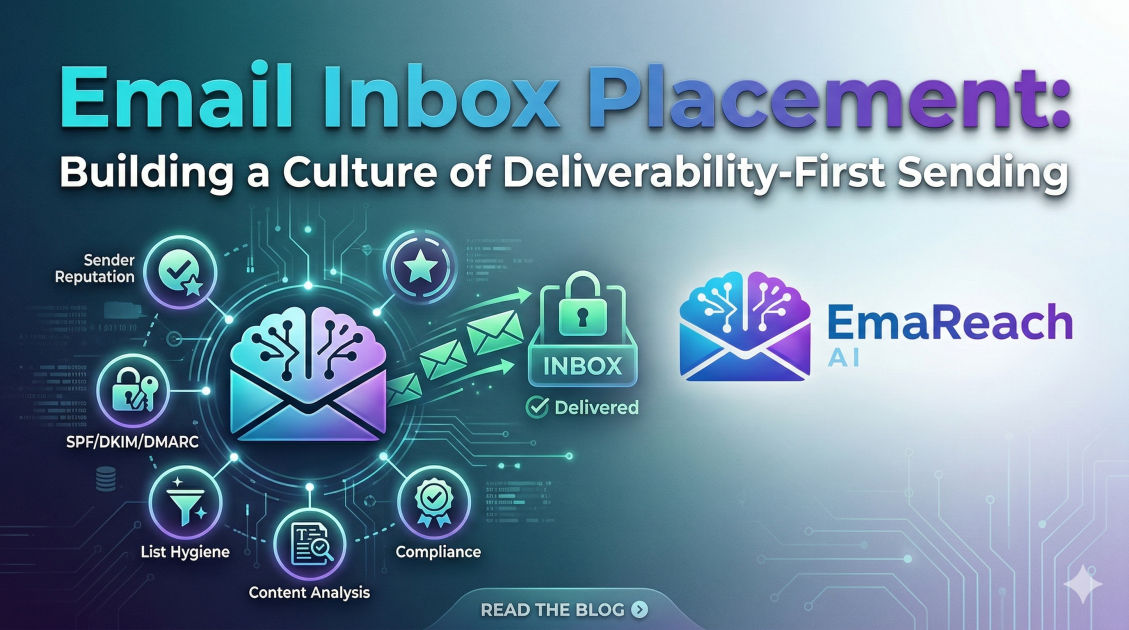
Email Inbox Placement: Building a Culture of Deliverability-First Sending
email deliverabilityinbox placementcold emailemail marketing strategysender reputationoutreach
Introduction: Beyond the Send Button
For years, the success of email marketing and outbound sales was measured by the size of the list and the frequency of the sends. If you sent enough emails, the law of averages suggested you would eventually hit your targets. However, the landscape of digital communication has undergone a seismic shift. Today, the most sophisticated email content in the world is worthless if it never reaches the intended recipient’s eyes.
Inbox placement—the ability to land in the primary inbox rather than the spam folder or the dreaded 'Promotions' tab—has become the ultimate competitive advantage. Achieving consistent placement requires more than just technical tweaks; it requires a fundamental shift in organizational mindset. It requires building a culture of deliverability-first sending.
The Anatomy of Email Deliverability
Before we can build a culture around it, we must understand that deliverability is not a single metric, but a complex ecosystem influenced by three distinct pillars: Infrastructure, Reputation, and Content.
Technical Infrastructure
This is the foundation. It involves the backend settings that prove to Mail Transfer Agents (MTAs) that you are who you say you are. Without proper authentication, your emails are essentially digital hitchhikers without ID cards.
- SPF (Sender Policy Framework): A text record that lists the IP addresses authorized to send mail on behalf of your domain.
- DKIM (DomainKeys Identified Mail): A digital signature that ensures the email content wasn't tampered with during transit.
- DMARC (Domain-based Message Authentication, Reporting, and Conformance): A policy that tells receiving servers what to do if an email fails SPF or DKIM checks.
Sender Reputation
Think of this as your credit score for email. It is a measurement of how Mail Box Providers (MBPs) like Google and Microsoft perceive your sending habits. It is tied to both your IP address and your domain. A high reputation leads to the primary inbox; a low reputation leads to the spam folder or outright rejection.
Content and Engagement
Modern spam filters use machine learning to analyze how users interact with your mail. High open rates, replies, and 'mark as important' actions boost your standing. High bounce rates, spam complaints, and low engagement signal that your mail is unwanted.
Why 'Culture' Matters More Than 'Hacks'
Many organizations treat deliverability as a fire to be put out. When open rates plummet, they scramble to change their tracking links or rotate domains. This reactive approach is exhausting and ultimately ineffective. A culture of deliverability-first sending means that every stakeholder—from the CEO to the junior copywriter—understands that protecting the domain's reputation is a shared responsibility.
When deliverability is baked into the culture, decisions are made through the lens of long-term sender health. You stop asking, "How many people can we blast this to?" and start asking, "How can we ensure this provides enough value that the recipient won't report it as spam?"
The Pillars of a Deliverability-First Culture
1. Data Hygiene as a Core Value
In a deliverability-first culture, a smaller, highly engaged list is infinitely more valuable than a massive, stagnant one. List decay is a natural phenomenon, but ignoring it is a choice.
- Sunset Policies: Organizations must implement strict sunset policies, automatically offboarding subscribers who haven't engaged in 90 to 180 days.
- Verification at Entry: Using real-time email verification at the point of lead capture prevents 'typo' bounces and malicious 'spam trap' entries from ever entering your database.
2. Radical Relevance in Content
Spam is not defined by the sender; it is defined by the recipient. If a user feels the content is irrelevant to them, they will reach for the 'Report Spam' button. A deliverability-first culture prioritizes deep segmentation. Instead of 'Batch and Blast,' teams focus on 'Segment and Serve.'
This is where AI can be a powerful ally. For those engaged in cold outreach, tools like EmaReach help bridge the gap. By combining AI-written cold outreach with inbox warm-up and multi-account sending, EmaReach ensures that your emails land in the primary tab and get replies. This focus on quality and account health over raw volume is the hallmark of a modern sending strategy.
3. Monitoring as a Daily Habit
You cannot manage what you do not measure. A deliverability-first culture moves beyond simple open and click rates. Teams should monitor:
- Bounce Rates: Keeping hard bounces below 0.5%.
- Spam Complaint Rates: Aiming for less than 0.1% (one in every thousand emails).
- Blacklist Status: Regularly checking if the sending IP or domain has been flagged by major providers.
- Inbox Placement Tests: Using seed lists to see where emails land across different providers before a major campaign goes out.
Technical Excellence: The Non-Negotiables
While culture drives behavior, technical excellence provides the framework. A deliverability-first organization ensures that its infrastructure is beyond reproach.
Domain Separation
One of the most common mistakes is sending marketing blasts, cold outreach, and transactional emails (like password resets) all from the same domain. If your marketing campaign gets flagged, your customers might stop receiving their invoices or login links.
Strategic organizations use subdomains or entirely separate 'lookalike' domains for different types of communication. For example:
company.comfor transactional and personal 1-to-1 mail.news.company.comfor opted-in marketing newsletters.outreach-company.comfor outbound sales efforts.
The Importance of Warm-Up
You cannot go from zero to 50,000 emails overnight. Mailbox providers find sudden spikes in volume highly suspicious. A deliverability-first culture respects the 'warm-up' period. Whether you are using a new IP or a new domain, volume must be increased gradually while monitoring engagement metrics closely.
Understanding the 'Human' Element of Spam Filters
Spam filters are essentially trying to mimic human annoyance. They look for patterns that suggest an email is unsolicited or manipulative. To build a culture that survives these filters, teams must avoid 'Spammy' behaviors:
- Subject Line Deception: Using "Re:" or "Urgent" when there is no prior conversation or actual urgency might get an open, but it will almost certainly get a spam complaint once the user feels tricked.
- The 'Hidden' Unsubscribe: Making the unsubscribe link hard to find or requiring a login to opt-out is a fast track to the spam folder. A deliverability-first approach makes it easy for uninterested users to leave, protecting the sender's reputation in the process.
- Heavy Image-to-Text Ratios: Since filters can't 'read' images as easily as text, they often view image-heavy emails (especially those with little text) as a way to hide spammy keywords.
Integrating Deliverability into the Sales and Marketing Workflow
How does this look in practice? It means that when a marketing manager proposes a new campaign, the first question isn't "What's the CTA?" but "Is the segment clean and warmed up?"
In the sales department, it means moving away from 'spraying and praying.' Instead of a single rep sending 500 identical emails, a deliverability-first culture encourages using multiple accounts and rotating copy variations to avoid footprint detection. This is where a solution like EmaReach becomes an essential part of the tech stack, as it manages the complexities of multi-account sending and automated warm-up, allowing the sales team to focus on closing deals without worrying about the 'spam' abyss.
The Financial Impact of Deliverability
It is often helpful to frame deliverability in financial terms to gain executive buy-in. If your email list has 100,000 subscribers and your average order value is $50, a 10% drop in inbox placement isn't just a technical glitch—it's a massive hit to the bottom line.
When 20% of your emails go to spam, you are effectively throwing away 20% of your marketing budget and 20% of your potential revenue. By investing in a culture of deliverability, you aren't just 'fixing email'; you are optimizing the ROI of your entire customer acquisition strategy.
Future-Proofing Your Sending Strategy
The criteria for 'good' sending are constantly evolving. Major providers like Google and Yahoo frequently update their sender requirements, often making previously 'optional' things like DMARC and one-click unsubscribe headers mandatory.
A culture of deliverability-first sending involves staying ahead of these shifts. It means subscribing to postmaster blogs, attending industry webinars, and maintaining a flexible enough infrastructure that you can pivot when the rules change.
The Feedback Loop
Finally, a deliverability-first culture relies on a tight feedback loop. When a campaign performs poorly, the team shouldn't just blame 'the algorithm.' They should perform a post-mortem:
- Was the bounce rate higher than usual?
- Did we see a spike in complaints from a specific provider (e.g., Outlook)?
- Did the content contain words or links that triggered filters?
By treating every 'spam' placement as a learning opportunity rather than a random misfortune, the organization grows more resilient over time.
Conclusion
Email inbox placement is no longer a 'set it and forget it' technical configuration. It is a living, breathing reflection of your brand's relationship with its audience. Building a culture of deliverability-first sending requires discipline, the right tools, and a commitment to quality over quantity.
By prioritizing technical authentication, maintaining rigorous data hygiene, and focusing on radical relevance, you ensure that your messages don't just get sent—they get seen. In an era of digital noise, the ability to consistently reach the primary inbox is the most valuable asset a communicator can possess. Transitioning to this mindset may require more effort upfront, but the long-term rewards in engagement, trust, and revenue are unparalleled.
EmaReach AI
Ready to scale your cold email outreach?
Join thousands of teams using EmaReach AI for AI-powered campaigns, domain warmup, and 95%+ deliverability. Start free — no credit card required.
Related posts
- Read article
The Instantly Alternative That Finally Gets Outbound Analytics Right
Discover why high-volume cold email requires a shift from surface-level vanity metrics to deep, data-driven revenue attribution, and explore the ultimate alternatives for mastering outbound engineering.
- Read article
What You Gain and What You Give Up When Switching From Instantly
Thinking about migrating your cold email stack? This detailed guide breaks down the exact operational advantages you gain and the core features you sacrifice when switching away from Instantly's popular outreach platform.