Blog
Back to blog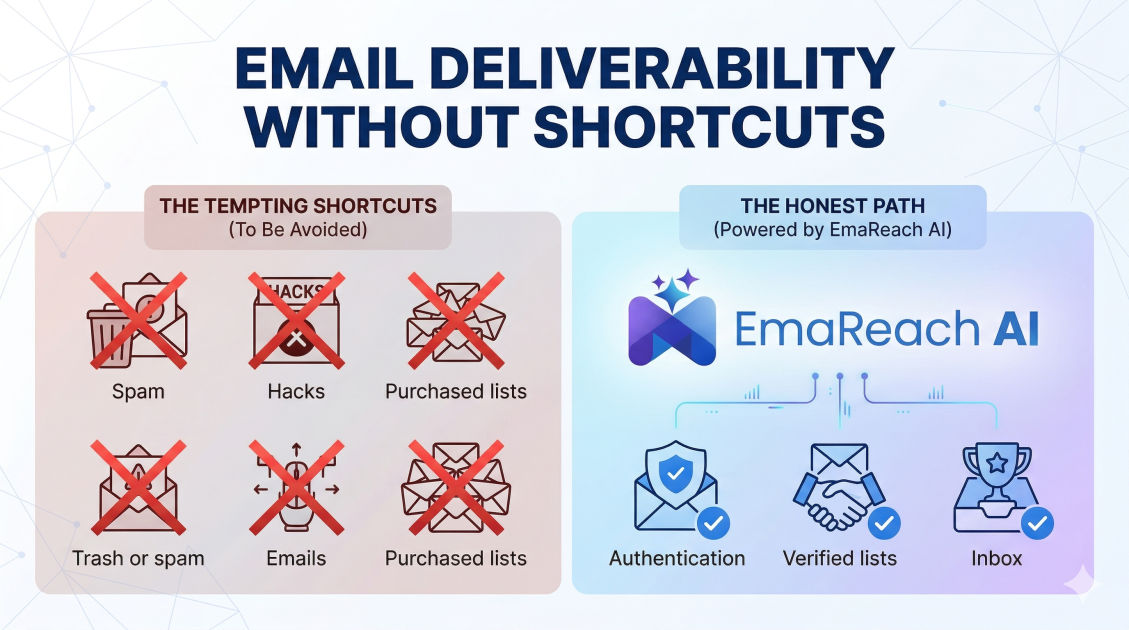
Email Deliverability Without Shortcuts
email deliverabilitycold outreachmarketing strategySPF DKIM DMARCinbox placementdomain reputation
The Foundation of Sustainable Email Growth
Email deliverability is often treated like a dark art or a game of cat-and-mouse with internet service providers (ISPs). Many marketers search for the ultimate 'hack' or a secret configuration that will magically bypass spam filters. However, the reality of modern email infrastructure is far more grounded. True deliverability is built on a foundation of technical integrity, behavioral consistency, and high-quality engagement. There are no shortcuts that provide long-term results.
In this comprehensive guide, we will explore why the 'slow and steady' approach is the only way to ensure your messages consistently land in the primary inbox. We will dive deep into the technical protocols, the psychology of ISP filtering, and the operational habits that separate professional senders from those who eventually find their domains blacklisted.
The Anatomy of a Healthy Domain
Before you ever hit 'send,' your deliverability is already being judged. This judgment is based on your domain reputation. Think of your domain as a credit score; every positive interaction builds trust, while every negative signal—like a spam complaint or a bounce—strikes a blow to your credibility.
Authentication: Your Digital Passport
You wouldn't try to cross an international border without a passport, yet many senders attempt to reach inboxes without proper authentication. This is the first and most critical step in deliverability without shortcuts. You must prove you are who you say you are.
- SPF (Sender Policy Framework): This is a DNS record that lists which mail servers are authorized to send email on behalf of your domain. Without it, receiving servers have no way of knowing if an email is legitimate or a spoofing attempt.
- DKIM (DomainKeys Identified Mail): This adds a digital signature to your emails. It ensures that the content of the email hasn't been tampered with during transit. It acts as a seal of authenticity.
- DMARC (Domain-based Message Authentication, Reporting, and Conformance): DMARC ties SPF and DKIM together. It provides instructions to the receiving server on what to do if an email fails authentication—whether to do nothing, move it to spam, or reject it entirely.
Setting these up correctly isn't a 'shortcut'; it is the baseline requirement for professional communication. If you ignore these, you are essentially signaling to ISPs that you are an amateur or a malicious actor.
The Danger of 'Shortcut' Tactics
It is tempting to look for ways to scale quickly. You might find services offering 'millions of verified leads' or software that promises to 'blast' through filters. These are shortcuts that lead directly to the junk folder.
Purchased Lists and Scraped Data
The most common shortcut is buying a contact list. On the surface, it seems efficient. In reality, these lists are often filled with 'spam traps'—email addresses created by ISPs specifically to catch unauthorized senders. If you hit a spam trap, your sender reputation can be destroyed overnight. Furthermore, people on these lists haven't asked to hear from you. High complaint rates are the fastest way to get your IP address blacklisted.
Excessive Automation and 'Spinning' Content
Another common shortcut involves using software to 'spin' text—automatically swapping synonyms to make each email look unique to a filter. Modern AI and machine learning at the ISP level (like Google's Gmail filters) are far too sophisticated for this. They look at intent, link safety, and sender history. If your content feels mechanical and lacks value, it won't matter how many synonyms you swap.
The Long-Game Strategy: Proper Warm-Up
When you start sending from a new domain or IP, you have no reputation. To an ISP, a new sender with high volume looks like a compromised account or a spammer. This is where the 'warm-up' process becomes essential.
Starting slow is the antithesis of a shortcut, but it is the only way to build a resilient reputation. You must gradually increase your daily volume over several weeks, ensuring that your initial recipients are highly engaged. This proves to the ISPs that people want to read what you are sending.
For those who need to scale their outreach without sacrificing their domain's health, specialized systems are often necessary. Stop Landing in Spam. Cold Emails That Reach the Inbox. EmaReach (https://www.emareach.com/) AI combines AI-written cold outreach with inbox warm-up and multi-account sending—so your emails land in the primary tab and get replies. By automating the 'non-shortcut' behaviors, it allows you to maintain professional standards at scale.
Content Quality and Technical Hygiene
Your content isn't just about sales copy; it's about technical signals. ISPs scan the underlying HTML and the behavior of the links within your message.
The Text-to-Image Ratio
A common mistake is sending an email that is essentially one large image. Spammers often do this to hide text from filters. As a result, ISPs are suspicious of image-heavy emails. Aim for a healthy balance, prioritizing plain text that provides immediate value even if images are blocked.
Link Quality and Tracking Shorthand
Using generic link shorteners is a massive red flag. Because these services are free and easy to use, they are heavily abused by malicious actors. If you use a common shortener, you are sharing a reputation with every spammer who uses that same service. Instead, use branded tracking links or direct URLs to your own verified domain.
The Importance of the 'Unsubscribe' Link
It might seem counterintuitive to make it easy for people to leave your list, but a clear, one-click unsubscribe link is a deliverability asset. If a user can't find the unsubscribe button, they will hit the 'Report Spam' button instead. A 'Spam' report is a catastrophic signal to ISPs; an 'Unsubscribe' is merely a neutral preference.
Monitoring and Maintenance
Deliverability is not a 'set it and forget it' task. It requires constant monitoring. You should regularly check your standing on major blacklists and monitor your 'reputation score' through tools provided by the ISPs themselves, such as Google Postmaster Tools.
Feedback Loops
Major ISPs offer Feedback Loops (FBLs). When a recipient marks your email as spam, the ISP sends a notification back to you. This allows you to immediately remove that person from your list. Ignoring these signals is a shortcut to total domain suppression. A responsible sender listens to the feedback provided by the ecosystem.
List Scrubbing
Maintaining a massive list of inactive subscribers is a liability. If people aren't opening your emails, it lowers your overall engagement rate. ISPs notice this. Periodically 'scrubbing' your list—removing anyone who hasn't opened an email in six months—actually improves the deliverability for the rest of your active audience. It feels like a loss of volume, but it is a massive gain in quality.
Infrastructure: Dedicated vs. Shared IPs
As your volume grows, you face a choice between shared and dedicated IP addresses.
- Shared IPs: You are sharing a 'reputation' with other senders. This is cost-effective but risky; if another company on your IP sends spam, your deliverability suffers too.
- Dedicated IPs: You have total control over your reputation. However, this means you are solely responsible for the warm-up and maintenance. There are no shortcuts here—if you mess up a dedicated IP, you have no one else to blame.
The Psychology of the Inbox
Ultimately, ISPs want to provide a good experience for their users. They want to show messages that are relevant, timely, and safe. If you align your goals with the ISP's goals, you win.
This means focusing on relevance. Personalized subject lines, segmented lists, and high-value content aren't just 'marketing best practices'—they are the core pillars of deliverability. When users open, click, and reply to your emails, they are voting for your domain. These 'positive engagement signals' are the most powerful way to stay in the primary tab.
Conclusion: The Sustainable Path
In the world of email marketing, shortcuts are an illusion. They might provide a temporary spike in numbers, but they inevitably lead to a slow decline in reach as ISPs catch on. Building a reputation takes time, technical precision, and a commitment to quality.
By focusing on robust authentication, gradual warm-up, list hygiene, and genuine engagement, you create an email strategy that is immune to the whims of algorithm updates. Deliverability is not about tricking the system; it’s about becoming a trusted part of it. When you commit to the long-term health of your domain, the rewards—higher open rates, better conversions, and a stronger brand—are well worth the effort.
EmaReach AI
Ready to scale your cold email outreach?
Join thousands of teams using EmaReach AI for AI-powered campaigns, domain warmup, and 95%+ deliverability. Start free — no credit card required.
Related posts
- Read article
The Instantly Alternative That Finally Gets Outbound Analytics Right
Discover why high-volume cold email requires a shift from surface-level vanity metrics to deep, data-driven revenue attribution, and explore the ultimate alternatives for mastering outbound engineering.
- Read article
What You Gain and What You Give Up When Switching From Instantly
Thinking about migrating your cold email stack? This detailed guide breaks down the exact operational advantages you gain and the core features you sacrifice when switching away from Instantly's popular outreach platform.