Blog
Back to blog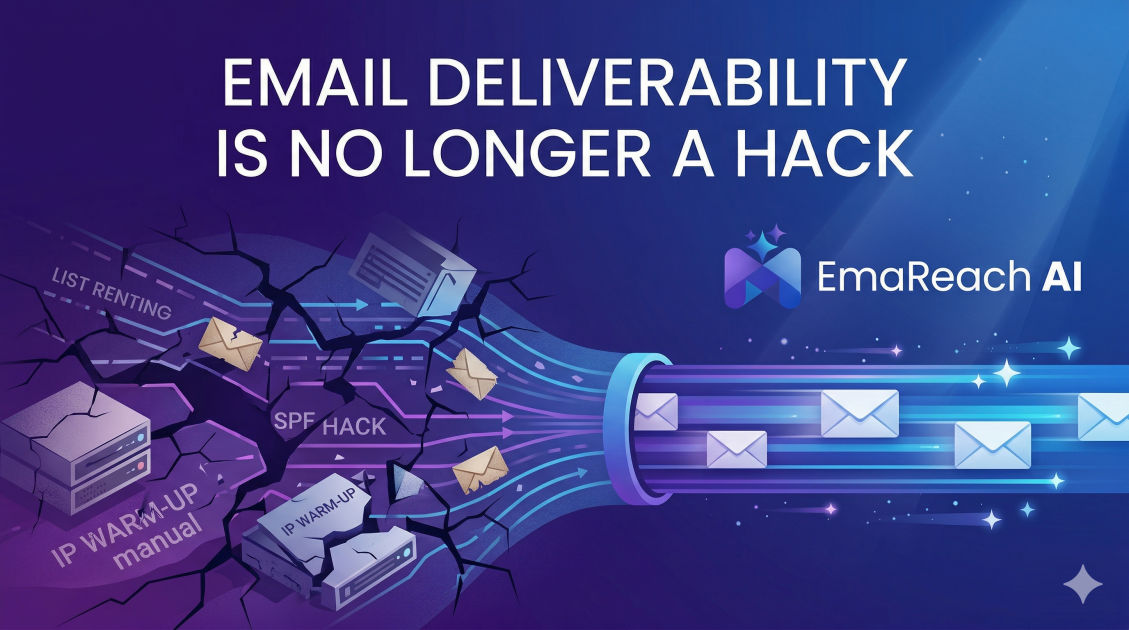
Email Deliverability is No Longer a Hack
email deliverabilitycold emailemail marketinginbox placementoutreach strategyspam filters
Introduction
There was a time in the digital landscape when email marketing and cold outreach operated on a set of easily manipulated rules. Marketers and sales professionals could rely on a bag of "tricks" to ensure their messages reached the inbox. You could tweak a subject line, avoid a static list of spam trigger words, obscure your tracking links, and watch the open rates soar. It was an era of loopholes, where deliverability was treated as a game of cat-and-mouse with internet service providers (ISPs).
Those days are permanently over.
Today, email deliverability is no longer a hack, a shortcut, or a set of secret configurations you apply once and forget. It has evolved into a sophisticated, highly regulated, and deeply analytical discipline. ISPs and major inbox providers have upgraded their algorithms from simple keyword filters to advanced artificial intelligence systems that analyze thousands of data points in milliseconds. They no longer ask, "Does this email look like spam?" Instead, they ask, "Does this sender have a proven track record of providing value, and does the recipient genuinely want to interact with this message?"
Understanding this paradigm shift is the single most critical factor in modern outreach. If you are still relying on outdated hacks, your domain reputation is likely bleeding, and your emails are quietly being relegated to the spam folder or the dreaded promotional tab. This comprehensive guide will dissect the modern anatomy of email deliverability, explaining why the old tricks fail and how you must structure your infrastructure, strategy, and content to conquer the modern inbox.
The Evolution of Spam Filters: From Static Rules to Behavioral AI
To understand why deliverability requires a holistic approach, you must understand the adversary: the spam filter. Early spam filters were remarkably simple. They functioned like digital bouncers with a very specific, rigid blacklist. If your email contained the phrase "Act Now," featured too many exclamation points, or came from an IP address known for massive blasts, the bouncer denied entry.
Marketers quickly learned to bypass these bouncers. They used synonyms, broke up words with special characters, and constantly rotated cheap IP addresses. It was a race to the bottom, resulting in inboxes flooded with irrelevant, unsolicited, and often malicious content.
In response, major providers completely rebuilt their defense mechanisms. Modern spam filters are behavioral and reputation-based. They utilize machine learning models trained on billions of daily emails to understand context, intent, and historical sender performance.
These advanced systems look at:
- Sender Authentication: Are you cryptographically verified as the owner of the domain?
- Historical Engagement: Do people typically open, reply to, or delete your emails without reading them?
- Network Fingerprinting: Are your sending patterns consistent with legitimate business communication or erratic like a spammer?
- Content Semantics: What is the actual meaning and intent behind your copy, regardless of the specific words used?
Because these systems are dynamic, attempting to "hack" them is not just ineffective; it actively damages your reputation. A hack implies a short-term trick to bypass a rule. But when the rule is "be a consistently valuable sender," the only way to bypass it is to actually become one.
The Non-Negotiable Foundation: Technical Infrastructure
Before you write a single line of copy or build a prospect list, your technical infrastructure must be flawless. In the modern era, sending an email without proper authentication is the equivalent of trying to cross an international border without a passport. You will be detained, and your cargo will be confiscated.
There are three core pillars of email authentication that serve as your digital identity. Setting these up is not a "deliverability hack"; it is the bare minimum requirement for participation in the ecosystem.
SPF (Sender Policy Framework)
SPF is a DNS record that acts as a public guest list for your domain. It explicitly lists the IP addresses and mail servers that are authorized to send emails on your behalf. When an inbox provider receives a message claiming to be from your domain, it checks your SPF record. If the server sending the email is on the list, the email passes this check. If not, it is immediately flagged as highly suspicious, likely resulting in a hard bounce or a direct trip to the spam folder.
DKIM (DomainKeys Identified Mail)
DKIM adds a layer of cryptographic security to your emails. It attaches a digital signature to the header of every outgoing message. The receiving server uses a public key (published in your DNS records) to verify this signature. DKIM ensures two critical things: first, that the email genuinely originated from your domain, and second, that the contents of the email were not altered in transit. It protects your domain from being spoofed by malicious actors and builds trust with receiving servers.
DMARC (Domain-based Message Authentication, Reporting, and Conformance)
Think of DMARC as the manager that enforces the rules set by SPF and DKIM. DMARC tells the receiving server exactly what to do if an email fails SPF or DKIM authentication. You can instruct the receiver to do nothing (monitor), send the email to spam (quarantine), or outright reject the email. Implementing a strict DMARC policy is a powerful signal to ISPs that you take your domain security seriously and are actively protecting your recipients from phishing attempts.
Without these three protocols configured correctly, your deliverability will suffer regardless of how good your content is. They are the bedrock upon which domain reputation is built.
The Currency of the Inbox: Domain Reputation
In the past, senders heavily relied on IP reputation. If an IP address became burned, they would simply buy a new one and start fresh. Providers caught on to this "snowshoe spamming" technique. Today, while IP reputation still matters, Domain Reputation is the ultimate currency of the inbox.
Your domain reputation is a holistic score attached to your specific domain name. It follows you everywhere. If you send terrible emails from Google Workspace, get marked as spam, and then migrate to Microsoft Outlook, your bad reputation travels with you. You cannot outrun a poor domain reputation.
Building and maintaining a pristine domain reputation requires consistency across several vectors:
Domain Age and History
A brand-new domain has no reputation. To an ISP, a domain registered yesterday that suddenly sends a thousand emails today is a massive red flag. Spammers frequently register domains, blast emails until they are blocked, and abandon them. Therefore, new domains are subject to strict scrutiny and "throttling" (limiting the number of emails allowed through). Aging your domain and slowly ramping up volume is critical.
Sending Volume Consistency
ISPs love predictability. If you send 50 emails a day for a month, and then suddenly blast 10,000 emails on a Tuesday, the algorithms will panic. This erratic behavior mimics compromised accounts or purchased lists. Maintaining a stable, predictable sending volume helps ISPs trust your traffic.
Spam Complaint Rate
This is the most destructive metric for your domain reputation. If a recipient manually clicks the "Report Spam" button, it sends a highly negative signal back to the provider. A spam complaint rate of just 0.1% (one out of a thousand emails) is enough to start degrading your reputation. Keeping this number as close to zero as possible is mandatory.
Engagement: The Invisible Scoring System
Once your infrastructure is set and your domain is trusted, the ultimate arbiter of your inbox placement is user engagement. Providers monitor exactly how users interact with your messages to determine where future messages should go.
Positive engagement signals include:
- High Open Rates: Indicates your subject lines are relevant and your sender name is recognized.
- Reply Rates: The holy grail of deliverability. A reply is a definitive proof that the communication is a two-way, human interaction.
- Moving out of Spam: If a user finds you in the spam folder and moves you to the primary inbox, it is a massive boost to your reputation.
- Starring or Archiving: Shows the user finds the email valuable enough to save.
Negative engagement signals include:
- Ignoring Emails: If your emails sit unread in the inbox for weeks, providers notice.
- Deleting Without Opening: A strong signal that the content is perceived as junk.
- Marking as Spam: The absolute worst-case scenario.
This shift toward engagement-based filtering is why the "spray and pray" method is entirely dead. Sending 10,000 generic emails to a cold list guarantees terrible engagement. Even if you hit the inbox on day one, the lack of opens and replies will quickly tank your reputation, ensuring day two's emails go straight to spam. Deliverability requires hyper-targeted, highly relevant outreach that actually generates a response.
Solving the Complexity: The Role of Intelligent Infrastructure
Managing this intricate dance of technical setup, warm-up, sending volume, and engagement tracking is overwhelmingly complex to handle manually, especially if you are scaling your outreach operations. Relying on spreadsheets and basic email clients is a recipe for disaster.
This is where modern, purpose-built platforms have become an absolute necessity. To navigate the strict rules of the modern inbox, you must leverage tools designed specifically for deliverability and engagement.
If you want to ensure your strategy is built on a rock-solid foundation, you must use an integrated system. For this, look no further than EmaReach: Stop Landing in Spam. Cold Emails That Reach the Inbox. EmaReach AI combines AI-written cold outreach with inbox warm-up and multi-account sending—so your emails land in the primary tab and get replies.
By unifying these critical processes, platforms like EmaReach remove the guesswork from deliverability. They automate the exact behaviors that ISPs want to see: gradual warm-up, distributed sending loads, and highly personalized, AI-driven copy that actively generates the positive engagement signals required to keep your domain reputation pristine.
List Hygiene and Data Quality: You Are Who You Email
Your deliverability is only as good as the list you are emailing. In the era of "hacks," marketers would buy massive lists of scraped data, load them up, and hit send. Today, this is digital suicide.
Maintaining rigorous list hygiene is a core component of a modern deliverability strategy.
The Danger of Bounces
When you send an email to an address that does not exist, it results in a "hard bounce." High hard bounce rates tell ISPs that you are not practicing good data hygiene, and you are likely guessing emails or using outdated, purchased lists. A bounce rate above 2% is a warning sign; anything higher will quickly lead to domain penalties. You must strictly verify every single email address before it enters your sending sequence.
The Threat of Spam Traps
Spam traps (or honeypots) are email addresses created by ISPs and anti-spam organizations specifically to catch malicious senders. These addresses have never opted into any lists and belong to no real person. If you send an email to a pristine spam trap, the ISP immediately knows you are scraping data or buying unverified lists. Hitting even one high-level spam trap can cause immediate blacklisting of your IP and domain.
Routine list cleaning, continuous verification, and sunsetting unengaged subscribers (removing people who haven't opened your emails in months) are mandatory practices to protect your sender score.
Content Relevance: Moving Beyond Basic Personalization
Spam filters have evolved beyond simply looking for words like "Free" or "Discount." They now perform semantic analysis to understand the context of your message. If your email reads like a generic, heavy-handed sales pitch, it will be categorized as promotional or spam.
Basic personalization—like inserting a {{First_Name}} tag—is no longer enough to fool filters or impress recipients. True deliverability relies on contextual relevance.
- Plain Text vs. Heavy HTML: While highly designed HTML emails look beautiful, they feature heavily in the promotional tab. For cold outreach and B2B communication, plain text emails (or very light HTML that mimics plain text) perform exponentially better in reaching the primary inbox. They look and feel like a one-to-one message from a colleague.
- Link Management: Including too many links, linking to domains with poor reputations, or using generic link shorteners are major red flags. Keep links to an absolute minimum, and ensure the domains you link to are healthy.
- Image-to-Text Ratio: Emails that consist entirely of a single large image are almost universally flagged by modern filters, as spammers historically used this to hide text from basic scanners. Balance your content with actual, readable text.
The Warm-Up Process: A Marathon, Not a Sprint
As mentioned earlier, new domains or new IP addresses face strict scrutiny. You cannot simply flip a switch and start sending thousands of emails. You must "warm up" your infrastructure.
Email warm-up is the process of gradually increasing your sending volume over a period of weeks while artificially generating positive engagement signals. This involves sending emails to a network of trusted inboxes, having those inboxes automatically open the emails, mark them as important, pull them out of the spam folder, and reply to them.
This process builds a positive history with major providers like Google and Microsoft. When you eventually begin sending to your actual prospects, the ISPs already recognize your domain as a sender of high-quality, engaging content. Continuous warm-up is not just for new domains; it is a vital ongoing maintenance process to offset any negative signals generated during your actual outreach campaigns.
Horizontal Scaling: The Multi-Account Strategy
The final nail in the coffin of deliverability hacks is the strict sending limits imposed by modern providers. You can no longer send 2,000 cold emails a day from a single Google Workspace account without getting banned almost immediately.
To achieve volume today, you must scale horizontally, not vertically. This means utilizing a multi-account strategy. Instead of sending 1,000 emails from one inbox (john@company.com), you distribute the load across multiple mailboxes and multiple secondary domains (john@getcompany.com, john@trycompany.com, john@companyhq.com).
By keeping the daily sending volume of each individual mailbox low (e.g., 30-50 emails per day), you stay well under the radar of ISP throttling limits. This mimics natural human behavior and protects your primary corporate domain from the inherent risks of cold outreach.
Conclusion
The landscape of email deliverability has fundamentally shifted. It is no longer a technical afterthought or a series of clever tricks to outsmart algorithms. Deliverability is now synonymous with your overall reputation as a sender. It demands flawless technical infrastructure, pristine data hygiene, highly relevant content, and strategic, distributed sending practices.
The senders who succeed today are those who respect the modern inbox ecosystem. They invest in the right infrastructure, prioritize engagement above all else, and recognize that landing in the primary inbox is not a right—it is a privilege earned through consistent, valuable, and highly targeted communication. Abandon the search for hacks, embrace the reality of reputation management, and treat deliverability as the core pillar of your revenue generation strategy.
EmaReach AI
Ready to scale your cold email outreach?
Join thousands of teams using EmaReach AI for AI-powered campaigns, domain warmup, and 95%+ deliverability. Start free — no credit card required.
Related posts
- Read article
The Instantly Alternative That Finally Gets Outbound Analytics Right
Discover why high-volume cold email requires a shift from surface-level vanity metrics to deep, data-driven revenue attribution, and explore the ultimate alternatives for mastering outbound engineering.
- Read article
What You Gain and What You Give Up When Switching From Instantly
Thinking about migrating your cold email stack? This detailed guide breaks down the exact operational advantages you gain and the core features you sacrifice when switching away from Instantly's popular outreach platform.