Blog
Back to blog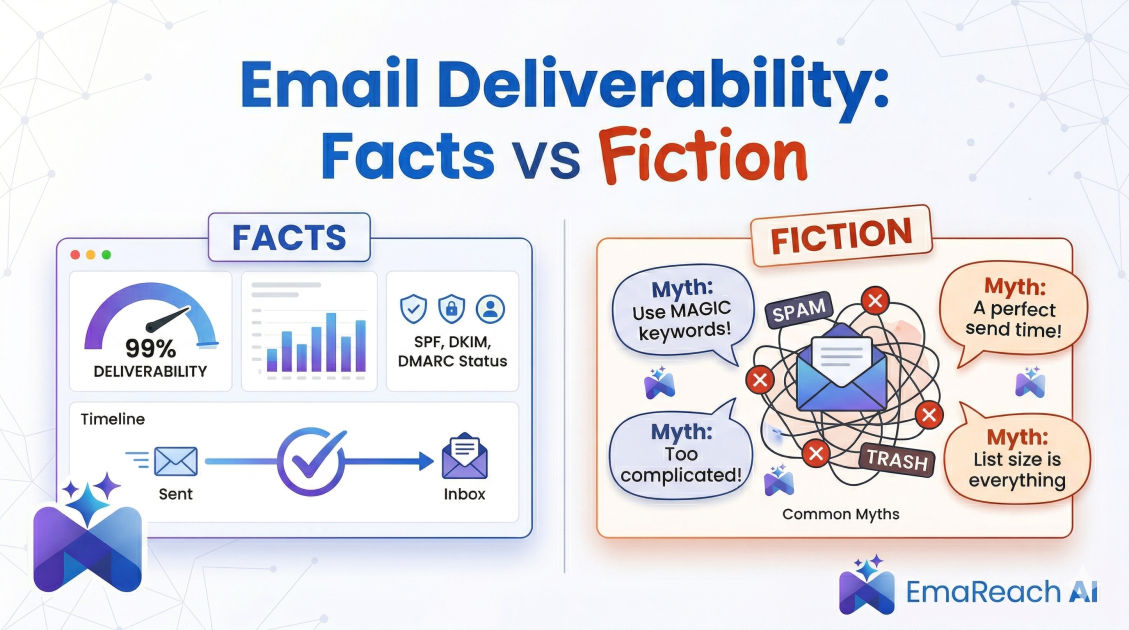
Email Deliverability: Facts vs Fiction
email deliverabilitycold emailinbox placementemail marketingsender reputationoutreach strategy
Introduction
In the world of digital marketing, few metrics are as misunderstood as email deliverability. For many, it remains a dark art—a mysterious combination of luck, timing, and technical wizardry. When a campaign fails to hit the mark, we often point to the 'algorithm' or 'spam filters' without truly understanding the mechanics behind the scenes.
Email deliverability is not just about whether an email was sent; it is about whether it reached the intended recipient's inbox. As inbox service providers (ISPs) like Google and Microsoft become more sophisticated, the line between reaching the primary tab and disappearing into the spam folder becomes thinner. This has led to a proliferation of myths, outdated advice, and pure fiction that can actually harm your sending reputation if followed blindly.
In this comprehensive guide, we will dismantle the common myths and highlight the core facts you need to master your inbox placement. Whether you are running newsletters or high-stakes sales outreach, understanding the reality of deliverability is the only way to ensure your voice is heard.
Section 1: The Core Foundation of Deliverability
Before we dive into the myths, we must define what deliverability actually is. It is a multi-layered ecosystem consisting of technical authentication, sender reputation, and content quality.
Delivery vs. Deliverability
One of the most common points of confusion is the difference between these two terms. Delivery means the receiving server accepted your email. A '100% delivery rate' simply means your emails didn't bounce; it says nothing about where those emails landed. Deliverability (or inbox placement) is the percentage of those delivered emails that actually reached the inbox rather than the junk folder.
The Role of ISPs
Inbox Service Providers (ISPs) act as gatekeepers. Their primary loyalty is to their users, not to senders. To protect their users from clutter and malicious content, they use complex machine-learning models to evaluate every incoming message. These models look at your history, your technical setup, and how users interact with your previous emails.
Section 2: Common Fictions in Email Deliverability
Fiction #1: Using 'Spam Trigger Words' Guarantees the Junk Folder
For years, marketers have lived in fear of words like 'Free,' 'Buy Now,' or 'Winner.' While it is true that certain keywords are associated with low-quality content, modern spam filters are far more intelligent than a simple keyword scanner.
The Fact: Deliverability is context-dependent. If a reputable brand with a high engagement rate uses the word 'Free' in a subject line, it will likely land in the inbox. However, if a brand with a poor reputation and high complaint rates uses it, the filter may trigger. It is the reputation of the sender, not a single word in the subject line, that carries the most weight.
Fiction #2: Sending More Emails Improves Your Reputation
There is a dangerous belief that 'more is better.' Some believe that high volume signals to ISPs that you are a legitimate, large-scale sender.
The Fact: High volume without high engagement is a recipe for disaster. If you send 100,000 emails and only 1% of people open them, ISPs see you as a nuisance. Consistency is more important than volume. Sudden spikes in sending volume are a major red flag for spam filters, which is why 'warming up' an inbox is a non-negotiable step for any serious outreach strategy.
Fiction #3: Hard Bounces Don't Matter if the List is Large
A hard bounce occurs when an email address is invalid or non-existent. Some marketers ignore a small percentage of bounces, thinking the sheer volume of successful deliveries will mask the errors.
The Fact: ISPs track your bounce rate meticulously. A high bounce rate (usually anything over 2%) suggests that you are using an unverified or 'scraped' list. This signals poor list hygiene and can lead to immediate temporary or permanent blacklisting.
Section 3: The Hard Facts of High-Performance Outreach
While avoiding myths is a start, proactive success requires doubling down on the proven pillars of deliverability. In the realm of cold outreach, where you are contacting people who don't yet know you, the stakes are even higher.
Fact #1: Technical Authentication is Mandatory
You cannot skip the technical setup. Without SPF, DKIM, and DMARC, you are essentially sending mail without an ID card.
- SPF (Sender Policy Framework): Specifies which mail servers are authorized to send email on behalf of your domain.
- DKIM (DomainKeys Identified Mail): Adds a digital signature to your emails, proving they weren't tampered with in transit.
- DMARC (Domain-based Message Authentication, Reporting, and Conformance): Tells the receiving server what to do if the SPF or DKIM checks fail.
Fact #2: Engagement is the New SEO
ISPs now prioritize 'behavioral signals.' If users regularly open your emails, move them to folders, or (most importantly) reply to them, your reputation soars. Conversely, if users delete your emails without opening them or mark them as spam, your deliverability will tank.
This is where the quality of your outreach becomes a technical necessity. To succeed in modern outreach, you need a solution that mimics human behavior and ensures high engagement from the start.
Stop Landing in Spam. Cold Emails That Reach the Inbox. EmaReach AI combines AI-written cold outreach with inbox warm-up and multi-account sending—so your emails land in the primary tab and get replies. By automating the 'human' element of engagement, EmaReach ensures that ISPs view your accounts as high-authority senders.
Fact #3: Dedicated IPs Aren't Always Better
Many believe that moving to a dedicated IP is the ultimate solution for deliverability. While it gives you total control over your reputation, it also means you bear total responsibility. If you don't have enough volume to keep a dedicated IP 'warm,' your deliverability will actually suffer compared to being on a high-quality shared IP pool.
Section 4: The Psychology of Spam Filters
To master deliverability, you must think like an ISP. Their goal is to provide a 'clean' experience for their users. They categorize mail into three main buckets: Inbox, Promotions/Social, and Spam.
The 'Promotions' Tab Myth
Many marketers view the Google Promotions tab as a failure.
The Fact: The Promotions tab is still the inbox. It is a categorized view, not a spam filter. Research shows that users often go to the Promotions tab when they are in a 'shopping' or 'learning' mindset, which can actually lead to higher conversion rates than a cluttered primary tab. However, for cold outreach and personal sales, landing in the Primary Tab is the holy grail. Achieving this requires personalized, plain-text-style emails that lack heavy tracking scripts or excessive imagery.
Reputation is Tied to the Domain, Not Just the IP
In the past, you could simply switch IP addresses to 'reset' your reputation. Today, ISPs track Domain Reputation. If your domain gets a bad name, switching servers won't save you. You must protect your domain at all costs by verifying your lists and ensuring your content is relevant to your audience.
Section 5: Best Practices for Maintaining a Pristine Reputation
Maintaining deliverability is an ongoing process of hygiene and monitoring. It is not a 'set it and forget it' task.
1. Rigorous List Cleaning
Use verification tools to remove 'catch-all' addresses, syntax errors, and known 'spam traps' (email addresses maintained by ISPs specifically to catch bad senders). If a subscriber hasn't engaged in six months, it is time to let them go. A smaller, engaged list is infinitely more valuable than a massive, dormant one.
2. Monitor Blacklists
Regularly check if your domain or IP has been added to major blacklists like Spamhaus or Barracuda. If you find yourself listed, investigate the cause immediately. Usually, it's a spike in complaints or a sudden change in sending volume.
3. Simplify Your Design
Heavy HTML, numerous images, and multiple links are common indicators of marketing blasts. For high-stakes outreach, keep it simple. Plain text or very light HTML often performs best because it looks like a one-to-one communication between two humans. This is a core philosophy behind platforms like EmaReach, which focuses on the effectiveness of personalized, human-centric AI writing to bypass the 'marketing' filters of modern ISPs.
4. Provide an Easy Way Out
It might seem counterintuitive, but making the 'Unsubscribe' button easy to find actually helps your deliverability. If a user can't find a way to opt-out, they will hit the 'Report Spam' button instead. A spam complaint is significantly more damaging to your reputation than an unsubscribe.
Section 6: Emerging Trends in Deliverability
As we look toward the future, the 'fiction' around email will continue to evolve as technology advances. We are seeing a shift toward even more personalized filtering.
Individualized Filtering
ISPs are moving toward 'individualized' deliverability. This means that an email from Sender A might land in User X's inbox because they frequently engage with it, but land in User Y's spam folder because they never open it. Your 'reputation' is becoming a personalized metric between you and every single person on your list.
BIMI (Brand Indicators for Message Identification)
BIMI is a new standard that allows brands to display their logo next to their emails in the inbox. While it requires a high level of DMARC enforcement, it provides a visual cue of trust that can significantly increase open rates and reinforce your legitimacy to the ISP.
Section 7: Troubleshooting Common Deliverability Issues
If you find your open rates dropping or your emails consistently hitting the junk folder, follow this checklist to identify the culprit:
- Check Your Authentication: Use a 'mail tester' tool to ensure SPF, DKIM, and DMARC are all passing.
- Analyze Complaint Rates: Did you recently send a controversial campaign? Did you buy a new list? A sudden jump in 'Mark as Spam' reports is the most common cause of a deliverability crash.
- Review Recent Changes: Did you change your 'From' name? Did you add a new tracking domain? Small changes in infrastructure can have outsized impacts.
- Test Your Content: Send a test version of your email to a tool that checks against major spam filters. Sometimes, a specific link or a broken piece of HTML code is the hidden trigger.
Conclusion
Mastering email deliverability requires moving past the myths and focusing on the fundamental truths of the inbox. Success is built on a foundation of technical excellence, consistent and gradual volume, and, above all, genuine engagement.
Spam filters are not your enemy; they are quality control mechanisms. By aligning your strategy with the goals of the ISPs—providing value and protecting the user—you can ensure your messages land exactly where they belong: the primary inbox.
Fiction may suggest there are 'hacks' or 'shortcuts' to the inbox, but the facts show that long-term success comes from reputation management and smart automation. Tools like EmaReach bridge the gap between scale and deliverability, allowing you to conduct high-volume outreach without sacrificing the sender reputation you have worked so hard to build. Focus on the data, respect your recipients, and the results will follow.
EmaReach AI
Ready to scale your cold email outreach?
Join thousands of teams using EmaReach AI for AI-powered campaigns, domain warmup, and 95%+ deliverability. Start free — no credit card required.
Related posts
- Read article
The Instantly Alternative That Finally Gets Outbound Analytics Right
Discover why high-volume cold email requires a shift from surface-level vanity metrics to deep, data-driven revenue attribution, and explore the ultimate alternatives for mastering outbound engineering.
- Read article
What You Gain and What You Give Up When Switching From Instantly
Thinking about migrating your cold email stack? This detailed guide breaks down the exact operational advantages you gain and the core features you sacrifice when switching away from Instantly's popular outreach platform.