Blog
Back to blog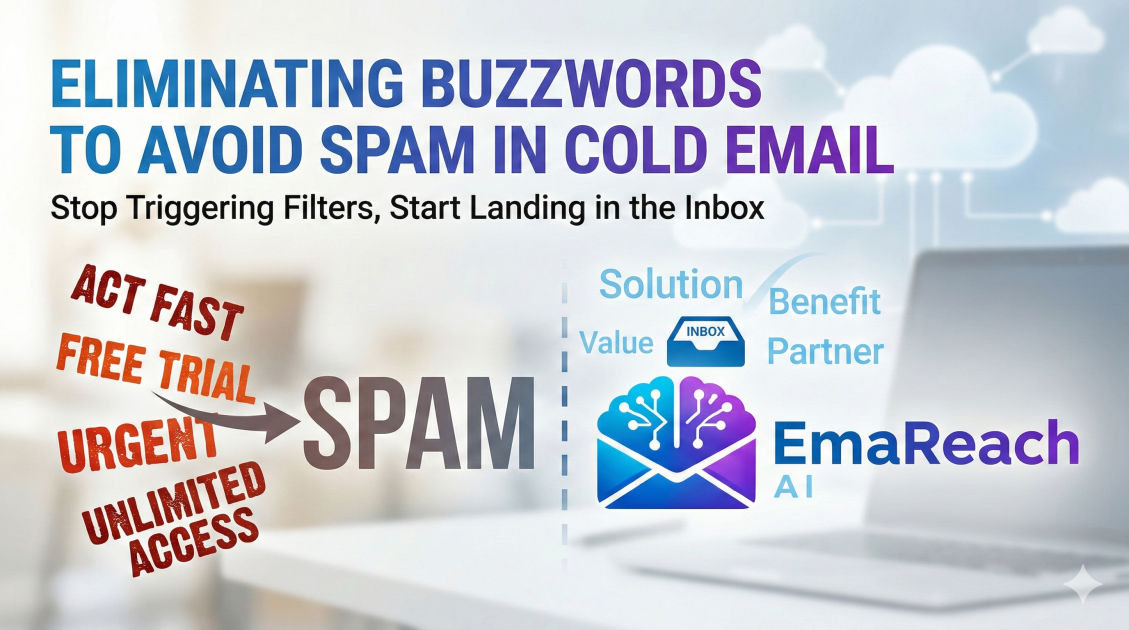
Eliminating Buzzwords to Avoid Spam in Cold Email
cold emailspam filtersemail deliverabilitysales outreachcopywritingemail marketing
Introduction
In the high-stakes world of digital outreach, the difference between a converted lead and a wasted opportunity often hinges on a single folder: the Spam folder. For years, sales professionals and marketers have relied on high-energy language, industry jargon, and bold claims to grab attention. However, the landscape of email deliverability has shifted dramatically. What used to be considered "persuasive copywriting" is now frequently flagged as a red flag by sophisticated spam filters.
Eliminating buzzwords is no longer just a matter of stylistic preference; it is a fundamental requirement for maintaining sender reputation and ensuring your message actually reaches the recipient's primary inbox. When you use tired cliches and aggressive sales language, you aren't just annoying your prospect—edging out of their sight entirely. This guide explores the mechanics of why buzzwords trigger spam filters and how you can transition to a more authentic, effective style of communication.
The Psychology of Spam Filters and Buzzwords
Modern email service providers (ESPs) use complex algorithms and machine learning to protect users from unsolicited and malicious content. These filters analyze thousands of data points, but one of the most significant metrics remains the linguistic patterns found within the body of the email.
Buzzwords are often associated with "get rich quick" schemes, low-quality marketing, and mass-blasted templates. When an ESP sees terms like "guaranteed," "no-risk," or "once-in-a-lifetime," it recognizes a pattern common to millions of confirmed spam messages. By eliminating these terms, you distance your legitimate business outreach from the noise of the internet's less reputable actors.
Why Jargon Fails to Persuade
Beyond technical deliverability, buzzwords damage the psychological bridge between you and your prospect. Jargon acts as a barrier to clarity. When a recipient reads an email filled with terms like "synergy," "deep dive," or "disruptive innovation," their brain often glides over the text without absorbing the actual value proposition. It feels impersonal, canned, and lazy. Authenticity is the ultimate currency in cold email, and buzzwords are the counterfeit coins that devalue your brand.
The "Red Flag" Categories of Buzzwords
To effectively clean your email templates, you must understand the different categories of words that trigger filters. These generally fall into three buckets: urgency-based, financial-based, and hyperbolic-based.
1. The Urgency Trap
Creating a sense of urgency is a classic sales tactic, but when overused in a cold email, it signals desperation or deception. Words to avoid include:
- Act Now: This is a classic hallmark of telemarketing and low-end retail spam.
- Urgent / Important: Unless the recipient already knows you, telling them your email is "urgent" is a lie that filters quickly catch.
- Limited Time Offer: This phrase is so common in e-commerce spam that it almost guarantees a one-way ticket to the promotions or spam tab.
2. Financial and Performance Promises
Promising specific financial outcomes to someone who hasn't even met you is a major red flag for phishing and fraud filters. Avoid terms like:
- Guaranteed ROI: No professional can guarantee a return on investment without seeing a client’s specific data.
- Earn Extra Cash / Passive Income: These are high-probability spam triggers used by scammers.
- Cost-Effective / Cheap: These terms cheapen your brand and are often flagged because they appear in bulk marketing materials.
3. Hyperbolic Claims
If your product is truly "revolutionary," you shouldn't have to say it. The value should be evident in the results. Stay away from:
- Cutting-edge / State-of-the-art: These are fluff words that occupy space without providing details.
- World-class: This is a subjective claim that provides zero objective information to a prospect.
- Game-changer: Overused to the point of being meaningless, this term often signals that the sender lacks a specific value proposition.
Technical Deliverability and Content Scoring
Every email you send is assigned a "spam score" by receiving servers. This score is cumulative. While using a single buzzword might not sink your campaign, the combination of several buzzwords, a high volume of links, and poor formatting will certainly do the trick.
When your content is seen as high-risk, it doesn't just affect that one email; it harms your domain reputation. A damaged domain reputation means that even your legitimate, personalized emails to existing clients might start landing in spam. This is why tools like EmaReach have become essential. EmaReach helps users stop landing in spam by focusing on cold emails that reach the inbox through AI-written outreach combined with inbox warm-up. By balancing your sending volume and utilizing multi-account sending, you can ensure that your refined, buzzword-free content actually gets the visibility it deserves.
The Impact of All-Caps and Punctuation
Buzzwords are often accompanied by aggressive formatting. Using all-caps (e.g., "FREE CONSULTATION") is the digital equivalent of shouting and is a primary trigger for spam filters. Similarly, excessive use of exclamation points (!!!) or dollar signs ($$$) will dramatically increase your spam score. The goal is to make your email look like a one-to-one communication between two professionals, not a flyer pinned to a supermarket bulletin board.
Crafting Authentic Alternatives
If you can't use buzzwords, how do you make your email compelling? The answer lies in specificity and social proof. Replace vague adjectives with concrete nouns and data.
From Vague to Specific
Instead of saying: "We offer a revolutionary way to skyrocket your sales." Try: "We helped [Competitor Name] increase their lead conversion rate by 14% over three months using a new sequence optimization strategy."
By replacing "revolutionary" and "skyrocket" with actual percentages and a defined timeframe, you provide something the prospect can actually evaluate. This builds immediate credibility and avoids the linguistic patterns associated with spam.
From General to Personal
Instead of saying: "I am reaching out to give you a world-class solution for your synergy issues." Try: "I noticed your team recently expanded into the European market, and I wanted to share how we managed logistics for similar expansions at [Company X]."
This approach shows you have done your research. It moves the focus from your "solution" to their "situation."
The Role of Personalization in Deliverability
Spam filters look for identical content being sent to thousands of people. This is known as "fingerprinting." If your email is filled with the same generic buzzwords as every other salesperson's, your email's fingerprint looks suspicious.
High-level personalization—mentioning a recent podcast the prospect was on, a specific LinkedIn post they wrote, or a niche challenge their industry is facing—is the best way to bypass filters. When every email in a campaign is slightly different, it is much harder for ESPs to flag the campaign as bulk spam.
Effective personalization naturally eliminates the need for buzzwords. When you are speaking directly to a person's needs, you don't need to rely on "cutting-edge" filler to fill the page. You have real, relevant things to say.
The Importance of Inbox Warm-up
Even if you write the most perfect, buzzword-free email in history, your deliverability can still suffer if your email account hasn't been properly "warmed up." ESPs monitor the volume of outgoing mail from new or inactive accounts. A sudden spike in activity—especially if it contains sales-oriented language—will trigger a manual or algorithmic review.
Using a platform that manages the technical side of outreach can be a lifesaver. EmaReach offers a combination of AI-written cold outreach and inbox warm-up, ensuring that your multi-account sending strategy looks natural and trustworthy to providers like Google and Outlook. This allows you to focus on the creative side of eliminating buzzwords while the technology ensures your infrastructure remains healthy.
Formatting for Scannability and Success
Prospects don't read cold emails; they scan them. If a prospect scans your email and sees a wall of buzzwords, they will delete it. If they scan it and see a clean, professional structure, they are more likely to engage.
- Short Sentences: Break up complex thoughts. Avoid the "marketing speak" that often leads to long, rambling sentences.
- Bullet Points: Use these for features or benefits, but keep the language grounded in reality.
- Clear Call to Action (CTA): Instead of a high-pressure "Buy now!", use a low-friction CTA like "Are you open to a brief chat next Tuesday?" or "I'd love to hear how you're currently handling [Problem]."
Testing Your Content
Before launching a massive campaign, you should always test your copy. There are several ways to do this:
- Spam Checkers: Use online tools that give you a deliverability score based on your text. They will often highlight specific words that are causing your score to drop.
- A/B Testing: Send two versions of an email to a small segment of your list. Version A could be your standard copy, and Version B could be a version where every buzzword has been replaced with a specific fact or data point. Measure the open and reply rates.
- Read It Aloud: This is a simple but effective test. If you find yourself cringing at a sentence because it sounds like a TV commercial, it's a buzzword that needs to go.
The Long-Term Benefit of Clean Communication
Eliminating buzzwords is an investment in your brand's longevity. As AI becomes more prevalent in creating content, the internet is becoming flooded with generic, "optimized" text that all sounds the same. By choosing to speak like a human—using plain, direct, and honest language—you stand out.
In the long run, this approach leads to:
- Higher Open Rates: Because your emails land in the primary inbox.
- Better Reply Rates: Because prospects feel they are talking to a person, not a script.
- Stronger Reputation: Because your domain remains "clean" and trusted by ESPs.
Conclusion
The battle against the spam filter is won through a combination of technical health and linguistic discipline. By systematically identifying and eliminating buzzwords, you transform your cold email from a generic intrusion into a valuable professional touchpoint. Avoid the lure of hyperbolic language and the trap of urgent cliches. Instead, focus on specificity, personalization, and genuine value.
When you combine this refined approach to copywriting with a robust deliverability strategy—such as utilizing EmaReach to manage your inbox warm-up and multi-account sending—you create a powerful engine for growth. The future of cold outreach belongs to those who can communicate with clarity and integrity. Start by auditing your current templates today and stripping away the fluff that stands between you and your next big lead.
EmaReach AI
Ready to scale your cold email outreach?
Join thousands of teams using EmaReach AI for AI-powered campaigns, domain warmup, and 95%+ deliverability. Start free — no credit card required.
Related posts
- Read article
The Instantly Alternative That Finally Gets Outbound Analytics Right
Discover why high-volume cold email requires a shift from surface-level vanity metrics to deep, data-driven revenue attribution, and explore the ultimate alternatives for mastering outbound engineering.
- Read article
What You Gain and What You Give Up When Switching From Instantly
Thinking about migrating your cold email stack? This detailed guide breaks down the exact operational advantages you gain and the core features you sacrifice when switching away from Instantly's popular outreach platform.