Blog
Back to blog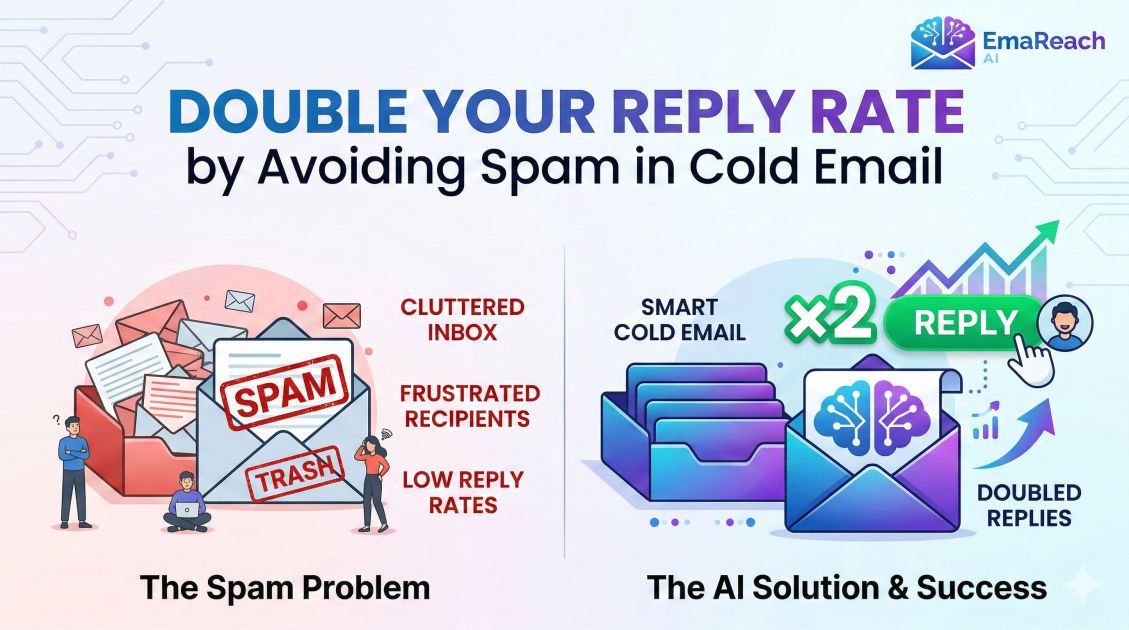
Double Your Reply Rate by Avoiding Spam in Cold Email
cold emailemail deliverabilitysales outreachspam filtersB2B marketingemail authentication
Introduction
In the world of B2B growth, cold email remains one of the most powerful levers for generating predictable revenue. However, a significant barrier stands between your carefully crafted pitch and your prospect's attention: the spam filter. Every year, mailbox providers like Google and Microsoft become more sophisticated, using machine learning and behavioral analysis to shield users from unwanted noise.
If your emails are landing in the 'Promotions' tab or, worse, the 'Spam' folder, your reply rate will inevitably hover near zero. Doubling your reply rate isn't always about writing a better subject line or a more clever call to action; often, it is simply about ensuring your message actually reaches the primary inbox. This guide explores the technical, behavioral, and content-driven strategies required to bypass filters and land where your prospects are actually looking.
The Technical Foundation: Authenticating Your Domain
Before you send a single email, you must prove to the receiving server that you are who you say you are. Without proper authentication, your emails are viewed as high-risk. There are three pillars of email authentication that every cold caller must implement.
SPF (Sender Policy Framework)
SPF is a DNS record that lists the specific IP addresses and services authorized to send emails on behalf of your domain. When an email arrives, the recipient's server checks the SPF record. If the sender isn't on the list, the email is flagged.
DKIM (DomainKeys Identified Mail)
DKIM adds a digital signature to your emails. This cryptographic header ensures that the content of the email hasn't been tampered with during transit. It acts as a seal of integrity for your domain.
DMARC (Domain-based Message Authentication, Reporting, and Conformance)
DMARC sits on top of SPF and DKIM. It tells receiving servers what to do if an email fails authentication—whether to do nothing, quarantine the email, or reject it entirely. Having a 'p=quarantine' or 'p=reject' policy signals to providers that you take security seriously.
Domain Reputation and the Dangers of the 'Burned' Domain
Your domain reputation is a score assigned by Internet Service Providers (ISPs) based on your sending history. If you send 1,000 emails a day from a brand-new domain, ISPs will assume you are a spammer and blackhole your messages.
Use Secondary Domains
Never send high-volume cold emails from your primary corporate domain (e.g., use getcompany.com instead of company.com). This protects your essential business operations from being blacklisted if your cold outreach hits a snag.
The Importance of Inbox Warm-up
Inbox warm-up is the process of gradually increasing your sending volume to build trust with ISPs. It involves sending small batches of emails that are opened, replied to, and marked as 'not spam' by a network of real or simulated users.
For those looking to streamline this process, EmaReach (https://www.emareach.com/) offers a powerful solution. EmaReach AI combines AI-written cold outreach with inbox warm-up and multi-account sending—so your emails land in the primary tab and get replies. This automated trust-building is essential for maintaining a high sender score over time.
Content Strategies to Bypass AI Filters
Modern spam filters don't just look at technical settings; they read your content. They look for patterns associated with 'spammy' behavior, such as aggressive sales language and poor formatting.
Avoiding Spam Trigger Words
Certain words act as red flags for filters. While a few might not hurt, a high density of these terms will trigger a manual or algorithmic review:
- Financial: 'Free', 'Cash', 'Earn $$$', 'No cost', 'Investment'.
- Urgency: 'Act now', 'Limited time', 'Urgent', 'Instant'.
- Hype: '100% Guaranteed', 'Risk-free', 'Winner', 'Miracle'.
The Role of Personalization
If you send the exact same template to 500 people, filters recognize the footprint of a mass blast. By using dynamic variables—such as the prospect’s specific job title, recent company news, or a unique pain point—you create 'fingerprint' diversity. This makes each email unique in the eyes of the ISP.
Minimizing Links and Attachments
Links and attachments are the primary vehicles for malware and phishing. If you include three different links and a heavy PDF in your first touchpoint, you are significantly increasing your chances of being marked as spam.
- Rule of Thumb: Use a maximum of one link in your initial cold email (usually a calendar link or a website link). Avoid tracking links that use suspicious redirects; instead, use custom tracking domains that match your sending domain.
Behavioral Triggers: How Engagement Impacts Deliverability
Deliverability is a feedback loop. If people open your emails, reply to them, and move them to their primary folder, your reputation goes up. If they delete them without opening or click 'Report Spam,' your reputation plummets.
The Power of the 'Unsubscribe' Link vs. Text
While it is legally required in many jurisdictions to provide an opt-out, the way you do it matters. Some experts suggest using a simple text-based opt-out (e.g., "Reply 'No' if you'd rather I not reach out") instead of a formatted 'Unsubscribe' link. This mimics a 1-to-1 personal email, which filters prefer over a newsletter-style marketing blast.
Managing Bounce Rates
A 'hard bounce' occurs when you send an email to an address that doesn't exist. High bounce rates (typically over 3%) tell ISPs that you are using a poor-quality, unverified list—a classic hallmark of a spammer. Use email verification tools to scrub your list before every campaign.
Optimizing Your Sending Schedule
Sending 500 emails at 9:00 AM on a Monday is a signal for 'mass mailing.' Instead, use a 'staggered' sending approach. Spread your emails out over the course of the day with random intervals between each send. This mimics human behavior—no human can send an email every exactly 30 seconds for four hours straight.
Multi-Account Sending
Instead of sending 200 emails from one account, send 40 emails from five different accounts. This reduces the load on any single inbox and provides a safety net. If one account is flagged, the others remain operational, ensuring your pipeline doesn't dry up while you troubleshoot.
Writing for the Primary Tab: Structure and Tone
Once you've solved the technical hurdles, you need to write content that encourages a reply. A reply is the ultimate signal to an ISP that your email is wanted. To double your reply rate, you must shift from 'broadcasting' to 'conversing.'
The Subject Line: Curiosity over Clickbait
Your subject line should look like it came from a colleague, not a marketing department.
- Bad: "Our Revolutionary New Software Will Increase Your ROI By 400%!!"
- Good: "Question about [Department] at [Company]"
- Good: "Internal process for [Pain Point]"
Keep it short (3-5 words) and avoid all-caps or excessive punctuation.
The Opening Sentence: The 'No-Me' Rule
Most cold emails start with "My name is... and I work for..." This is an immediate signal to the prospect that a sales pitch is coming. Instead, start with something about them. Mention a recent podcast they appeared on, a promotion, or a specific problem their industry is facing.
The Call to Action (CTA): Low Friction is King
Asking for a 30-minute demo in the first email is a high-friction request. To get a reply, lower the barrier to entry.
- High Friction: "Are you free for a 30-minute call on Tuesday?"
- Low Friction: "Is this something you're currently prioritizing?"
- Low Friction: "Mind if I send over a 1-minute video explaining how we solved this for [Competitor]?"
Monitoring and Maintenance
Deliverability is not a 'set it and forget it' task. It requires constant monitoring of key metrics:
| Metric | Healthy Benchmark | Warning Sign |
|---|---|---|
| Open Rate | 40% - 60% | Below 20% (Potential Spam Folder issue) |
| Bounce Rate | < 2% | > 5% (Bad data quality) |
| Spam Complaint Rate | < 0.1% | > 0.5% (Irrelevant or annoying content) |
| Reply Rate | 5% - 15% | Below 2% (Poor targeting or weak CTA) |
If your open rates suddenly drop, check your domain against common blacklists and verify that your SPF/DKIM records haven't been altered. Regular 'health checks' on your domain reputation are vital for long-term success.
Conclusion
Doubling your reply rate is a two-step process: first, you must earn the right to be seen by mastering the technical nuances of deliverability; second, you must earn the right to be heard by crafting personalized, low-friction messages. By implementing SPF, DKIM, and DMARC, warming up your domains, and avoiding spam-heavy language, you clear the path for your message.
Remember that cold email is a marathon, not a sprint. Maintaining a clean reputation and focusing on high-quality, targeted outreach will always outperform high-volume, low-quality blasts. When you treat the prospect's inbox with respect and provide genuine value, the replies will follow naturally.
EmaReach AI
Ready to scale your cold email outreach?
Join thousands of teams using EmaReach AI for AI-powered campaigns, domain warmup, and 95%+ deliverability. Start free — no credit card required.
Related posts
- Read article
The Instantly Alternative That Finally Gets Outbound Analytics Right
Discover why high-volume cold email requires a shift from surface-level vanity metrics to deep, data-driven revenue attribution, and explore the ultimate alternatives for mastering outbound engineering.
- Read article
What You Gain and What You Give Up When Switching From Instantly
Thinking about migrating your cold email stack? This detailed guide breaks down the exact operational advantages you gain and the core features you sacrifice when switching away from Instantly's popular outreach platform.