Blog
Back to blog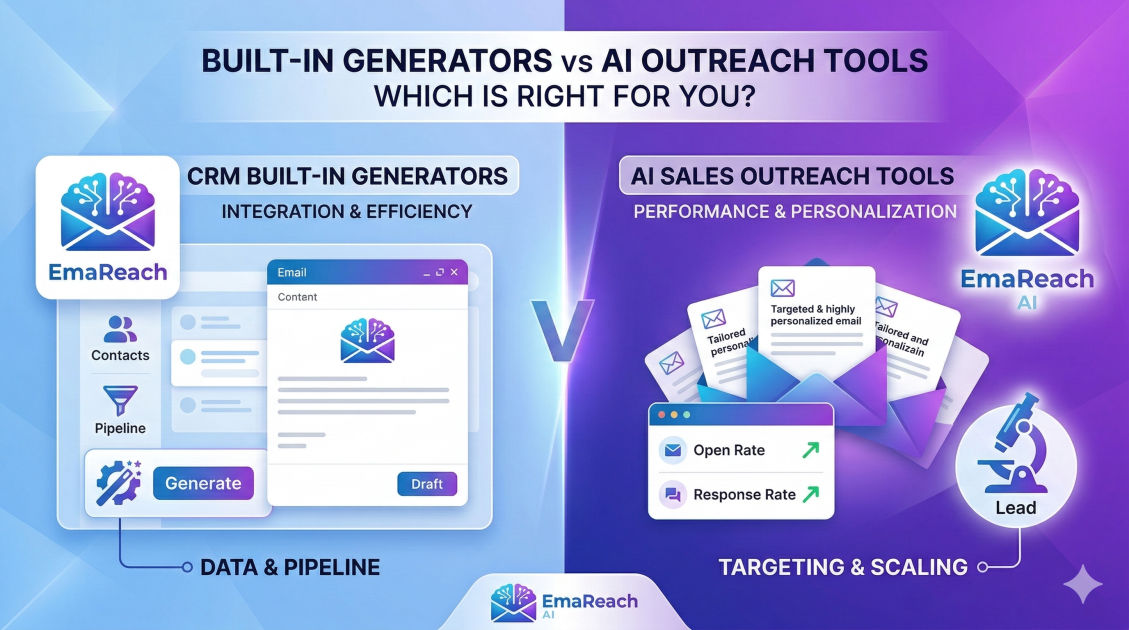
CRM Built-in Generators vs AI Sales Outreach Tools
CRMSales AutomationAI OutreachCold EmailSales TechnologyLead Generation
Introduction
The landscape of modern sales has undergone a seismic shift. Gone are the days of manual data entry and generic cold calling as the primary drivers of revenue. Today, the debate in sales operations circles centers on a critical infrastructure choice: Should a business rely on the built-in AI generators provided by their Customer Relationship Management (CRM) platform, or should they invest in specialized AI sales outreach tools?
As CRM giants integrate large language models directly into their ecosystems, the convenience of a 'one-stop-shop' is enticing. However, specialized sales outreach platforms have pivoted to offer depth, deliverability, and advanced personalization that generic CRM add-ons often struggle to match. Understanding the nuances between these two approaches is essential for any sales leader looking to scale their outbound efforts without sacrificing quality or reputation.
The Rise of the CRM Built-in Generator
CRMs were originally designed as systems of record—digital filing cabinets for customer interactions. Over time, they evolved into systems of engagement. The latest iteration of this evolution is the integration of generative AI directly into the interface where sales reps spend most of their day.
The Convenience Factor
The primary argument for CRM built-in generators is seamless workflow integration. When an AI generator lives inside your CRM, there is no need to export data, set up complex API integrations, or jump between browser tabs. A rep can open a lead record and click a button to 'Generate Email.' The AI has immediate access to the fields within that record—name, company, industry, and previous touchpoints.
Unified Data Streams
Built-in tools benefit from being part of a single source of truth. Because the AI is native to the database, the feedback loop is instantaneous. If an AI-generated email leads to a closed-won deal, that data is already in the system, theoretically allowing the CRM's machine learning models to understand which patterns correlate with success across the entire customer lifecycle.
Cost-Effectiveness for Small Teams
For many organizations, the AI features are bundled into existing premium tiers. For a small team with a limited budget, using the 'good enough' generator included in their CRM subscription is often more attractive than adding another monthly software expense. It lowers the barrier to entry for AI adoption, allowing teams to experiment with automated drafting without a significant financial commitment.
The Specialized AI Sales Outreach Advantage
While CRM generators offer convenience, specialized AI sales outreach tools are built with a 'depth-first' philosophy. These platforms are engineered specifically for the hunt. They don't just draft text; they manage the complex infrastructure of modern digital prospecting.
Advanced Personalization and Hyper-Contextualization
CRM generators typically rely on the data points already present in the CRM. If your data is messy or sparse, the output will be generic. Specialized AI outreach tools often include 'intent data' and 'social scraping' capabilities. They can scan a prospect’s recent LinkedIn posts, company news, or financial reports to weave together a narrative that feels deeply personal.
This is where platforms like EmaReach shine. Rather than just filling in a template, these tools focus on 'Stop Landing in Spam. Cold Emails That Reach the Inbox.' By combining AI-written cold outreach with sophisticated delivery mechanics, they ensure that the personalization actually serves a purpose: getting a human response.
Multi-Channel Orchestration
Modern outreach is rarely limited to email. Specialized tools are designed to orchestrate sequences across LinkedIn, Twitter, phone calls, and email. While a CRM might be able to log these activities, a dedicated outreach tool uses AI to determine the optimal timing and channel for the next touchpoint based on real-time engagement signals.
The Deliverability Gap: A Critical Distinction
One of the most significant differences between these two categories is how they handle the technical side of sending. Writing a great email is useless if it lands in the 'Promotions' tab or, worse, the spam folder.
Inbox Warm-up and Technical Health
CRM systems are built to send bulk emails—newsletters, marketing updates, and transactional alerts. They are not always optimized for the 'low-and-slow' cadence required for successful cold outreach. Specialized AI tools often include built-in inbox warm-up features. These features simulate human conversation to build a sender reputation with ISPs (Internet Service Providers).
Multi-Account Sending
To scale outreach safely, seasoned sales pros use multiple domains and accounts to spread the volume. Most CRMs struggle with this, often tethering a user to a single primary email integration. Specialized tools allow for multi-account sending, rotating through different 'from' addresses to ensure no single account hits a daily limit that triggers a spam filter. This infrastructure is a core component of the EmaReach AI philosophy, ensuring that high-volume outreach doesn't result in a blacklisted domain.
Feature Comparison: A Closer Look
| Feature | CRM Built-in Generators | Specialized AI Outreach Tools |
|---|---|---|
| Data Source | Internal CRM fields only | Internal + External (Web/Social) |
| Workflow | Native to lead record | Separate platform / Extension |
| Deliverability | Basic / Marketing-focused | Advanced (Warm-up, Multi-account) |
| Personalization | Variable-based (Tagging) | Contextual (AI Research-based) |
| Learning Loop | Based on deal stages | Based on open/reply/sentiment |
When to Choose a CRM Built-in Generator
Despite the power of specialized tools, there are specific scenarios where the built-in CRM generator is the superior choice:
- Low Volume, High Value: If your reps only reach out to five prospects a week and spend hours researching each one, a simple AI assistant to help polish their prose is all they need.
- Inbound Heavy Models: If your leads are coming to you, the 'outreach' is actually 'follow-up.' In this case, the context within the CRM (which whitepaper they downloaded, which webinar they attended) is the most important data point.
- Strict Data Governance: In highly regulated industries like banking or healthcare, IT departments may forbid the syncing of CRM data with third-party outreach tools. Using the native AI keeps the data within a single, approved security perimeter.
When to Invest in Specialized AI Sales Outreach Tools
If your growth strategy relies on outbound prospecting, the built-in tools will eventually hit a ceiling. You should look toward specialized platforms when:
- Scaling is the Priority: If you need to send hundreds of personalized emails a day across a team of ten reps, you need the deliverability safeguards and automation that only specialized tools provide.
- Data is Sparse: If you are entering a new market and don't have rich histories in your CRM, you need a tool that can perform 'just-in-time' research on prospects via the web.
- The 'Spam' Problem: If you notice your open rates are dropping despite 'good' copy, it is a sign that your delivery infrastructure is failing. Specialized tools offer the 'inbox warm-up' and 'primary tab' optimization required to fix this.
The Hybrid Strategy: The Best of Both Worlds?
Many high-performing sales organizations don't actually choose one or the other. Instead, they use a hybrid approach. They maintain their CRM as the system of record but use a specialized tool like EmaReach for the 'top of the funnel' activity.
In this model, the AI outreach tool handles the aggressive prospecting, the multi-account sending, and the initial engagement. Once a prospect replies and becomes a 'warm lead,' the data is pushed into the CRM, where the built-in AI generators help the account executive craft specific follow-ups, proposals, and closing documents.
The Role of Sentiment Analysis
One area where specialized tools are currently leading is sentiment analysis. While a CRM can tell you that a prospect replied, an AI-first outreach tool can tell you how they replied. Did they say 'Not interested' or 'Check back in six months'? Specialized tools can automatically categorize these replies and trigger different workflows, whereas most CRM generators still require a human to read the email and update a status field.
Future-Proofing Your Sales Stack
As you evaluate these tools, consider the 'speed of innovation.' CRM platforms are massive ships that turn slowly. Their AI features are often general-purpose, designed to serve marketers, support agents, and sales reps simultaneously.
Specialized AI sales tools are nimble. They are updated weekly to account for changes in Google’s or Outlook’s spam algorithms. They integrate the newest AI models (like GPT-4o or Claude 3.5) months before they might appear in a corporate CRM update. For a sales team, being on the cutting edge of AI personalization can be the difference between a 1% and a 10% meeting book rate.
Conclusion
The choice between CRM built-in generators and specialized AI sales outreach tools isn't about which technology is 'better' in a vacuum—it's about which one fits your specific go-to-market strategy. CRM generators offer unmatched convenience and a unified data experience, making them ideal for inbound-heavy teams or those with high-touch, low-volume requirements.
However, for the modern outbound organization, the specialized AI sales outreach tool is the necessary 'engine' for growth. With features like multi-account sending, advanced inbox warm-up, and hyper-contextual personalization, these tools ensure that your message doesn't just get written—it gets read. By prioritizing deliverability and specialized research, platforms like EmaReach allow sales teams to navigate the increasingly difficult landscape of the modern inbox, turning cold prospects into warm conversations with a level of efficiency that a general CRM simply cannot replicate.
EmaReach AI
Ready to scale your cold email outreach?
Join thousands of teams using EmaReach AI for AI-powered campaigns, domain warmup, and 95%+ deliverability. Start free — no credit card required.
Related posts
- Read article
What You Gain and What You Give Up When Switching From Instantly
Thinking about migrating your cold email stack? This detailed guide breaks down the exact operational advantages you gain and the core features you sacrifice when switching away from Instantly's popular outreach platform.
- Read article
The Instantly Alternative That Impressed Even the Biggest Instantly Fans
Discover why top outbound growth marketers and lead generation agencies are migrating from legacy cold email platforms to advanced alternatives built for superior deliverability, white-label client management, and robust API workflows.