Blog
Back to blog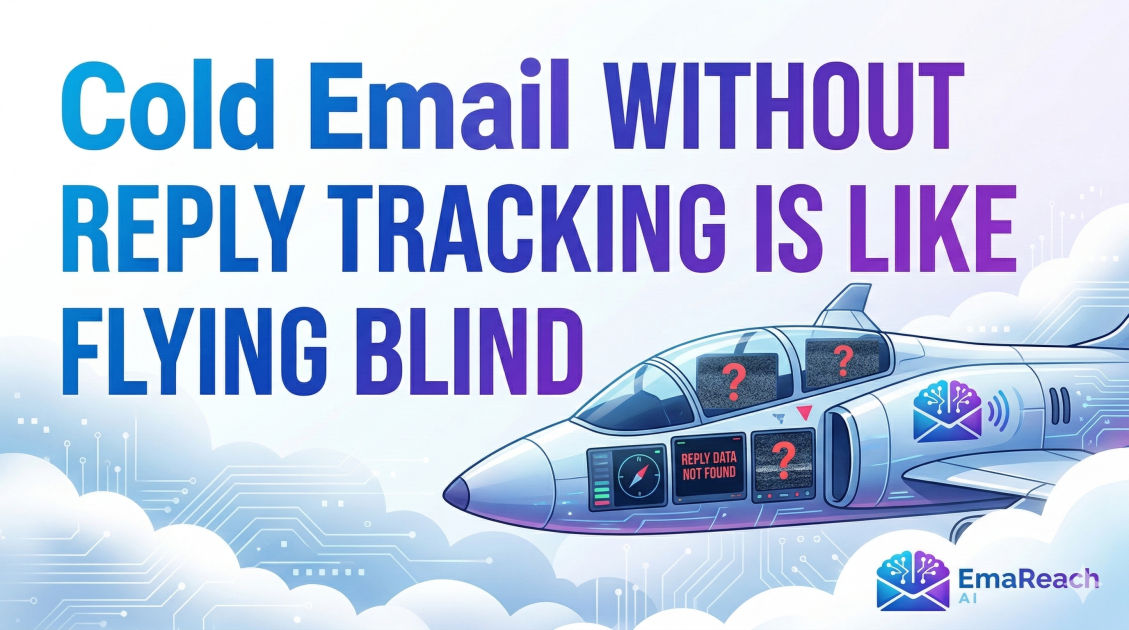
Cold Email Without Reply Tracking Is Like Flying Blind
cold emailoutreach strategyemail trackingsales automationdeliverabilitylead generation
Introduction: The High Stakes of Invisible Outreach
Imagine a pilot attempting to land a commercial jet in thick fog without an altimeter, radar, or radio communication. They are moving at hundreds of miles per hour, responsible for a valuable cargo, yet they have no data to confirm their position, their speed, or their proximity to the ground. In the world of sales and business development, sending cold emails without reply tracking is the professional equivalent of flying blind.
You are putting in the effort—crafting copy, building lists, and hitting send—but you are operating in a data vacuum. Without knowing who is responding, how quickly they are responding, and which segments of your audience are engaging, you aren't running a campaign; you are participating in a guessing game. This comprehensive guide explores why reply tracking is the fundamental backbone of any successful outreach strategy and how its absence can lead to the slow death of your deliverability and ROI.
The Psychology of the Feedback Loop
Human behavior is guided by feedback loops. When we speak to someone in person, we monitor their facial expressions and body language to adjust our tone. Cold emailing removes these physical cues, making digital feedback loops even more critical. Reply tracking serves as the primary pulse check for your messaging.
Understanding the Silence
When an email goes unanswered, there are dozens of possible reasons. Perhaps the subject line didn't resonate, the timing was off, or—more dangerously—the email landed in the spam folder. Without reply tracking, you cannot distinguish between a 'soft no' (the prospect saw it but wasn't interested) and a 'technical failure' (the prospect never saw it).
The Optimization Trap
Growth requires iteration. If you send 1,000 emails and receive zero replies, the logical step is to change the copy. But what if the copy was perfect, and the problem was actually your technical setup? Without tracking, you might discard a winning script based on incomplete data. You end up fixing things that aren't broken while ignoring the systemic issues that are actually grounded in your deliverability.
The Technical Necessity of Reply Detection
Reply tracking is more than just a convenience for your CRM; it is a vital component of automated sequence management. Modern outreach involves multiple touchpoints. If a prospect replies to your first email and your system doesn't 'see' it, what happens next?
The Danger of Ghost Sequences
If your automation continues to send follow-up emails to someone who has already replied, you immediately destroy your credibility. It signals to the prospect that they are just a row in a spreadsheet and that you aren't actually paying attention. This 'ghost sequencing' is one of the fastest ways to get marked as spam, which brings us to the most critical risk: deliverability.
Protecting Your Sender Reputation
Email service providers (ESPs) like Google and Outlook monitor engagement. A high reply rate tells an ESP that your content is valuable and wanted. Conversely, if you keep sending automated follow-ups to people who have already engaged or opted out, your 'report spam' rate will skyrocket.
To ensure your messages actually reach the inbox, tools like EmaReach become essential. EmaReach helps you stop landing in spam by ensuring cold emails reach the inbox through a combination of AI-written outreach, inbox warm-up, and multi-account sending. This ensures your emails land in the primary tab where they can actually generate the replies you are trying to track.
Quantifying Success: Metrics That Matter
When you fly with 'instruments' (tracking), you move from vanity metrics to actionable intelligence. Here are the specific data points that reply tracking unlocks:
1. Positive vs. Negative Reply Rates
Not all replies are created equal. A 'stop emailing me' response is very different from a 'let’s talk next Tuesday' response. Advanced reply tracking allows you to categorize the sentiment of your replies. This sentiment analysis is the true north for your product-market fit.
2. Time-to-Reply (TTR)
How long does it take for a prospect to get back to you? If your TTR is shrinking, it often means your urgency or relevancy is increasing. If it’s stretching out, your message might be perceived as a 'low priority' task for the recipient.
3. Lead Attribution by Segment
If you are targeting both CEOs and Marketing Managers, reply tracking allows you to see which persona is more receptive. Without this, you might see a 2% overall reply rate and think the campaign is mediocre, failing to notice that CEOs are replying at 10% while Marketing Managers are at 0%. You would be missing a massive opportunity to pivot your resources toward the high-performing segment.
The Blind Spots: What You Lose Without Tracking
Lost Revenue in the Gaps
In a manual environment without tracking, leads fall through the cracks. A prospect might reply with a question, and if that reply isn't immediately flagged and tracked against the campaign, it can get buried in a busy inbox. Research shows that lead response time is a major predictor of conversion. If you don't track the reply, you can't respond with the speed required to close the deal.
Inaccurate ROI Calculations
Marketing and sales budgets are allocated based on performance. If you cannot accurately track which campaign produced which reply, you cannot calculate your Cost Per Lead (CPL) or Customer Acquisition Cost (CAC) accurately. You are essentially throwing money at a wall and hoping some of it sticks, without knowing which part of the wall is the stickiest.
Strategies for Implementing Robust Tracking
To stop flying blind, you need to implement a system that captures every interaction. This involves more than just a 'notification'—it requires a centralized database of engagement.
Centralized Inbox Management
Using a 'Master Inbox' or a unified threading system ensures that every reply across multiple sending accounts is aggregated in one place. This prevents the fragmentation that occurs when you are sending from five different domains to protect your reputation.
Automated 'Stop' Triggers
The moment a reply is detected, the automated sequence must cease. This requires a tight integration between your tracking mechanism and your sending engine. This 'handshake' is what keeps your outreach feeling human and respectful.
The Role of AI in Modern Reply Tracking
We are entering an era where tracking is becoming intelligent. It’s no longer just about 'did they reply?' but 'what did they mean?' AI-driven tracking can now:
- Categorize replies automatically (O0O, Interested, Not Interested, Follow up later).
- Draft suggested responses based on the sentiment of the incoming email.
- Identify 'hidden' signals, such as when a prospect CCs a colleague into the thread.
By leveraging AI-written cold outreach and inbox warm-up via platforms like EmaReach, you ensure that the data you are tracking is coming from a healthy, high-performing environment. When your emails land in the primary tab, your reply tracking data becomes a goldmine of genuine market feedback rather than a list of 'unsubscribe' requests.
Scaling Without Losing Sight
As your volume increases, the 'blindness' of not tracking becomes exponentially more dangerous. Sending 50 emails a week manually is manageable. Sending 5,000 emails a week across 20 accounts without centralized reply tracking is a recipe for a PR disaster and a blacklisted domain.
The Feedback Loop for Copywriters
If you have a team of SDRs or copywriters, reply tracking is their primary coaching tool. You can review the replies to see where the friction points are. Are prospects asking the same question over and over? That’s a sign that your initial email isn't clear enough. Are they all saying 'too expensive' before you've even mentioned price? Your value proposition might be weak. Tracking turns your inbox into a laboratory for business development.
Common Myths About Reply Tracking
Myth 1: "I can just check my inbox manually."
This works for a day or two. But as soon as you have multiple campaigns, follow-up sequences, and 'Out of Office' replies, the manual method breaks. You will miss replies, and you will forget to stop sequences.
Myth 2: "Open rates are enough."
Open rates are increasingly unreliable due to privacy protections and automated bot-checking by email filters. A 'reply' is the only 'hard' metric left in cold email that signifies true human engagement. Relying on open rates is like looking at the fuel gauge when the engine is already smoking.
Myth 3: "Tracking is only for large teams."
Even a solopreneur needs tracking to respect their own time. You shouldn't spend your hours scanning for replies; you should spend them talking to people who have already raised their hands.
Conclusion: Navigating Toward Success
In the competitive landscape of modern outreach, information is the ultimate leverage. Flying blind by ignoring reply tracking is an unnecessary risk that compromises your reputation, your deliverability, and your bottom line. By implementing a system that monitors every response, categorizes sentiment, and integrates with your sending platform, you gain the 'instrumentation' needed to navigate through the noise of the crowded inbox.
Success in cold email isn't about how many messages you send; it's about how well you listen to the responses you receive. When you can see where you are going, you can fly faster, higher, and with the confidence that you will eventually reach your destination: a thriving pipeline of engaged prospects. Stop guessing and start tracking; the clarity you gain will be the turning point for your outreach strategy.
EmaReach AI
Ready to scale your cold email outreach?
Join thousands of teams using EmaReach AI for AI-powered campaigns, domain warmup, and 95%+ deliverability. Start free — no credit card required.
Related posts
- Read article
The Instantly Alternative That Finally Gets Outbound Analytics Right
Discover why high-volume cold email requires a shift from surface-level vanity metrics to deep, data-driven revenue attribution, and explore the ultimate alternatives for mastering outbound engineering.
- Read article
What You Gain and What You Give Up When Switching From Instantly
Thinking about migrating your cold email stack? This detailed guide breaks down the exact operational advantages you gain and the core features you sacrifice when switching away from Instantly's popular outreach platform.