Blog
Back to blog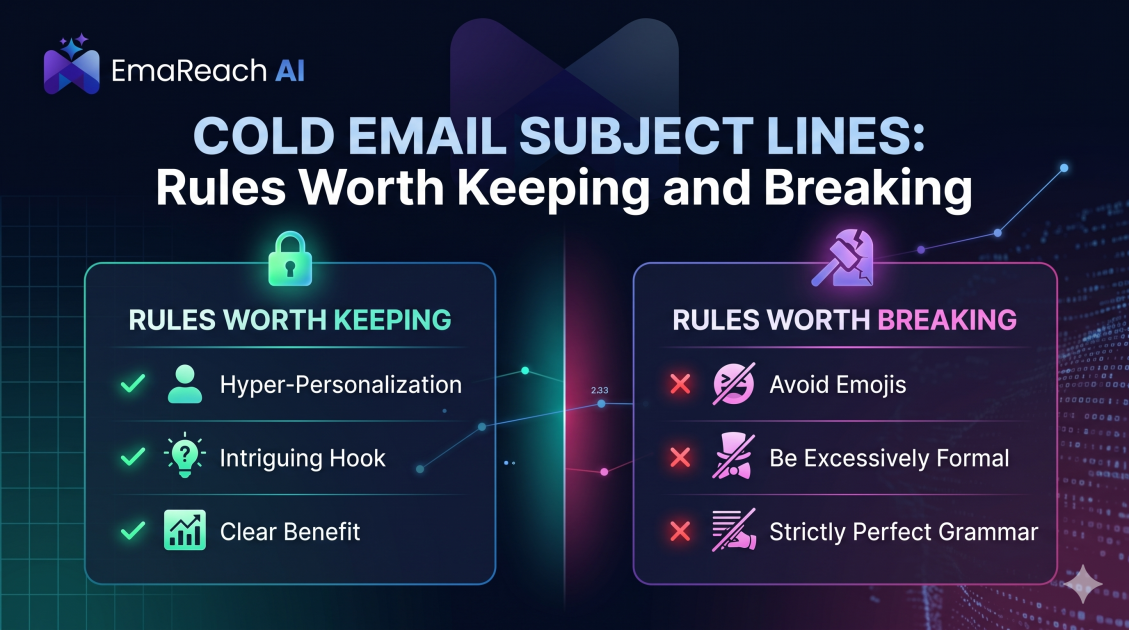
Cold Email Subject Lines: Rules Worth Breaking and Rules Worth Keeping
cold emailoutreach strategyemail marketingsubject linesdeliverabilitysales tips
Introduction: The Gateway to Every Conversion
In the world of cold outreach, the subject line is the most important ten words you will ever write. It is the gatekeeper of your sales funnel. No matter how incredible your product is, how persuasive your copy reads, or how personalized your offer might be, none of it matters if the recipient never clicks "Open."
For decades, marketers have operated under a strict set of "best practices" regarding how these lines should look. We’ve been told to be professional, to use specific lengths, and to avoid certain words at all costs. However, as inboxes become more crowded and AI-driven filters become more sophisticated, many of the old rules have begun to fail. To stand out today, you need to know which traditional mandates are still the bedrock of success and which ones are outdated relics that are actually hurting your open rates.
Mastering this balance is only half the battle. Even the perfect subject line won't help if your technical setup is flawed. To ensure your carefully crafted messages actually reach the people you're targeting, you need a robust delivery system. EmaReach helps you Stop Landing in Spam. Cold Emails That Reach the Inbox. EmaReach AI combines AI-written cold outreach with inbox warm-up and multi-account sending—so your emails land in the primary tab and get replies.
The Rules Worth Keeping: The Non-Negotiables of Outreach
While experimentation is key to growth, certain principles remain evergreen because they are rooted in human psychology and the technical realities of email service providers (ESPs).
1. The Rule of Mobile Optimization
Nearly half of all emails are opened on mobile devices. If your subject line is too long, it will be truncated, often losing the most important context or the specific hook meant to grab attention. Keeping your subject lines between 3 and 6 words (roughly 40-50 characters) ensures that the full message is visible on almost any screen size.
2. The Rule of Relevance (Personalization)
Generic subject lines are the fastest way to the trash folder. The rule of relevance states that the subject line must immediately signal to the recipient that the email was written specifically for them or their business. This goes beyond just including a first name. It involves mentioning a recent company milestone, a specific pain point common to their industry, or a shared connection.
3. The Rule of Honesty
Clickbait is the enemy of long-term success. One of the most important rules to keep is ensuring your subject line accurately reflects the content of the email. If you use a deceptive subject line like "Re: Our meeting tomorrow" when no such meeting exists, you might get the open, but you will immediately lose the recipient's trust. Once trust is broken, a conversion is nearly impossible, and you run the risk of being marked as spam.
4. The Rule of Low-Friction Language
Avoid using high-pressure sales language. Words like "Buy," "Discount," or "Final Call" trigger psychological resistance. Instead, keep the tone helpful and inquisitive. The goal of a cold email is to start a conversation, not to close a complex deal in the first five seconds.
The Rules Worth Breaking: Where Modern Outreach Wins
As the volume of cold email increases, standard patterns become recognizable and easy to ignore. This is where breaking the rules can give you a significant advantage.
1. Breaking the "Professionalism" Rule
For a long time, the consensus was that cold emails must be formal. However, in a sea of corporate jargon, a subject line that sounds like it came from a friend or a peer often performs better.
- The Old Rule: "Inquiry Regarding Your Current Marketing Strategy"
- The Rule-Breaking Approach: "quick marketing question"
Using all lowercase letters—which technically breaks the rules of formal grammar—can actually boost open rates because it looks more like a natural, internal email rather than a polished sales pitch.
2. Breaking the "Clear and Direct" Rule (The Curiosity Gap)
While you should never be deceptive, you don't always have to reveal exactly what is inside the email. Creating a "curiosity gap" can be incredibly effective. By providing just enough information to pique interest without giving away the full story, you compel the recipient to click.
- Example: "I noticed something on your LinkedIn page..."
This is vague, yet highly personal and intriguing. It breaks the rule of being explicitly clear about the email's purpose in favor of driving curiosity.
3. Breaking the "No Emojis" Rule
While it was once thought that emojis were unprofessional and would trigger spam filters, modern ESPs handle them much better. In a crowded inbox, a single, relevant emoji can act as a visual anchor that draws the eye to your subject line. The trick is to use them sparingly—one is usually enough to stand out without looking like a newsletter.
4. Breaking the "Short is Always Better" Rule
While we mentioned mobile optimization as a rule to keep, there are times when a longer, highly detailed subject line can work. If you are targeting a very niche, technical audience, a subject line that demonstrates deep industry knowledge—even if it's 10 words long—can prove your authority immediately.
Technical Foundations: Beyond the Subject Line
You can spend hours perfecting the "perfect" rule-breaking subject line, but if your email domain has a poor reputation, your message will never be seen. This is where the intersection of copywriting and technical deliverability becomes critical.
Effective outreach requires more than just good writing; it requires a strategy for staying out of the "Promotions" or "Spam" folders. This involves:
- Domain Warm-up: Gradually increasing sending volume to build trust with ESPs.
- Multi-Account Sending: Spreading your volume across multiple addresses to avoid hitting rate limits.
- AI-Enhanced Personalization: Using technology to scale the "Rule of Relevance" without losing the human touch.
To manage these complexities effortlessly, platforms like EmaReach provide an all-in-one solution. By combining AI-driven writing with sophisticated warm-up protocols, EmaReach ensures that your creative efforts aren't wasted on a blacklisted domain.
Categories of High-Performing Subject Lines
To help you decide which rules to follow and which to toss, let’s look at several categories of subject lines that consistently perform well in current market conditions.
The "Question" Subject Line
Questions are naturally engaging because the human brain is wired to seek answers.
- Rule to Keep: Keep the question relevant to their business.
- Rule to Break: Use casual formatting (lowercase).
- Examples:
- "question about [Company Name]"
- "can you handle more leads?"
- "thoughts on your latest blog post?"
The "Specific Observation" Subject Line
These are the ultimate proof that you aren't sending a mass blast. They rely heavily on the Rule of Relevance.
- Rule to Keep: Be genuine.
- Rule to Break: Don't be afraid to be a little informal.
- Examples:
- "Loved your take on [Topic]"
- "Congrats on the [Award/Funding]!"
- "Saw [Company Name] in the news today"
The "Low-Friction Request" Subject Line
This approach works because it asks for very little from the recipient, making it easy for them to say yes to opening it.
- Rule to Keep: Be brief.
- Rule to Break: You don't need to introduce yourself in the subject line.
- Examples:
- "Quick request"
- "Permission to send a video?"
- "Can I ask a favor?"
Common Pitfalls: Why Even Good Subject Lines Fail
Sometimes, even when you follow the rules of thumb, your open rates might stay low. Here are the common reasons why:
1. The "RE:" and "FWD:" Trickery
This is a "Rule to Keep": Never fake a thread. Using "Re:" in the subject line of a first-touch email is a deceptive tactic that might spike open rates temporarily but will destroy your reply rates and brand reputation instantly. It also triggers modern spam filters that look for inconsistencies in email headers.
2. Excessive Punctuation
Using multiple exclamation points or all caps is a red flag for both human readers and automated filters. It screams "spam." Stick to standard punctuation or, for a more casual "rule-breaking" feel, use no punctuation at all.
3. Ignoring the Preview Text
The subject line doesn't work alone. The preview text (the first few words of the email visible in the inbox) acts as a secondary subject line. If your subject line is great but your preview text starts with "Hi, my name is [Name] and I work for a company that...", you have lost the momentum. Use the preview text to expand on the hook in the subject line.
The Science of Testing: Creating Your Own Rules
The most important realization any outbound specialist can have is that there is no universal "best" subject line. What works for a SaaS founder in San Francisco might fail for a manufacturing head in the Midwest. This is why A/B testing is the only way to truly determine which rules you should be breaking.
What to Test:
- Format: Title Case vs. sentence case vs. all lowercase.
- Length: 2 words vs. 7 words.
- Personalization: Company name vs. Recipient name vs. Niche-specific pain point.
- Tone: Ultra-professional vs. peer-to-peer.
When testing, only change one variable at a time. If you change both the subject line and the body of the email, you won't know which one caused the change in performance. Aim for a statistically significant sample size (at least 200–500 emails per variation) before making a final decision on which style to adopt.
Leveraging Technology for Better Deliverability
As you refine your subject lines, remember that the technical infrastructure is the foundation of your success. Even the most perfectly researched, rule-breaking subject line is useless if it is sitting in a spam folder.
Modern outreach requires tools that understand the nuances of the current email landscape. EmaReach offers a comprehensive platform designed to solve the two biggest problems in cold outreach: writing content that resonates and ensuring that content is actually delivered. With EmaReach, you benefit from:
- Automated Inbox Warm-up: Ensuring your sender reputation stays high.
- AI Writing Assistance: Generating subject lines and body copy that follow (and break) the right rules.
- Deliverability Monitoring: Keeping a constant eye on whether your emails are hitting the primary tab.
By automating the technical side of the process, you free yourself up to focus on the creative strategy—testing new hooks, researching your prospects, and refining your offer.
Conclusion: The Evolving Landscape of Outreach
The "rules" of cold email subject lines are not set in stone; they are a reflection of current human behavior and technological constraints. The rules worth keeping—relevance, brevity, and honesty—are those that respect the recipient's time and intelligence. The rules worth breaking—formality, rigid structures, and predictable patterns—are those that have become so common they are now invisible.
Success in cold outreach belongs to those who are willing to experiment. By combining psychological triggers with a lighthearted, human touch—and supporting that effort with a powerful delivery platform like EmaReach—you can turn the crowded inbox from a barrier into a massive opportunity for growth. Focus on starting conversations, not just sending messages, and you will find that your subject lines become the key that unlocks new partnerships and revenue.
EmaReach AI
Ready to scale your cold email outreach?
Join thousands of teams using EmaReach AI for AI-powered campaigns, domain warmup, and 95%+ deliverability. Start free — no credit card required.
Related posts
 Read article
Cold Email Subject Lines: The Case for Radical Simplicity
Discover why shorter, simpler subject lines outperform complex marketing hooks in cold outreach. Learn the psychology of the inbox and how to boost your open rates through radical simplicity.
Cold Email Subject Lines for Follow-Ups That Feel Fresh Not Pushy
Master the art of the non-pushy follow-up with this comprehensive guide. Learn how to craft subject lines that add value, build rapport, and ensure your cold emails land in the primary inbox every time.