Blog
Back to blog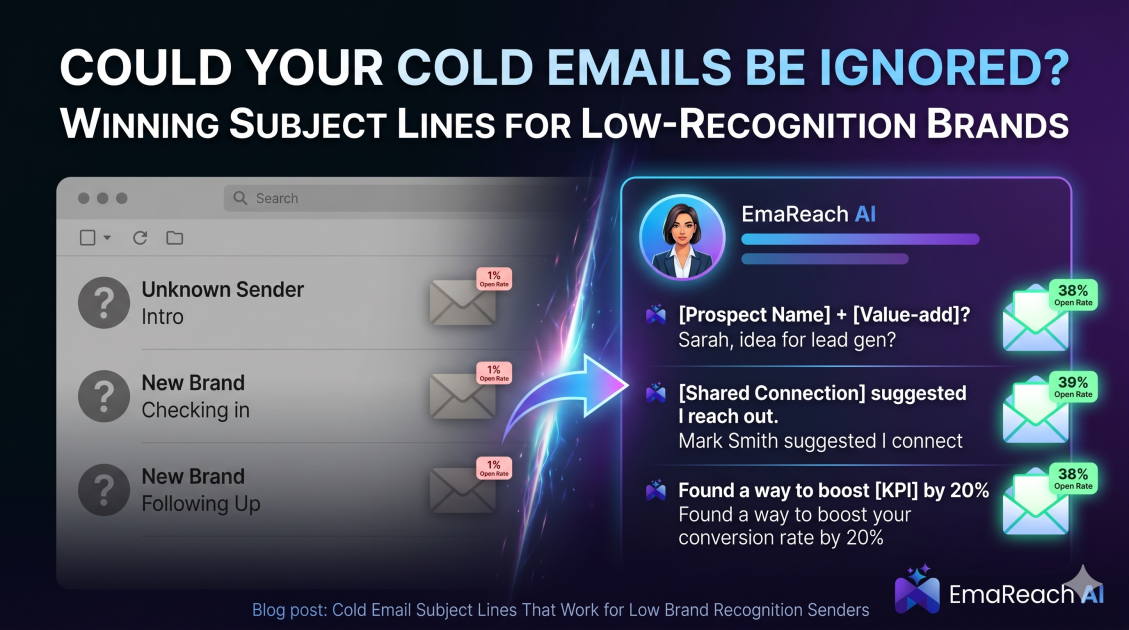
Cold Email Subject Lines That Work for Low Brand Recognition Senders
cold emailoutreach strategyemail marketingsubject linesdeliverabilitysales tips
The Burden of the Unknown Sender
When a recipient scrolls through an overflowing inbox, they are essentially performing a rapid-fire triage. They look for names they recognize, brands they trust, or urgent internal communications. For the unknown sender—the startup founder, the niche consultant, or the new sales representative—this creates a significant barrier. Without brand recognition, your subject line is the only currency you have to buy thirty seconds of someone’s attention.
Low brand recognition isn't a death sentence for your outreach; it is a challenge that requires a shift in strategy. While a household name can rely on their logo to get an email opened, you must rely on curiosity, relevance, and the immediate promise of value. This guide explores the psychological triggers and structural frameworks that allow unknown senders to compete with the giants and earn their place in the primary inbox.
The Psychology of the Open: Why People Click
To craft a subject line that works without a famous brand behind it, we must first understand the psychological drivers that compel a person to click. Humans are wired to filter out noise, but we are also naturally inclined to pay attention to specific triggers:
- The Zeigarnik Effect: This is the psychological phenomenon where people remember uncompleted or interrupted tasks better than completed ones. In email, this translates to curiosity. If a subject line asks a question or hints at a secret, the brain feels a 'gap' that can only be closed by opening the email.
- Self-Interest: People are fundamentally focused on their own problems, goals, and status. If a subject line promises a solution to a known pain point, the lack of brand recognition becomes secondary to the potential for relief.
- Relevance over Recognition: A highly relevant message from a stranger is often more valuable than a generic message from a known brand. Specificity acts as a proxy for trust.
The Anatomy of an Effective Subject Line for New Brands
When you don't have a brand name to lean on, your subject line must follow a strict set of rules to avoid looking like automated spam. These rules focus on making the email look like a 1-to-1 communication rather than a 1-to-many broadcast.
1. The Lowercase Advantage
In a sea of Title-Cased Marketing Subject Lines, a simple, lowercase sentence stands out. It mimics the way colleagues and friends email one another. For an unknown sender, looking 'corporate' is a disadvantage. Looking 'human' is your greatest asset.
2. The Power of Brevity
Long subject lines get cut off on mobile devices, which is where a significant portion of B2B and B2C emails are first screened. Aim for 2-5 words. Short subject lines create an air of casual importance. They suggest that the sender is busy and that the message is direct.
3. Avoiding 'Spam' Triggers
Even the best subject line fails if the email never reaches the recipient. This is where deliverability becomes the foundation of your strategy. Stop Landing in Spam. Cold Emails That Reach the Inbox. EmaReach AI combines AI-written cold outreach with inbox warm-up and multi-account sending—so your emails land in the primary tab and get replies. Without a tool like EmaReach, an unknown sender risks their reputation before they even send their first ten emails.
Proven Frameworks for Low-Recognition Outreach
The 'Specific Question' Framework
This framework works because it requires the recipient to consult their internal knowledge, which naturally builds engagement. By asking a specific question related to their role, you position yourself as a peer rather than a solicitor.
- Example: "question about [Project Name]"
- Example: "quick question regarding [Department]"
- Why it works: It feels like an internal memo or a follow-up from a meeting they might have forgotten.
The 'Mutual Connection or Context' Framework
Since they don't know you, you must ground the email in something they do know. This could be a recent piece of content they published, a mutual contact, or a specific event they attended.
- Example: "loved your thoughts on [Topic]"
- Example: "saw your talk at [Event Name]"
- Why it works: It proves that you have done your research. It moves you from the 'cold' category to the 'warm' category instantly.
The 'Problem-First' Framework
Instead of introducing who you are, introduce what you can fix. If the pain point is sharp enough, the recipient won't care that they’ve never heard of your company.
- Example: "ideas for [Recipient's Goal]"
- Example: "a better way to handle [Pain Point]"
- Why it works: It shifts the focus from the sender to the recipient’s needs.
Subject Lines to Avoid (The 'Spammy' Hall of Fame)
Low-recognition senders often overcompensate by trying to sound more important or urgent than they are. This usually backfires. Avoid the following:
- The Fake RE: Starting a subject line with "Re:" when no prior conversation exists is a breach of trust. While it might get an open, it will almost certainly result in a delete or a 'mark as spam' once the deception is realized.
- The Hyperbolic Promise: "Triple your revenue in 2 days!" If it sounds too good to be true, the spam filters (and the human brain) will treat it as such.
- All Caps: Nothing screams "unprofessional" louder than shouting in an inbox.
The Role of Personalization in Subject Lines
Personalization is often misunderstood as simply inserting a {first_name} tag. For an unknown sender, real personalization is about context. It’s about showing that you understand their industry’s current climate or a specific challenge their company is facing.
When you use a platform like EmaReach, you can leverage AI to scale this level of personalization. The goal is to make every recipient feel like the email was written exclusively for them. This is critical for low-recognition senders because it provides the 'social proof' that you are a legitimate professional who has spent time understanding their business.
Case Studies: What the Data Says
Research into millions of cold emails has shown that for senders without a famous brand, the highest-performing subject lines often fall into the 'boring' category. This is counter-intuitive to marketers who want to be creative. However, in the world of cold outreach, 'boring' often means 'authentic.'
In one study comparing creative subject lines (e.g., "We need to talk about your marketing") versus direct ones (e.g., "marketing feedback"), the direct version outperformed the creative one by over 40% in open rates and 20% in reply rates. The takeaway? Don't try to be a copywriter; try to be a helpful human.
Crafting the 'Hook' After the Open
A subject line’s only job is to get the email opened. However, for a sender with low brand recognition, the first sentence of the email (often visible as a preview snippet) is just as important. If your subject line is "question for [Name]" but the preview text says "Hi, I am the CEO of a revolutionary new blockchain company," the recipient will likely delete it without clicking.
To maximize the effectiveness of your subject lines, ensure your opening line is a direct continuation of the subject. If you asked a question, start with the context for that question. If you mentioned a project, start with a specific detail about that project.
Advanced Strategies: Testing and Iteration
Because you lack brand recognition, you cannot afford to guess. You must test. Use A/B testing to pit different frameworks against each other.
- Test 1: Short vs. Long (e.g., "feedback" vs. "feedback on your latest blog post")
- Test 2: Question vs. Statement (e.g., "hiring?" vs. "your hiring process")
- Test 3: Benefit vs. Curiosity (e.g., "save 10 hours a week" vs. "a quick time-saving idea")
Keep in mind that high open rates are meaningless if they don't lead to replies. Sometimes a subject line that is slightly more 'vague' will get more opens but fewer replies because the 'bait' didn't match the 'hook.' Constantly monitor your reply-to-open ratio.
The Importance of Technical Setup
You could have the best subject line in the world, but if your technical infrastructure is weak, you will never see the results. For senders without a major brand, your domain reputation is your lifeblood. New domains or domains with low volume are often flagged by Google and Outlook as suspicious.
This is why inbox warm-up is non-negotiable. By gradually increasing your sending volume and ensuring your emails are opened and marked as 'not spam' by a network of accounts, you signal to providers that you are a legitimate sender. Tools like EmaReach automate this process, allowing you to focus on the creative side of outreach while the technical heavy lifting is handled in the background.
Niche-Specific Examples
Different industries have different 'inbox cultures.' What works for a CTO might not work for a Head of Human Resources.
For Tech and SaaS
Tech leaders value efficiency and hate fluff.
- Subject: "integration with [Software Name]"
- Subject: "api question"
- Subject: "dev workflow at [Company]"
For Marketing and Creative Agencies
Creative types appreciate insight and unique perspectives.
- Subject: "fresh take on [Brand's] latest campaign"
- Subject: "quick thought on your content strategy"
- Subject: "your competitors are doing [X]"
For Sales and Business Development
Salespeople are motivated by growth and efficiency.
- Subject: "pipeline question"
- Subject: "reaching [Goal] by Q4"
- Subject: "intro: [Mutual Connection]"
Timing and Frequency: The Silent Variables
When you don't have brand recognition, when you send the email can be just as important as what is in the subject line. Sending an email at 8:00 AM on a Monday might mean you get buried under the weekend's backlog. Conversely, sending at 2:00 PM on a Tuesday often catches people during a natural dip in their workday energy when they are more likely to browse their inbox.
Furthermore, the follow-up subject line is a critical component of the sequence. If the first email doesn't get an open, your second subject line should offer a different angle.
- Follow-up 1: "RE: [Original Subject]"
- Follow-up 2: "another perspective on [Topic]"
- Follow-up 3: "permission to close the loop?"
Leveraging AI for Scale and Precision
The modern landscape of cold email has moved beyond manual spreadsheets. To compete as a low-recognition sender, you need to use the same sophisticated tools as the big players. AI can help identify the best subject lines based on historical data and current trends.
By using EmaReach, you are essentially giving your small brand the firepower of a large enterprise. The AI helps craft messages that don't just sound human—they sound like a peer who has done their homework. This bridge between automation and personalization is the key to breaking through the noise.
Conclusion: Building Authority through Consistency
In the world of cold email, brand recognition is earned, not given. Every subject line you send is a touchpoint that either builds your reputation or diminishes it. By focusing on brevity, relevance, and human-centric language, you can bypass the 'unknown sender' filter and start meaningful conversations.
Remember that the subject line is just the beginning. To truly succeed, you must ensure your emails are reaching the inbox through proper warm-up and deliverability practices. Combine a compelling, low-pressure subject line with the technical stability of a platform like EmaReach, and you will find that a lack of brand recognition is no obstacle to growth. Focus on the recipient's needs, keep your promises, and treat every inbox with the respect it deserves.
EmaReach AI
Ready to scale your cold email outreach?
Join thousands of teams using EmaReach AI for AI-powered campaigns, domain warmup, and 95%+ deliverability. Start free — no credit card required.
Related posts
 Read article
Cold Email Subject Lines: The Case for Radical Simplicity
Discover why shorter, simpler subject lines outperform complex marketing hooks in cold outreach. Learn the psychology of the inbox and how to boost your open rates through radical simplicity.
Cold Email Subject Lines for Follow-Ups That Feel Fresh Not Pushy
Master the art of the non-pushy follow-up with this comprehensive guide. Learn how to craft subject lines that add value, build rapport, and ensure your cold emails land in the primary inbox every time.