Blog
Back to blog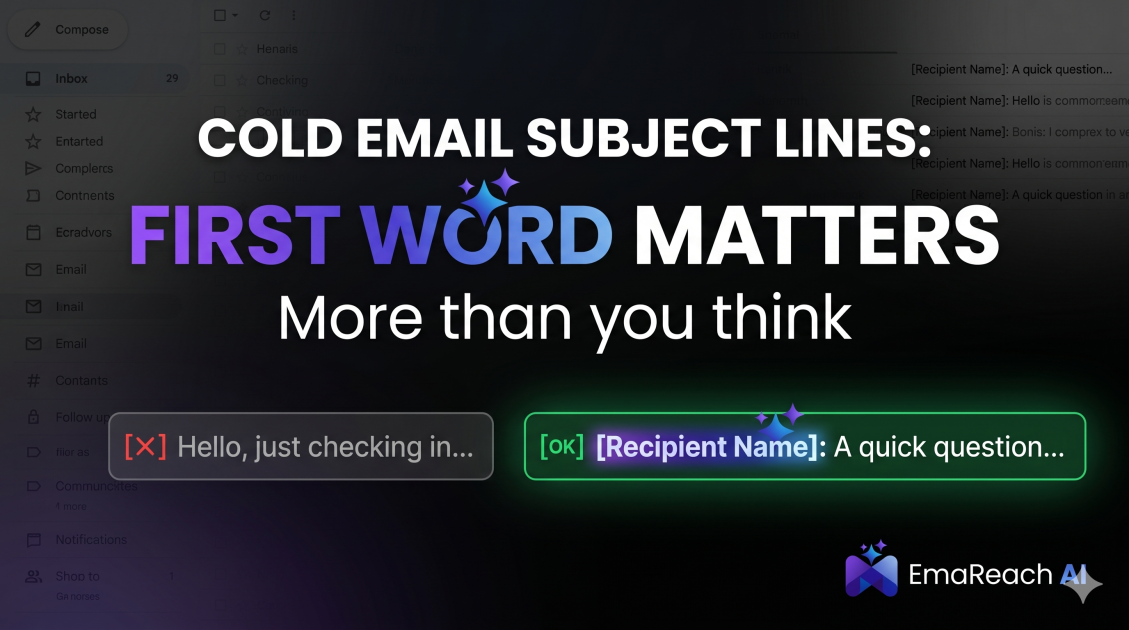
Cold Email Subject Lines: First Word Matters More Than You Think
cold emailoutreach strategyemail marketingsubject linesdeliverabilitysales psychology
The Psychology of the Inbox: Why the First Word is Your Only Chance
In the high-stakes world of digital outreach, the battle for attention is won or lost in milliseconds. When a prospect opens their inbox, they aren't reading; they are scanning. They are looking for reasons to delete, archive, or report as spam. Amidst a sea of generic notifications and newsletters, your cold email has one job: to stop the scroll. While much has been written about the length of subject lines or the use of emojis, the most critical element often goes overlooked—the very first word.
The first word of your subject line acts as a cognitive anchor. It sets the tone, establishes the relationship, and signals the relevance of the entire message. If that first word feels like a sales pitch, the email is dead on arrival. If it feels like a personal memo from a colleague or a valuable insight, the open rate skyrockets. Understanding the weight of this single word is the difference between a campaign that generates revenue and one that simply adds to the noise.
The "Notification" Effect and Modern Scanning Habits
Most professionals today consume emails on mobile devices or through desktop notification banners. In these formats, the subject line is often truncated. If your most important value proposition or the 'hook' is buried at the end of a seven-word sentence, the recipient will never see it. They see the first two or three words and make a snap judgment.
Psychologically, humans are wired to prioritize information that appears familiar or urgent. When the first word is a verb like "Question" or a specific noun like "Feedback," it triggers a different neural response than a marketing-heavy word like "Improve" or "Solution." The goal is to bypass the 'marketing filter' that every modern professional has developed as a survival mechanism against information overload.
Categorizing the Power of the First Word
To master the art of the first word, we must categorize how different types of words impact the recipient's psyche.
1. The Curiosity Gap
Words that imply there is missing information can be incredibly effective. However, they must be used with caution to avoid appearing like 'clickbait.'
- "Ideas": Starting with "Ideas for [Company]" suggests a collaborative spirit rather than a sales pitch.
- "Thoughts": This implies you are seeking an opinion, which appeals to the recipient's ego and expertise.
- "Strange": A risky but high-reward word that immediately breaks the pattern of a standard inbox.
2. The Relationship Signal
These words suggest that you already have a connection or a reason to be in their inbox.
- "Re:": While controversial, using a legitimate "Re:" (referring to a previous interaction or a mutual event) is the strongest way to ensure an open.
- "Intro": Signals a bridge between people. It implies a social proof that lowers the recipient's guard.
- "Follow-up": Only effective if there was a previous touchpoint; otherwise, it can damage trust.
3. The Specificity Driver
Generalities are the enemy of cold outreach. The first word should ideally lead into a very specific piece of data or a niche topic.
- "Revenue": Directly addresses a core business pain point.
- "Hiring": Shows you have researched their current company growth.
- "Efficiency": Targets operational leaders looking for optimizations.
The Science of Deliverability: Beyond the Subject Line
Even the most perfect first word won't save you if your email never reaches the inbox. Modern spam filters are incredibly sophisticated; they look at your sender reputation, the technical configuration of your domain, and how users interact with your messages. This is where many outreach campaigns fail—they focus on the copy but neglect the infrastructure.
To ensure your carefully crafted subject lines actually get seen, you need a robust delivery strategy. EmaReach (https://www.emareach.com/) is a critical ally in this process. Stop Landing in Spam. Cold Emails That Reach the Inbox. EmaReach AI combines AI-written cold outreach with inbox warm-up and multi-account sending—so your emails land in the primary tab and get replies. By automating the technical hurdles of deliverability, you can focus on the creative side of outreach, knowing that your "First Word" strategy is actually being put to the test in front of real human eyes.
Common Mistakes: The First Words That Kill Conversions
Just as certain words can open doors, others act as an immediate "No." Avoid starting your subject lines with these common offenders:
- "Checking": As in "Checking in." This is the hallmark of a desperate salesperson with no new value to provide. It creates a feeling of guilt or annoyance in the recipient.
- "Discount": This immediately flags the email as a promotional blast. High-level decision-makers are rarely moved by discounts in a first touchpoint; they care about value and ROI.
- "Help": While it sounds humble, "Help with [X]" often sounds like you are asking for a favor rather than offering a solution. It places a cognitive burden on the recipient.
- "Meeting": Starting with the 'ask' is too aggressive. You haven't earned their time yet, so mentioning a meeting in the first word feels premature and demanding.
The Power of Personalization in the First Position
If you want to truly stand out, the first word should be the recipient's name or their company's name.
Example: "[Name], quick question regarding [Project]"
Using a name as the first word mimics the way we receive emails from friends and colleagues. It is the ultimate pattern interrupt. However, personalization must be authentic. If the first word is their name but the rest of the email is a generic template, the sense of betrayal will result in a quick click of the 'Unsubscribe' button.
A/B Testing the "First Word" Variable
Don't take our word for it—data should drive your outreach strategy. When running A/B tests, many marketers change the entire subject line, which makes it impossible to know what actually worked. Instead, keep the body of the subject line the same and change only the first word.
- Variant A: "Question about your Q3 goals"
- Variant B: "Ideas for your Q3 goals"
By isolating the first word, you can identify the specific psychological triggers that resonate with your particular target audience. Some industries respond better to directness ("Question"), while others respond to value-add language ("Ideas").
Contextual Relevance: Matching the Word to the Persona
Different roles have different "Inbox Personalities." Your choice of the first word should reflect the daily reality of the person you are emailing.
The CEO / Executive
Executives have zero time. They value brevity and bottom-line impact.
- Recommended First Words: "Impact," "Growth," "Competitor," "Scale."
- Why: These words suggest high-level strategic value.
The Marketing Manager
Marketers are often looking for creative edges and tools to make their workflow easier.
- Recommended First Words: "Creative," "Traffic," "Conversion," "Workflow."
- Why: These address specific KPIs they are judged on.
The Engineer / Technical Lead
Technical professionals have a high 'BS detector.' They dislike fluff and marketing jargon.
- Recommended First Words: "Technical," "Integration," "Architecture," "API."
- Why: These words signal that the email is relevant to their specific craft and likely contains substance.
The Role of AI in Subject Line Optimization
We are entering an era where AI can predict the success of a subject line before it is even sent. AI models can analyze millions of data points to determine which words are currently trending toward high engagement and which are being flagged by filters.
Using a platform like EmaReach allows you to leverage these insights. By combining AI-driven copywriting with automated warm-up sequences, you ensure that your first word isn't just clever—it's mathematically optimized for the current landscape of email algorithms. This synergy between human creativity and machine intelligence is the future of B2B sales.
Structuring the Rest of the Subject Line
While the first word is the anchor, the subsequent words must provide the support. A great first word can get the email noticed, but the rest of the line must justify the click.
- Keep it under 40 characters: This ensures the entire message is visible on mobile devices.
- Use lowercase: Interestingly, all-lowercase subject lines often perform better in cold outreach because they look less like a formal marketing email and more like a quick note from a peer.
- Avoid punctuation overload: One question mark is fine. Three exclamation points will land you in the spam folder.
Lowercase vs. Title Case: The First Word Style
Does starting with a capital letter matter? In many cold outreach circles, the 'casual' approach is winning. Starting your subject line with a lowercase first word (e.g., "quick question") signals an informal, peer-to-peer communication. It feels less like a corporate broadcast. Conversely, starting with a capital letter feels more professional and structured. The choice depends on your brand voice, but the lowercase trend is currently yielding higher open rates in the tech and startup sectors.
Actionable Templates Based on the "First Word" Principle
Here are several frameworks you can adapt for your next campaign, focusing on the strength of the opening word:
The "Direct Inquiry" Framework
- Subject: "Question regarding [Specific Goal]"
- Why it works: The word "Question" creates an open loop in the brain that most people feel compelled to close by clicking.
The "Resource Sharing" Framework
- Subject: "Resource for your [Department] team"
- Why it works: "Resource" implies value and helpfulness rather than a request for time.
The "Observation" Framework
- Subject: "Observed [Specific Event] at [Company]"
- Why it works: "Observed" proves you have done your homework. It’s a high-intent word that suggests the email content is bespoke.
Conclusion: Mastering the Micro-Conversion
An open is a micro-conversion. It is the first 'Yes' in a series of 'Yeses' that lead to a deal. By focusing on the first word of your subject line, you are mastering the most critical moment of the recipient's journey. You are moving from being a stranger to being a person of interest.
Remember that the best subject line in the world is useless if the email never arrives. Consistently monitoring your deliverability and using tools like EmaReach to maintain a healthy sender reputation is the foundation upon which all your copywriting success is built. Stop guessing and start optimizing. Your first word is waiting to be written.
EmaReach AI
Ready to scale your cold email outreach?
Join thousands of teams using EmaReach AI for AI-powered campaigns, domain warmup, and 95%+ deliverability. Start free — no credit card required.
Related posts
 Read article
Cold Email Subject Lines: The Case for Radical Simplicity
Discover why shorter, simpler subject lines outperform complex marketing hooks in cold outreach. Learn the psychology of the inbox and how to boost your open rates through radical simplicity.
Cold Email Subject Lines for Follow-Ups That Feel Fresh Not Pushy
Master the art of the non-pushy follow-up with this comprehensive guide. Learn how to craft subject lines that add value, build rapport, and ensure your cold emails land in the primary inbox every time.