Blog
Back to blog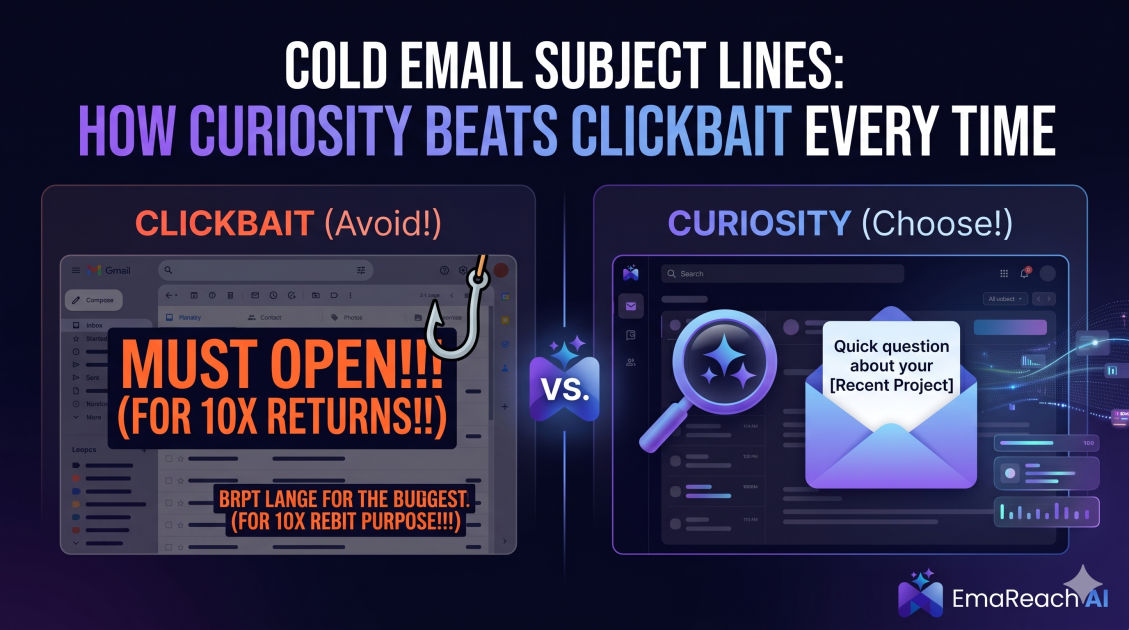
Cold Email Subject Lines: How Curiosity Beats Clickbait Every Time
cold emailemail marketingoutreach strategycopywritingemail deliverabilitysales tips
Introduction
In the high-stakes world of cold outreach, the subject line is the gatekeeper. It is the single line of text that determines whether your carefully crafted message is read or relegated to the digital graveyard of the trash folder. For years, marketers and sales professionals have leaned heavily on "clickbait"—sensationalized, urgent, or even deceptive headlines designed to trigger an impulsive click.
However, the landscape has shifted. Modern prospects are more sophisticated and guarded than ever. They can smell a sales pitch from a mile away, and clickbait now acts as a red flag rather than an invitation. The true winner in the inbox isn't the loudest voice, but the one that sparks genuine curiosity. Curiosity creates an open loop in the human brain that can only be closed by clicking.
In this comprehensive guide, we will explore why curiosity is the ultimate psychological lever for cold emails, how to avoid the pitfalls of clickbait, and how tools like EmaReach can ensure your curiosity-driven messages actually reach the inbox.
The Psychology of the Open: Why Curiosity Wins
Curiosity is often described in psychology as the "Information Gap Theory." When there is a gap between what we know and what we want to know, it creates a sense of cognitive dissonance. This discomfort serves as a powerful motivator; we feel a biological urge to close that gap.
The Information Gap in Action
When a subject line provides just enough information to be relevant but withholds the "punchline," the recipient's brain enters a state of active inquiry. Unlike clickbait, which relies on false promises or exaggerated urgency, curiosity-based subject lines rely on relevance and mystery.
The Fatigue of Hyperbole
Clickbait relies on shock value. Phrases like "You won't believe this!" or "URGENT: Open immediately" create a spike in cortisol. While this might get a one-time open, it destroys trust the moment the user realizes the content doesn't match the hype. In B2B sales, where trust is the primary currency, clickbait is a long-term liability. Curiosity, on the other hand, respects the reader's intelligence.
Clickbait vs. Curiosity: Defining the Difference
To master the art of the subject line, you must be able to distinguish between these two approaches.
The Anatomy of Clickbait
- Deceptive Urgency: Using "RE:" or "FWD:" when no prior conversation exists.
- False Scarcity: Claiming an offer expires in an hour when it doesn't.
- Hyperbolic Claims: "How to double your revenue in 24 hours."
- The Emotional Bait-and-Switch: Using a personal-sounding subject line for a mass-marketing blast.
The Anatomy of Curiosity
- Specific Ambiguity: Mentioning a specific detail about the prospect's business without explaining the context.
- Low-Pressure Inquiry: Asking a simple, relevant question.
- The Internal Reference: Referencing a specific project, person, or event relevant to them.
- The Short & Personal Approach: Often just 1-3 words that look like a casual internal memo.
Ensuring Your Curiosity-Driven Emails Actually Land
Even the most brilliant subject line is useless if your email lands in the spam folder. Deliverability is the foundation of any successful outreach campaign. This is where EmaReach becomes an essential part of your strategy.
Stop Landing in Spam. Cold Emails That Reach the Inbox. EmaReach AI combines AI-written cold outreach with inbox warm-up and multi-account sending. This ensures that your curiosity-driven subject lines land in the primary tab rather than the promotions or spam folders. By automating the technical heavy lifting of deliverability, EmaReach allows you to focus on the creative psychology of your messaging.
The "Casual Professional" Framework
One of the most effective ways to pique curiosity is to mimic the way colleagues or friends email each other. When we see a subject line that is all lowercase or just a single word, our brain assumes it is a personal communication rather than a marketing blast.
Examples of Casual Curiosity
- Subject: thoughts?
- Subject: question about [Project Name]
- Subject: quick idea for [Company Name]
- Subject: regarding your latest post
These work because they don't look like "Subject Lines"—they look like messages. The lack of capitalization or formal punctuation signals a human-to-human connection, which is the ultimate goal of cold outreach.
Using Specificity to Trigger Interest
Vague subject lines are often ignored. However, subject lines that are specifically vague are irresistible. This involves using a piece of data or a specific observation that proves you've done your homework, but leaving the "why" unanswered.
Case Study: The "Broken Link" Approach
Instead of saying "I have a suggestion for your website," try: Subject: 404 error on your [Specific Page] page
The recipient knows exactly what you are talking about (specificity), but they are curious about how you found it and why you are telling them (curiosity).
The "Competitor Observation" Approach
Subject: What [Competitor Name] is doing differently
This triggers the competitive nature of business leaders. It’s not clickbait because you are providing a genuine observation, but it forces them to open the email to see what they might be missing.
Avoiding the Spam Filter: The Technical Side
While we are focusing on the psychology of the human reader, we cannot ignore the psychology of the spam filter. Modern ESPs (Email Service Providers) use sophisticated algorithms to scan for clickbait-heavy language.
Words to Avoid
- FREE
- CASH
- GUARANTEED
- ACT NOW
- $ symbols or excessive exclamation points !!!
When you use curiosity instead of clickbait, you naturally avoid these trigger words. Curiosity-based subject lines tend to use neutral, professional language that passes through filters with ease. Furthermore, using a service like EmaReach helps manage your sender reputation by using multi-account sending, which prevents any single account from being flagged for high volume, keeping your deliverability rates high.
The Power of the Question Mark
A question is a literal request for information, making it the perfect tool for opening an information gap. However, the type of question matters. Avoid "Yes/No" questions that can be answered without opening the email.
- Bad: Do you want more leads?
- Good: How is [Company Name] handling [Industry Challenge]?
The first example is a leading question that sounds like a sales pitch. The second example is an open-ended inquiry that suggests the sender might have an alternative perspective or solution.
Personalization: The Ultimate Curiosity Driver
Deep personalization is the antithesis of clickbait. Clickbait is broad; personalization is surgical. When a prospect sees a subject line that contains a detail only they would know, or a reference to a specific recent achievement, their curiosity is piqued because the email is clearly for them.
Techniques for Personalization
- The Podcast/Article Mention: "Loved your take on [Topic]"
- The New Hire: "Congrats on hiring [Name] - a quick question"
- The Geographic Hook: "A question from a fellow [City] local"
By leveraging these specific details, you demonstrate that you are not a bot and that the contents of the email are highly relevant to their current situation.
Testing and Optimization
In the world of cold outreach, data is king. What works for a SaaS founder might not work for a Head of Logistics. You must constantly A/B test your subject lines to see which curiosity hooks resonate most with your specific audience.
Metrics to Track
- Open Rate: The primary metric for subject line success.
- Reply Rate: If your subject line is too "curiosity-heavy" and doesn't match the body content, your open rate will be high but your reply rate will be zero.
- Unsubscribe Rate: A high unsubscribe rate often indicates that your subject line felt like clickbait to the recipient.
Using EmaReach allows you to see these metrics clearly and use AI-driven insights to refine your approach. If one curiosity hook isn't landing, the platform can help you pivot to a different angle based on real-world performance data.
The Ethical Boundary: Why You Must Deliver
The biggest danger of curiosity-based marketing is crossing the line into deception. If your subject line promises a "question about your recent post," the very first line of your email better mention that post.
If you use curiosity to trick someone into opening an email only to hit them with a generic sales pitch, you have failed. You have traded a long-term relationship for a vanity metric (the open). The body of your email must "close the loop" that the subject line opened.
Closing the Loop Example
Subject: idea for [Company]'s blog Body: "Hi [Name], I was reading your recent piece on [Topic] and noticed you didn't cover [Sub-topic]. I actually have a few data points on that which might help your readers..."
This is a cohesive experience. The curiosity is rewarded with value.
Advanced Curiosity Frameworks
1. The "Negative Hook"
Counter-intuitive subject lines often drive the highest curiosity.
- Example: Why [Strategy] might be failing you
- Why it works: Humans are naturally loss-averse. We are more curious about what we are doing wrong than what we are doing right.
2. The "Relevant Stat"
- Example: [Number]% of [Job Title]s miss this
- Why it works: It creates FOMO (Fear of Missing Out) and a desire to be part of the "in-the-know" group.
3. The "Direct & Short"
- Example: [Your Name] <> [Their Name]
- Why it works: It looks like an introduction from a mutual acquaintance, triggering curiosity about who the sender is.
Conclusion
In the battle for the inbox, curiosity is your most potent weapon. While clickbait offers a temporary sugar high of high open rates, it ultimately erodes trust and damages your brand's reputation. By focusing on genuine information gaps, personal relevance, and low-pressure inquiries, you can engage prospects in a way that feels human and respectful.
Remember that a great subject line is only half the battle. To truly succeed in cold outreach, your emails must land in the inbox. Leveraging a platform like EmaReach ensures that your technical infrastructure is as solid as your copywriting. By combining the psychological power of curiosity with the technical precision of AI-driven deliverability, you can transform your cold outreach from a numbers game into a relationship-building engine. Focus on the gap, deliver the value, and watch your reply rates soar.
EmaReach AI
Ready to scale your cold email outreach?
Join thousands of teams using EmaReach AI for AI-powered campaigns, domain warmup, and 95%+ deliverability. Start free — no credit card required.
Related posts
- Read article
The Instantly Alternative That Works Better for Trigger-Based Campaigns
Discover why Instantly falls short for advanced, signal-driven outbound and explore the ultimate API-first alternatives optimized for high-converting, trigger-based cold email campaigns.
- Read article
The Instantly Alternative That Handles High Bounce Rates Without Panic
Discover how transitioning to an advanced Instantly alternative can safeguard your cold email infrastructure. Learn to handle high bounce rates effortlessly using real-time verification, smart mailbox rotation, and automated safety nets to protect your sender reputation and maintain consistent primary inbox placement.