Blog
Back to blog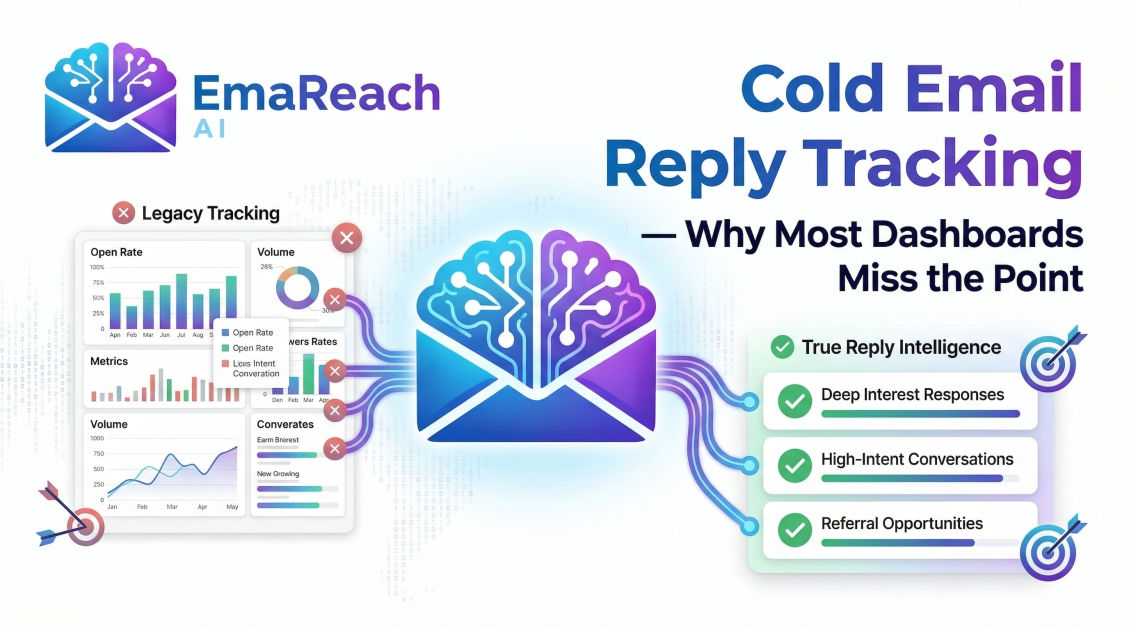
Cold Email Reply Tracking — Why Most Dashboards Miss the Point
cold emailsales automationoutreach strategyemail metricsdeliverabilitylead generation
Introduction: The Mirage of the Metric
In the world of outbound sales, data is often treated as the ultimate source of truth. We build complex dashboards, sync our CRMs, and obsess over percentages. But there is a growing disconnect between what the numbers show and what is actually happening in the inbox.
Most sales teams celebrate a high 'Reply Rate' as a sign of a successful campaign. On paper, a 10% reply rate looks like a victory. However, when you peel back the layers, you often find that a significant portion of those replies are 'Unsubscribe' requests, 'Not Interested' rebukes, or automated OOO (Out of Office) notifications.
This is why most dashboards miss the point. They track activity, not intent. In this deep dive, we will explore why traditional reply tracking is broken and how to shift your focus toward metrics that actually drive revenue.
The Fundamental Flaw of Binary Tracking
Most cold email software operates on a binary logic: did the recipient reply? Yes or no. If the answer is yes, the dashboard increments the reply count.
The 'Noise' Problem
When your tracking is binary, your data becomes noisy. Consider these three scenarios:
- Lead A: Replies with "This sounds interesting, let's chat Tuesday."
- Lead B: Replies with "Please remove me from your list and never email me again."
- Lead C: Replies with an automated "I am on vacation until next week."
A standard dashboard treats all three of these as identical 'Replies.' This creates a false sense of security for growth teams. If you are scaling your volume but your 'Positive Intent' rate is dropping while your 'Negative Reply' rate is climbing, your dashboard might still show a beautiful green upward trend.
The Impact on Deliverability
Binary tracking doesn't just mess up your sales projections; it masks deliverability crises. If a large portion of your replies are negative or manual spam complaints (in the form of angry replies), your sender reputation is taking a hit. A dashboard that doesn't distinguish between a 'Yes' and a 'Stop' prevents you from seeing that your messaging might be triggering spam filters or annoying your target market.
To ensure your messages even have a chance to get a positive reply, you need a system that prioritizes reaching the inbox. EmaReach helps you stop landing in spam by combining AI-written outreach with inbox warm-up and multi-account sending, ensuring your emails land in the primary tab where they can actually be tracked effectively.
Why Sentiment Analysis is the Missing Link
To fix reply tracking, we have to move toward Sentiment Analysis. This is the process of using natural language processing to categorize the nature of the reply.
Categorizing the Inbox
A sophisticated tracking system should break down replies into specific buckets:
- Positive Intent: The lead asks a question, requests a meeting, or expresses interest.
- Neutral/Informational: The lead asks for more content or redirects you to another person in the organization.
- Negative/Rejection: The lead explicitly says no or asks to be unsubscribed.
- Automated: Out-of-office replies or bounce notifications.
Without this breakdown, you are flying blind. You might be optimizing your subject lines to get more opens and replies, but if those replies are 90% negative, your 'optimization' is actually destructive to your brand.
The Attribution Gap: Tracking Beyond the First Reply
Another reason dashboards miss the point is that they stop tracking once the reply happens. In a complex B2B sales cycle, the first reply is just the beginning.
The 'Ghosting' Metric
How many leads reply once and then disappear? Most dashboards don't show the 'Drop-off Rate' after the initial engagement. If you have a high reply rate but a low meeting-booked rate, the problem might not be your initial cold email; it might be your follow-up speed or the quality of your response to their inquiry.
Multi-Channel Blind Spots
Reply tracking often lives in a silo. If a lead receives your cold email, doesn't reply, but then visits your website and fills out a demo form, most cold email dashboards count that as a 'Non-Reply.' In reality, the email was the catalyst. Traditional dashboards fail to attribute 'view-through' conversions or cross-channel interest, leading teams to undervalue their cold outreach efforts.
The False Idol of Open Rates
While the topic is reply tracking, we cannot ignore the metric that often precedes it: the Open Rate. Many dashboards prioritize this above all else. However, with the rise of 'Privacy Protection' features in major email providers, open rates have become highly unreliable.
Mail privacy features often pre-load images (including tracking pixels), which triggers a 'false open.' If your dashboard tells you that you have an 80% open rate but a 0.5% reply rate, you aren't seeing a 'hook' problem—you're seeing a data accuracy problem. High-performing teams are moving away from caring about opens and focusing entirely on Positive Reply Velocity.
How to Build a Better Tracking Framework
If you want to move beyond the vanity metrics of standard dashboards, you need to implement a more rigorous framework for measuring success.
1. Define 'Qualified Replies'
Stop reporting on total replies. Start reporting on 'Qualified Replies.' This requires a manual or AI-assisted audit of your inbox to filter out the noise. A Qualified Reply is any response from a target prospect that moves the needle toward a discovery call.
2. Measure Reply-to-Meeting Ratio
This is the ultimate health check for your sales copy. If you are getting plenty of replies but struggling to book meetings, your 'Ask' might be too high-friction, or your value proposition might be too vague.
3. Track Negative Reply Trends
Keep a close eye on your 'Opt-out' rate. If this starts to spike, it is an early warning sign that your targeting is off or your messaging is too aggressive. Most dashboards hide this in a 'replied' bucket, but you need to see it front and center to protect your domain health.
The Role of AI in Modern Tracking
We are entering an era where manual tracking is no longer sustainable at scale. AI now allows us to automate the sentiment analysis that dashboards have historically ignored.
AI can read the nuance of a reply—detecting the difference between "Not right now, try me in six months" and "Never contact me again." By feeding this data back into your tracking system, you can build a dynamic feedback loop. For example, if a certain segment of your list is producing a high volume of 'Not Interested' replies, your system should automatically pause outreach to similar profiles and alert you to refine your ICP (Ideal Customer Profile).
The Deliverability-Reply Loop
There is a symbiotic relationship between how you track replies and your ability to land in the inbox. When you track and categorize replies correctly, you can identify which 'sending accounts' are performing best.
If one of your sending domains has a significantly lower positive reply rate than others—despite using the same script—it's a clear indicator of a deliverability issue. The emails are likely hitting the 'Promotions' or 'Spam' folders for that specific domain.
Tools like EmaReach are essential here because they solve the foundational problem: getting the email seen. By using multi-account sending and automated warm-ups, you ensure that your reply tracking data is based on emails that actually reached the prospect, not just those that escaped the spam filter by chance.
Rethinking the 'Success' Dashboard
A truly useful dashboard for a modern growth team should look very different from the standard templates provided by most SaaS tools. It should prioritize:
- Positive Intent Rate: (Positive Replies / Total Emails Sent)
- Reply Quality Score: A weighted metric based on the seniority of the person replying.
- Domain Reputation Health: Integration with postmaster tools to ensure high deliverability.
- Time to Lead: How quickly your team responds to a positive reply (the 'Speed to Lead' metric).
Conclusion
Data is only as valuable as the insights it provides. If your current dashboard only tells you that someone replied, but not why or how they replied, you are missing 90% of the story. By shifting your focus from binary reply rates to sentiment-based intent and deliverability-aware metrics, you can transform your cold email operations from a numbers game into a precision instrument.
Stop chasing the 'Reply' and start chasing the 'Intent.' When you align your tracking with the actual goals of your business—meetings and revenue—the path to growth becomes much clearer.
EmaReach AI
Ready to scale your cold email outreach?
Join thousands of teams using EmaReach AI for AI-powered campaigns, domain warmup, and 95%+ deliverability. Start free — no credit card required.
Related posts
- Read article
The Instantly Alternative That Finally Gets Outbound Analytics Right
Discover why high-volume cold email requires a shift from surface-level vanity metrics to deep, data-driven revenue attribution, and explore the ultimate alternatives for mastering outbound engineering.
- Read article
What You Gain and What You Give Up When Switching From Instantly
Thinking about migrating your cold email stack? This detailed guide breaks down the exact operational advantages you gain and the core features you sacrifice when switching away from Instantly's popular outreach platform.