Blog
Back to blog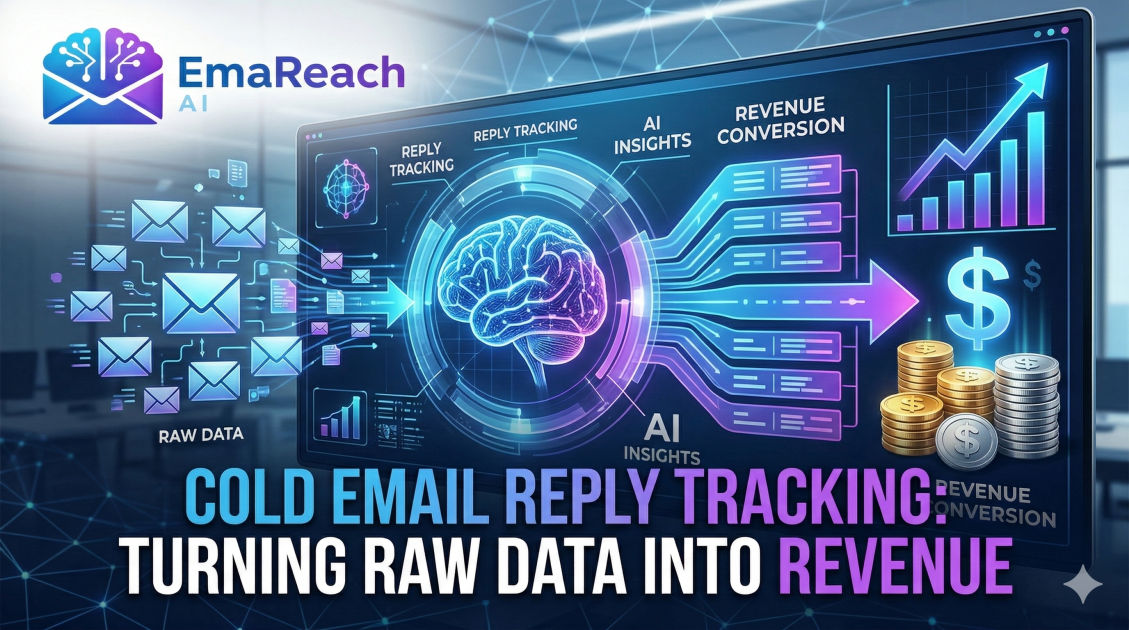
Cold Email Reply Tracking: Turning Raw Data Into Revenue
cold emailsales automationlead generationemail deliverabilityCRM strategyoutreach optimization
Introduction: Beyond the Send Button
In the world of B2B sales and digital outreach, the 'send' button is often treated as the finish line. In reality, it is merely the starting block. Most businesses measure the success of their cold email campaigns by open rates or the sheer volume of messages sent. However, these are vanity metrics that rarely correlate directly with bankable revenue. The true bridge between a digital message and a signed contract lies in Cold Email Reply Tracking.
Tracking replies is not just about counting how many people said 'hello.' It is about capturing raw behavioral data, categorizing intent, and optimizing every subsequent interaction to ensure that interested prospects don't fall through the cracks. When handled correctly, reply tracking transforms a chaotic inbox into a streamlined revenue engine.
The Anatomy of a Reply: Why Raw Data Isn't Enough
To turn data into revenue, one must first understand that not all replies are created equal. A 'reply' in the context of cold outreach can range from a legal threat to an immediate request for a demo. Without a system to track and categorize these nuances, your sales team is essentially flying blind.
The Three Tiers of Reply Intent
- Positive Intent: The prospect asks a question, requests more information, or agrees to a meeting. This is the 'gold' that needs immediate attention.
- Neutral/Passive Intent: The prospect asks to be contacted later, refers you to another department, or gives a 'soft' no. These represent future revenue if tracked and nurtured correctly.
- Negative Intent: Unsubscribe requests or 'not interested' messages. While these don't lead to sales, tracking them is vital for maintaining sender reputation and cleaning your data lists.
By implementing a rigorous tracking system, you move away from subjective 'gut feelings' about how a campaign is performing and toward a data-driven model where every response is an opportunity for optimization.
The Technical Foundation of Reply Tracking
Effective tracking requires a marriage between your email infrastructure and your CRM (Customer Relationship Management) system. If your replies are sitting in individual sales reps' inboxes without being logged, you are losing money every single day.
Centralized Inbox Management
One of the biggest leaks in the revenue funnel is the 'siloed inbox.' When multiple team members are sending emails, replies can get lost in the noise. A centralized master inbox allows your team to see every incoming response in one place. This ensures that no lead is left behind and that the response time—a critical factor in conversion—is kept to a minimum.
Threading and Attribution
To turn a reply into revenue, you must know which specific message triggered that reply. Was it the initial 'problem-centric' hook? Or was it the third follow-up that focused on social proof? Advanced tracking attributes the reply to the specific step in the sequence, allowing you to double down on the messaging that actually works.
For those looking to ensure their messages even have a chance to be replied to, tools like EmaReach can be a game-changer. EmaReach helps you stop landing in spam by combining AI-written cold outreach with inbox warm-up and multi-account sending, ensuring your emails land in the primary tab where they can actually be tracked and converted.
Quantitative vs. Qualitative Tracking
Most marketers stop at quantitative tracking: How many replies did we get? To drive revenue, you must move into qualitative tracking: What was the quality of those replies?
Establishing a 'Positive Reply Rate' (PRR)
Instead of looking at the total reply rate, focus on the Positive Reply Rate. If a campaign has a 10% reply rate but 9% of those are 'stop emailing me,' the campaign is a failure. Conversely, a 2% reply rate where 1.5% are 'let's talk' is a massive success. Tracking this specific metric allows you to pivot your strategy toward high-value targets rather than high-volume noise.
Sentiment Analysis
Modern reply tracking often utilizes sentiment analysis. By using algorithms to scan the text of a reply, you can automatically tag prospects based on their mood and urgency. This allows for 'triage' in the sales process—prioritizing the 'hot' leads who need a call today over the 'warm' leads who just want a whitepaper.
Closing the Loop: From Reply to CRM
Raw data becomes revenue only when it triggers an action. The moment a reply is tracked, it should initiate a workflow in your sales stack.
Automated Status Updates
When a prospect replies, their status in your CRM should automatically shift from 'Contacted' to 'Engaged' or 'Lead.' This prevents them from receiving further automated cold follow-ups, which would look unprofessional and robotic.
The 'Speed to Lead' Variable
Studies consistently show that the likelihood of closing a deal drops significantly if the first response takes more than an hour. A robust tracking system sends real-time alerts (via Slack, email, or SMS) to the account executive the moment a positive reply is detected. This 'speed to lead' is often the difference between a closed-won deal and a prospect who goes cold.
Optimization Through Reply Feedback Loops
Reply tracking provides the ultimate feedback loop for your marketing and sales copy. If you are tracking replies correctly, you can perform deep-dive 'post-mortems' on your campaigns.
Identifying 'Friction Points'
If you notice a high volume of replies asking for pricing early on, your tracking data is telling you that your value proposition isn't clear enough, or perhaps you should experiment with being more transparent about costs. If replies frequently mention a competitor, you know you need to update your 'battle cards' and objection-handling scripts.
A/B Testing Based on Intent
Don't just A/B test subject lines for open rates. A/B test entire sequences based on the intent of the replies they generate. Sequence A might get more replies, but Sequence B might get more meetings. Without granular reply tracking, you might mistakenly choose Sequence A and leave revenue on the table.
The Role of Inbox Deliverability in Tracking
You cannot track a reply to an email that was never seen. Deliverability is the invisible foundation of reply tracking. If your emails are landing in the 'Promotions' tab or, worse, the 'Spam' folder, your tracking data will be skewed. You'll think your copy is bad when, in reality, your technical setup is the culprit.
This is why a holistic approach is necessary. Using a service like EmaReach ensures that your 'multi-account sending' doesn't trigger spam filters, keeping your primary tab presence high. When your emails land where they should, your reply tracking data becomes a true reflection of your market resonance.
Advanced Tracking: Handling 'Out of Office' and Referrals
Standard tracking software often chokes on 'Out of Office' (OOO) replies or referrals. To turn these into revenue, you need a nuanced approach.
The OOO Goldmine
An OOO reply isn't a 'no'; it’s a 'not right now' with a specific date attached. Advanced tracking extracts the return date from the OOO message and automatically schedules a follow-up for one or two days after the prospect returns. This level of personalization, driven by tracked data, shows a level of attention to detail that wins deals.
The Referral Pivot
If a prospect replies with 'I’m not the right person, talk to Sarah,' your tracking system should be able to log this connection. This 'referral data' is incredibly valuable. Reaching out to 'Sarah' with the note that her colleague referred you carries significantly more weight than a cold outreach, and tracking this chain of command allows you to map out the decision-making unit (DMU) within a target account.
Scalability: Tracking Across Multiple Accounts
As your outreach scales, the complexity of tracking grows exponentially. If you are sending from 10, 20, or 50 different email accounts to avoid domain throttling, tracking replies manually becomes impossible.
Scalable revenue requires a 'unified inbox' approach where replies from all sending accounts are funneled into a single dashboard. This allows for macro-level analysis—seeing how different domains or different personas are performing across the entire organization. It also allows managers to see which reps are best at converting a 'tracked reply' into a 'booked meeting,' identifying coaching opportunities.
Data Privacy and Compliance in Tracking
In an era of GDPR, CCPA, and increasing privacy regulations, how you track replies matters. Tracking must be done in a way that respects 'Right to be Forgotten' requests. If a reply is tracked as 'Negative/Unsubscribe,' your system must ensure that person is globally blacklisted across all your accounts instantly. Turning data into revenue also means protecting your brand from legal and reputational risk.
The Revenue Calculator: Measuring the ROI of Tracking
To justify the investment in advanced reply tracking, you must calculate its impact on the bottom line. Consider the following formula:
- Lost Opportunity Cost: (Number of positive replies) x (Average lead-to-meeting conversion rate) x (Average deal value) = Potential Revenue.
If your current 'untuned' system misses just two positive replies a month due to inbox clutter or slow response times, and your average deal value is $5,000, you are losing $120,000 in potential revenue every year. Tracking is the tool that plugs this leak.
Conclusion: Data is the Map, Revenue is the Destination
Cold email reply tracking is the difference between 'sending emails' and 'building a business.' By moving beyond basic metrics and diving deep into the sentiment, intent, and timing of every response, you turn raw digital data into a predictable stream of revenue.
It requires the right technical setup—ensuring deliverability through platforms like EmaReach—and a disciplined approach to CRM integration and lead triage. But for those who master the art of the follow-through, the rewards are clear. Don't just track your emails; track your growth. Every reply is a signal; your job is to make sure you're listening.
EmaReach AI
Ready to scale your cold email outreach?
Join thousands of teams using EmaReach AI for AI-powered campaigns, domain warmup, and 95%+ deliverability. Start free — no credit card required.
Related posts
- Read article
The Instantly Alternative That Finally Gets Outbound Analytics Right
Discover why high-volume cold email requires a shift from surface-level vanity metrics to deep, data-driven revenue attribution, and explore the ultimate alternatives for mastering outbound engineering.
- Read article
What You Gain and What You Give Up When Switching From Instantly
Thinking about migrating your cold email stack? This detailed guide breaks down the exact operational advantages you gain and the core features you sacrifice when switching away from Instantly's popular outreach platform.