Blog
Back to blog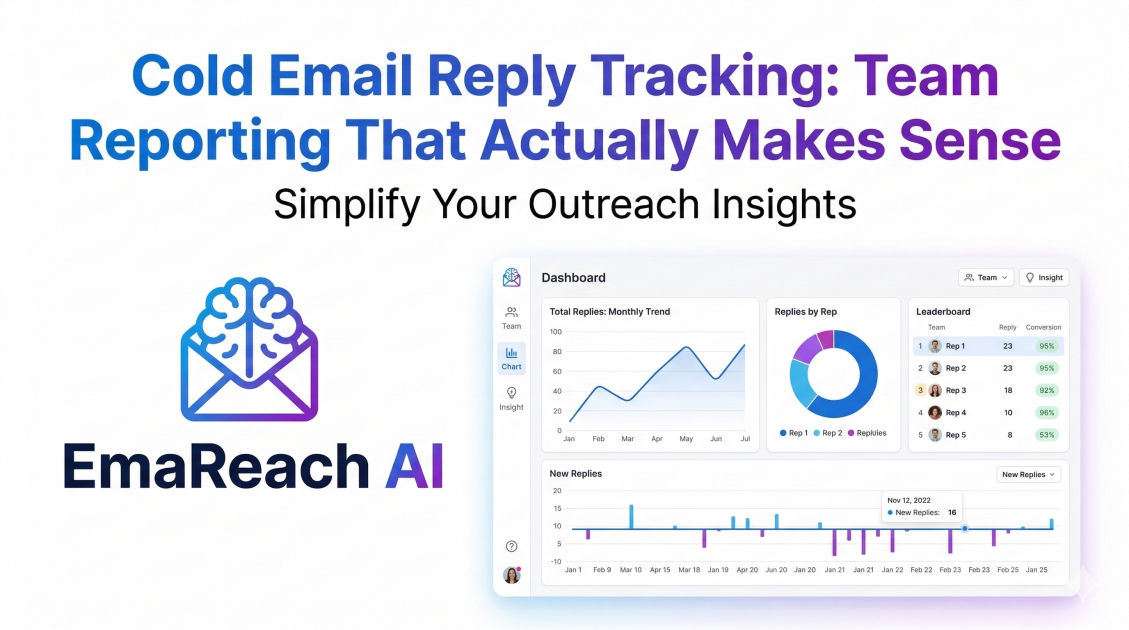
Cold Email Reply Tracking: Team Reporting That Actually Makes Sense
cold emailsales outreachreportinglead generationemail trackingsales management
Introduction
In the high-stakes world of outbound sales, data is often treated as the ultimate source of truth. However, for many sales development teams, the data being tracked is often a collection of vanity metrics that tell a story of activity rather than productivity. We track opens, we track clicks, and we track send volumes—but when it comes to the metric that actually moves the needle—the reply—the reporting often becomes murky.
Cold email reply tracking is the backbone of any successful outreach strategy. Yet, most team reporting structures fail to provide actionable insights. If your reports show that your team sent 5,000 emails last week and received 50 replies, you have a data point, but you don't have a strategy. To build a reporting system that actually makes sense, teams must move beyond simple counts and dive into the nuances of sentiment, response velocity, and attribution.
The Problem with Traditional Reply Tracking
Most sales organizations fall into the trap of binary tracking: an email is either replied to or it isn't. This oversimplification masks the reality of the sales funnel. A "stop emailing me" response and a "let's chat next Tuesday" response are both technically replies, but they represent polar opposite outcomes for the business.
The Vanity Metric Trap
When leadership focuses solely on the number of replies, they inadvertently incentivize the wrong behaviors. Sales Development Representatives (SDRs) might start sending provocative or misleading subject lines just to get a response. This inflates the reply rate but tanks the conversion rate further down the line. Real reporting must distinguish between positive, neutral, and negative sentiment to provide a clear picture of campaign health.
Fragmentation of Data
Another common hurdle is the fragmentation of data across different platforms. If one team member is using a specific sequence tool and another is manually following up via a different CRM integration, the global view of team performance becomes distorted. Without a unified system for tracking every interaction, leadership cannot identify which templates are truly performing and which are simply benefiting from a high-quality lead list.
Building a Framework for Meaningful Reporting
To create reporting that makes sense, you need to establish a framework that categorizes replies based on their value to the sales cycle. This involves more than just a software integration; it requires a cultural shift in how your team views data.
Defining "Meaningful" Replies
Step one is defining what counts as a win. A meaningful reply is typically one that indicates interest, asks a clarifying question, or provides a referral to the correct stakeholder. By categorizing these as "Positive Replies," you can calculate a "Positive Reply Rate," which is a far more accurate predictor of revenue than a standard reply rate.
The Role of Sentiment Analysis
Modern outreach requires a level of sophistication that manual tagging can rarely match. Implementing sentiment analysis allows teams to automatically categorize incoming mail. This is where tools like EmaReach become invaluable. By ensuring your emails actually land in the primary inbox rather than the spam folder, you maximize the opportunity for these high-value interactions to occur. EmaReach helps you stop landing in spam by combining AI-written outreach with inbox warm-up, ensuring that when you do track a reply, it's coming from a prospect who actually saw your best work in their primary tab.
Key Metrics for Team Accountability
When building out your team dashboards, focus on these five pillars of reply tracking to ensure your reporting is both transparent and actionable.
1. Sentiment-Adjusted Reply Rate (SARR)
Instead of looking at the raw reply percentage, calculate your SARR. This is the percentage of total emails sent that resulted in a positive or inquisitive response. If your raw reply rate is 5% but your SARR is only 0.5%, your messaging is likely too aggressive or misaligned with your target audience.
2. Time-to-Reply (TTR)
How long does it take for a prospect to respond to your sequence? If the majority of replies come after the fourth or fifth touchpoint, you know your persistence is paying off. Conversely, if replies drop off entirely after the second email, your follow-up strategy needs a complete overhaul. Tracking TTR helps teams optimize the spacing and cadence of their sequences.
3. Reply-to-Meeting Conversion Rate
This is perhaps the most critical metric for sales leadership. It tracks how effectively your team handles the replies they receive. If an SDR is getting plenty of interest but failing to book meetings, the issue isn't the email—it's the objection handling or the call-to-action (CTA) used in the follow-up.
4. Lead Source Performance
Not all lead lists are created equal. Your reporting should tie reply rates back to the original source of the contact data. This allows you to see which data providers or prospecting methods are yielding the highest quality conversations, allowing you to reallocate budget to the most effective channels.
5. Inbox Deliverability Health
Reply tracking is impossible if your emails aren't being seen. You must track your deliverability metrics alongside your reply metrics. If you see a sudden dip in replies across the whole team, it’s rarely a messaging issue—it’s usually a technical deliverability hit. Monitoring sender reputation and ensuring you have a steady warm-up process is essential for maintaining a consistent flow of data.
Strategic Segmentation in Reporting
To make sense of the data, you must be able to slice it by different variables. High-level aggregates often hide the very insights you need to scale.
Tracking by Persona
A message that resonates with a CTO might fall flat with a CFO. Your reporting should allow you to view reply rates segmented by job title or department. This helps you tailor your value proposition for different stakeholders within a target account.
Tracking by Offer/CTA
Are you asking for a 15-minute demo, or are you offering a free audit? Different CTAs will yield different reply styles. By tracking which offers generate the most "Positive Replies," you can refine your sales strategy to lead with your most compelling hook.
Individual vs. Team Benchmarks
Reporting should foster healthy competition and collaborative learning. By displaying team benchmarks, individual contributors can see where they stand. If one person has a significantly higher SARR, the team can analyze their specific customizations and apply those learnings across the board.
Overcoming Common Tracking Challenges
Even with the best intentions, tracking can go wrong. Here is how to handle the most common pitfalls.
Dealing with Out-of-Office (OOO) Replies
OOO replies can clutter your data. A robust reporting system should automatically filter these out or categorize them separately. However, savvy teams use OOO replies as a data source—noting when a prospect will be back and setting a task to follow up manually on that date.
Handling "Unsubscribe" Requests
While technically a reply, an unsubscribe request should be tracked as a negative outcome. High unsubscribe rates are a leading indicator that your targeting is off or your frequency is too high. Monitoring this metric helps protect your domain reputation in the long run.
The "Silent" Reply (The Forward)
Sometimes, a prospect doesn't reply to you, but they forward your email to a colleague who then reaches out. This is a massive win but is notoriously difficult to track. Implementing account-based tracking—where any activity from a specific domain is attributed to the campaign—helps capture this "dark" influence of cold email.
Best Practices for Presenting Data to Leadership
When presenting these reports to stakeholders, clarity is more important than volume. Executives don't want to see every reply; they want to see the trend lines and the ROI.
- Focus on Trends: Show how the Positive Reply Rate has improved month-over-month.
- Link to Revenue: Whenever possible, show the dollar value of the pipeline generated from those replies.
- Highlight Bottlenecks: Use data to show exactly where the process is breaking down (e.g., "We have a high reply rate but a low meeting-booked rate, indicating a need for better sales training").
Conclusion
Cold email reply tracking is not just about counting the number of times someone wrote back. It is about understanding the conversation, measuring the quality of engagement, and optimizing the entire outreach engine for predictable revenue. By moving toward sentiment-based reporting, focusing on conversion metrics, and ensuring your technical foundations—like deliverability and inbox placement—are rock solid, you turn a chaotic inbox into a streamlined sales laboratory.
Effective team reporting provides the roadmap for growth. It tells you what to stop doing, what to do more of, and most importantly, it gives your team a clear, honest view of their impact on the company’s bottom line. When your data makes sense, your strategy becomes unstoppable.
EmaReach AI
Ready to scale your cold email outreach?
Join thousands of teams using EmaReach AI for AI-powered campaigns, domain warmup, and 95%+ deliverability. Start free — no credit card required.
Related posts
- Read article
The Instantly Alternative That Finally Gets Outbound Analytics Right
Discover why high-volume cold email requires a shift from surface-level vanity metrics to deep, data-driven revenue attribution, and explore the ultimate alternatives for mastering outbound engineering.
- Read article
What You Gain and What You Give Up When Switching From Instantly
Thinking about migrating your cold email stack? This detailed guide breaks down the exact operational advantages you gain and the core features you sacrifice when switching away from Instantly's popular outreach platform.