Blog
Back to blog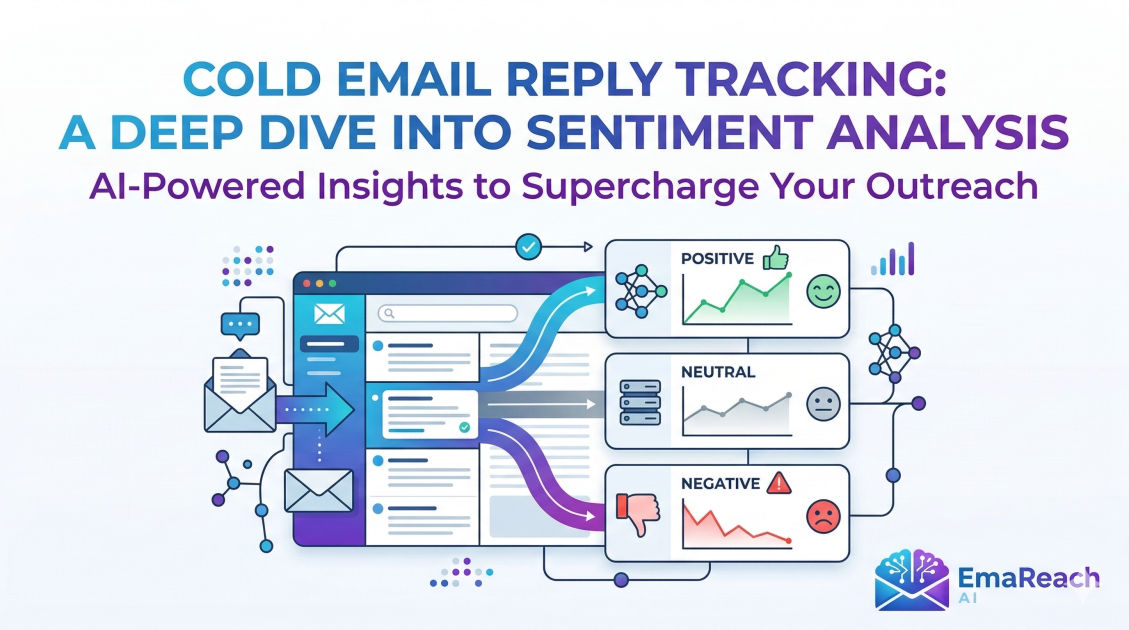
Cold Email Reply Tracking: A Deep Dive Into Sentiment Analysis
cold emailsentiment analysisoutreach strategysales automationemail marketinglead generation
Introduction
In the high-stakes world of outbound sales and digital networking, the success of a cold email campaign has traditionally been measured by binary metrics: open rates and reply rates. If someone opens the email, the subject line worked. If someone replies, the body copy worked. However, as outreach scales and the volume of communication increases, these surface-level metrics begin to lose their utility. A 'reply' is not inherently a 'success.' A 'reply' can be a scathing request to be removed from a list, a polite 'not right now,' or an enthusiastic request for a demo.
This is where Sentiment Analysis transforms the landscape of cold email reply tracking. By leveraging Natural Language Processing (NLP) and machine learning, businesses can move beyond counting replies and start understanding the emotional intent behind them. This deep dive explores how sentiment analysis is revolutionizing outreach, the technical mechanics of how it works, and how to implement a sentiment-driven workflow to maximize ROI.
The Evolution of Reply Tracking
For decades, sales teams relied on manual sorting. An SDR (Sales Development Representative) would log into an inbox, read through fifty replies, and manually categorize them in a CRM. This process was not only time-consuming but also prone to human bias. What one representative might mark as a 'neutral' response, another might see as a 'soft objection' that could be overcome with the right follow-up.
Modern outreach demands more precision. When sending thousands of emails across various segments, understanding the nuance of human language at scale is impossible without automation. Sentiment analysis provides a standardized, objective framework for evaluating the health of an outreach campaign. It allows marketers to see at a glance whether their messaging is resonating or if they are inadvertently burning through their lead lists with polarizing copy.
What is Sentiment Analysis in Cold Email?
At its core, sentiment analysis is a branch of artificial intelligence that categorizes text based on the emotional tone it conveys. In the context of cold email, this involves analyzing incoming replies to determine if the prospect is interested, disinterested, or somewhere in between.
The Three Pillars of Sentiment Classification
- Positive Sentiment: These are the 'wins.' They include direct expressions of interest, requests for more information, meeting bookings, or compliments on the outreach itself.
- Negative Sentiment: These include 'unsubscribe' requests, expressions of frustration, or clear rejections ('We don't need this,' 'Stop emailing me').
- Neutral Sentiment: This category often contains out-of-office replies, referrals to other colleagues, or clarifying questions that don't yet signal a clear intent.
Why Sentiment Analysis Matters for Your Bottom Line
Tracking sentiment isn't just about making reports look pretty; it's about operational efficiency. Here is why it has become a non-negotiable component of sophisticated outreach strategies:
1. Accurate ROI Calculation
If you send 1,000 emails and get 50 replies, but 45 of those are 'Never contact me again,' your 5% reply rate is a vanity metric that masks a failing campaign. Sentiment analysis reveals the Positive Reply Rate (PRR), which is the only metric that truly correlates with revenue.
2. Automated Lead Routing
By automatically identifying the sentiment of a reply, systems can trigger different workflows. A positive reply can be immediately pushed to a high-priority CRM view for a human to take over, while a negative reply can trigger an automatic 'Opt-out' tag to protect the company's sender reputation.
3. Messaging Optimization (A/B Testing 2.0)
Traditional A/B testing compares reply rates. Sentiment-based A/B testing compares the quality of those replies. You might find that Template A gets fewer replies than Template B, but Template A's replies are 80% positive, whereas Template B's are 20% positive and 60% angry. Without sentiment analysis, you would incorrectly choose Template B.
The Technical Mechanics: How AI Understands Intent
How does a machine know the difference between 'Not today' and 'Not ever'? It involves several layers of linguistic processing.
Tokenization and Lemmatization
First, the AI breaks down the reply into 'tokens' (words or phrases). It then performs lemmatization, which reduces words to their root form. For example, 'interested,' 'interests,' and 'interesting' are all mapped back to the core concept of 'interest.'
Contextual Understanding
Advanced sentiment models use Large Language Models (LLMs) to understand context. Sarcasm, for instance, is the bane of simple keyword-based tracking. If a prospect replies, 'Oh great, another cold email,' a basic tool might flag 'great' as positive. An AI-driven sentiment engine recognizes the sarcastic structure and correctly flags it as negative.
Intent Recognition
Beyond just 'feeling,' modern systems track 'intent.' This distinguishes between a prospect who is interested but lacks budget (Negative/Neutral) and a prospect who is interested and wants a call (Positive/High Intent).
Implementation Strategies for Sales Teams
To successfully implement sentiment analysis into your cold email strategy, you need a structured approach that combines technology with human oversight.
Setting Up Your Taxonomy
Don't just settle for 'Positive' or 'Negative.' Create a more granular taxonomy that fits your business model:
- Interested/Meeting Requested
- Information Requested
- Referral (Talk to X instead)
- Not Interested (Current Provider)
- Not Interested (No Budget)
- Unsubscribe/Do Not Contact
Integrating with the Tech Stack
The real power of sentiment analysis is unlocked when it talks to your other tools. For instance, using a platform like EmaReach can ensure that your emails actually reach the inbox in the first place. Once they do, and the replies start coming in, the sentiment data should flow directly into your CRM (like Salesforce or HubSpot). This allows for 'Closed-Loop Reporting,' where you can trace a closed-won deal all the way back to the specific positive sentiment reply that started the conversation.
Overcoming the Challenges of Sentiment Tracking
While powerful, sentiment analysis is not without its hurdles. It is important to be aware of these limitations to maintain a high-performing outreach engine.
The 'Out of Office' Noise
One of the biggest challenges in reply tracking is the 'Out of Office' (OOO) email. These are technically replies, but they contain no sentiment regarding your offer. Sophisticated sentiment engines use 'OOO Detection' to filter these out entirely, ensuring they don't skew your data or trigger unnecessary follow-up sequences.
The Nuance of Referrals
When a prospect says, 'I'm not the right person, talk to Dave,' is that positive or negative? Technically, they rejected you, but they provided a warm path to a better lead. Most high-level teams categorize 'Referrals' as a 'Neutral-Positive' hybrid that requires a specific automated response to the new contact.
Language and Cultural Barriers
Sentiment is often tied to cultural norms. A reply from a prospect in the UK might be more understated ('That sounds interesting') compared to a prospect in the US ('This is awesome!'). Global teams must ensure their sentiment models are trained on multilingual and multi-cultural datasets to avoid misinterpretation.
Best Practices for Maximizing Positive Sentiment
If your sentiment analysis reveals a high volume of negative replies, it is time to audit your outreach. Here is how to shift the needle back toward positive intent:
1. Hyper-Personalization
Negative sentiment is often a reaction to 'spammy' behavior. When an email feels like it was written specifically for the recipient, even a 'no' tends to be polite. Use data points beyond just the first name—mention recent company news, a shared connection, or a specific pain point relevant to their industry.
2. Timing and Frequency
Over-sequencing (sending too many emails too quickly) is the fastest way to generate negative sentiment. Spread out your touchpoints and respect the prospect's 'digital space.'
3. Deliverability Matters
If your emails are constantly being flagged as 'suspect' by email providers, prospects will view them with skepticism before they even read the first word. Ensuring your technical setup (SPF, DKIM, DMARC) is flawless is the foundation. Tools like EmaReach focus on this specific area, ensuring that 'Cold Emails That Reach the Inbox' actually stay there, which helps maintain a professional image and encourages positive engagement.
The Role of Sentiment in Predictive Analytics
As you accumulate sentiment data over months of outreach, you move from reactive to proactive. You can start using 'Predictive Sentiment.' This involves analyzing which types of prospects (by industry, job title, or company size) are most likely to respond with positive sentiment to specific value propositions.
Imagine knowing that 'CTOs at Mid-Market FinTech firms' have an 18% positive sentiment rate when you mention 'compliance automation,' but only a 2% positive sentiment rate when you mention 'cost reduction.' This level of insight allows you to pivot your entire Go-To-Market (GTM) strategy based on hard emotional data.
Conclusion
Cold email reply tracking has moved far beyond the simple tallying of responses. Sentiment analysis is the bridge between raw data and actionable human insight. By understanding the emotional 'why' behind every reply, sales and marketing teams can refine their messaging, protect their sender reputation, and focus their human energy on the leads that actually want to talk to them.
In an era where every inbox is crowded, the ability to listen—even through an automated process—is what separates the leaders from the spammers. Tracking sentiment isn't just a technical upgrade; it’s a commitment to more respectful, relevant, and effective communication. By implementing these deep-dive strategies into your outreach, you ensure that every reply is a data point that leads you closer to your next partner, client, or breakthrough.
EmaReach AI
Ready to scale your cold email outreach?
Join thousands of teams using EmaReach AI for AI-powered campaigns, domain warmup, and 95%+ deliverability. Start free — no credit card required.
Related posts
- Read article
The Instantly Alternative That Works Better for Trigger-Based Campaigns
Discover why Instantly falls short for advanced, signal-driven outbound and explore the ultimate API-first alternatives optimized for high-converting, trigger-based cold email campaigns.
- Read article
The Instantly Alternative That Handles High Bounce Rates Without Panic
Discover how transitioning to an advanced Instantly alternative can safeguard your cold email infrastructure. Learn to handle high bounce rates effortlessly using real-time verification, smart mailbox rotation, and automated safety nets to protect your sender reputation and maintain consistent primary inbox placement.