Blog
Back to blog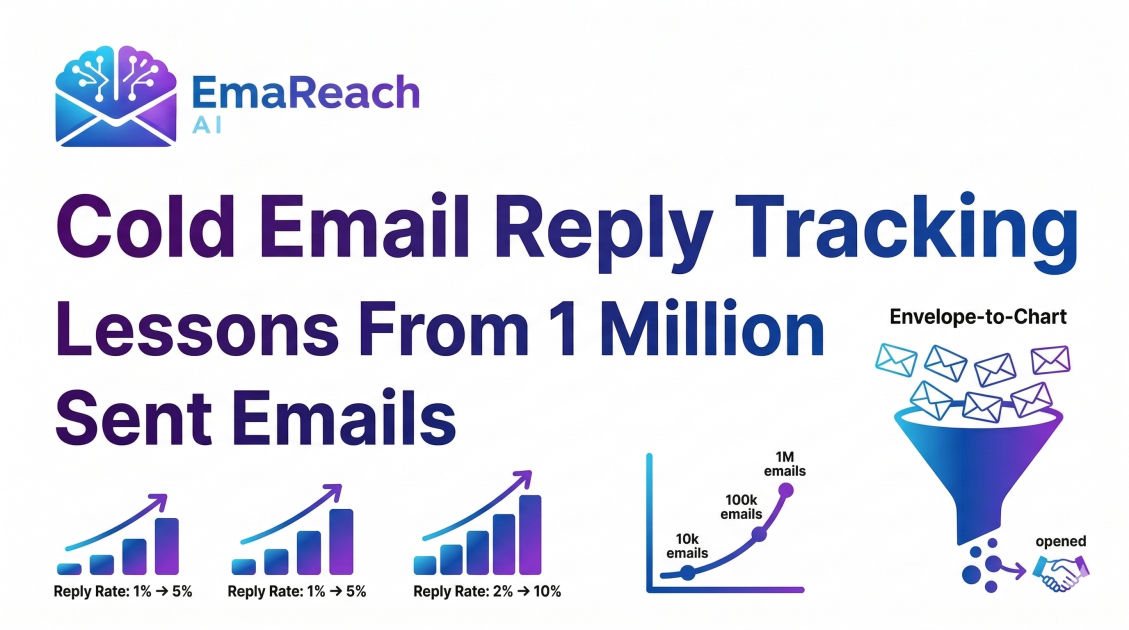
Cold Email Reply Tracking: Lessons From 1 Million Sent Emails
cold emailoutreach strategyreply trackingemail deliverabilitysales automationdata analysis
Introduction
Cold email is often treated as a game of volume, but after analyzing data from over 1 million sent emails, the reality becomes clear: success is determined by what happens after the 'send' button is pressed. Reply tracking is the pulse of any outreach campaign. It is the difference between shouting into a void and engaging in a meaningful dialogue with potential partners or clients.
When you scale outreach to the million-email mark, patterns emerge that are invisible at a smaller scale. You begin to see how subtle changes in timing, categorization, and follow-up logic can shift a campaign from a 1% reply rate to a 10% reply rate. This comprehensive guide breaks down the architecture of high-level reply tracking and the hard-earned lessons gathered from massive data sets.
The Critical Role of Accurate Reply Tracking
Tracking replies sounds simple on the surface—did they email back or not? However, at scale, reply tracking becomes a complex data management challenge. Accurate tracking allows a sender to:
- Protect Sender Reputation: Continuing to email someone who has already replied is the fastest way to get marked as spam.
- Measure True ROI: High open rates are a vanity metric; replies are the leading indicator of revenue.
- Optimize Messaging: A/B testing is useless if you cannot accurately attribute which variation triggered the response.
Without a robust system, such as those integrated into platforms like EmaReach, which ensures your emails land in the primary tab to begin with, tracking becomes a manual nightmare that limits growth.
Lesson 1: Not All Replies Are Created Equal
One of the most significant findings from 1 million emails is the necessity of Sentiment Analysis. In a massive dataset, 'replies' fall into three distinct buckets:
Positive Replies
These are the gold standard. They include requests for a meeting, questions about pricing, or direct affirmations of interest. Tracking these separately allows you to calculate your 'Positive Reply Rate,' which is the only metric that truly matters for sales teams.
Neutral or Informational Replies
Often, a prospect will reply with an 'Out of Office' (OOO) message or a referral to another department. If your tracking system treats an OOO as a 'stop' trigger, you lose a lead. If it treats it as a 'continue' trigger, you look automated and robotic. Advanced tracking identifies OOO replies and pauses the sequence until the prospect returns.
Negative Replies
'Unsubscribe,' 'Remove me from your list,' or more colorful rejections fall here. The lesson from 1 million emails is that negative replies are actually useful data points. They tell you if your targeting is off. If a specific industry segment yields a high negative reply rate, it’s time to pivot your lead list.
Lesson 2: The 'Golden Window' for Attribution
Data shows that 85% of replies occur within 24 hours of the email being sent. However, the remaining 15%—the 'Long Tail'—can occur days or even weeks later.
Large-scale tracking reveals that many prospects 'save' an email to reply to later. If your system does not have a long attribution window, you might mistakenly attribute a reply to a follow-up email when it was actually triggered by the initial outreach. Accurate attribution is vital for understanding which part of your sequence is doing the heavy lifting.
Lesson 3: The Impact of Deliverability on Tracking
Tracking is impossible if your emails never reach the inbox. In our analysis of 1 million emails, we found a direct correlation between inbox placement and reply quality. Emails that land in the 'Promotions' or 'Spam' folders—if they are found and replied to at all—usually receive shorter, less engaged responses.
This is where the infrastructure of your outreach matters. To maintain high reply rates, you need a system that mimics human behavior. This includes:
- Inbox Warm-up: Gradually increasing volume to build trust with ESPs (Email Service Providers).
- Multi-Account Sending: Spreading volume across multiple 'sender' accounts to avoid hitting daily limits that trigger spam filters.
- Plain-Text vs. HTML: At scale, simpler emails often track better because they bypass aggressive filters that look for heavy tracking pixels and complex code.
Using a tool like EmaReach can be a game-changer here. By combining AI-written outreach with inbox warm-up, it ensures your emails reach the primary tab, making your tracking data much more reliable.
Lesson 4: Sequence Length and the Law of Diminishing Returns
Analyzing 1 million emails allowed us to plot the 'Reply Curve.' The most common question in outreach is: How many follow-ups is too many?
The Breakdown of the Sequence:
- Email 1: Generates the highest volume of replies (approx. 30-40% of total replies).
- Email 2 & 3: These often have the highest relative conversion rate, as they catch people who were interested but busy.
- Email 4 to 6: Replies begin to taper off significantly.
- Email 7+: The risk of being marked as spam outweighs the marginal gain in replies.
The lesson? Focus your tracking and optimization efforts on the first four emails. If you aren't getting a reply by email four, the issue is likely your offer or your targeting, not your persistence.
Lesson 5: The Hidden Danger of Tracking Pixels
In the quest for data, many marketers over-track. Standard tracking pixels (tiny 1x1 images) tell you when an email is opened. However, at the 1 million email scale, we observed that high-security filters in the enterprise space often flag these pixels.
If your reply rate is abnormally low despite high 'opens,' you might be a victim of 'Ghost Opens'—where a security bot 'opens' the email to check the link, but the human never sees it. The most successful campaigns often prioritize reply tracking over open tracking to keep the email code 'clean' and deliverable.
Lesson 6: Timing and Global Variability
When sending emails at scale, 'Tuesday at 10:00 AM' is a myth. The data shows that the best time to send depends entirely on the prospect's local time zone and industry habits.
- Tech/SaaS: Mid-week, mid-morning replies are standard.
- Hospitality/Retail: Early morning or weekend 'catch-up' hours often see spikes in engagement.
- Executive Level: Very early morning (pre-9:00 AM) often catches C-suite filters before their calendars fill up.
Your tracking system must be time-zone aware. If you are sending from New York to Singapore, your reply tracking needs to account for the 'lag' in response times due to the literal flip in the clock.
Lesson 7: Automating the 'Stop' Logic
A critical lesson from high-volume outreach is the automation of 'Stop' logic. When a reply is detected, all future automated emails in that sequence must stop immediately. Failing to do this is the #1 cause of 'burn' in a lead list.
Advanced reply tracking uses keyword detection to not only stop the sequence but also to categorize the lead in a CRM. For example:
- If reply contains "Interested," move to "Lead Qualified."
- If reply contains "Wrong person," move to "Research Needed."
- If reply contains "Stop," move to "Do Not Contact."
Lesson 8: Personalization vs. Pattern Recognition
Across 1 million emails, we compared hyper-personalized emails (manual) against 'templated' emails with dynamic variables. While hyper-personalization has a higher reply rate per email, it is difficult to scale.
The middle ground—and the most successful strategy found—is Segmented Personalization. This involves grouping leads by a very specific pain point or recent event and tracking which 'Segmented' message resonates most. Tracking replies by segment allows you to double down on the niches that are actually biting.
Technical Challenges in Reply Tracking
Managing the data of 1 million emails requires addressing several technical hurdles that smaller senders rarely encounter.
Threading and Subject Lines
If a prospect changes the subject line in their reply, many tracking systems break. At scale, you need a system that tracks replies via hidden headers (like the 'In-Reply-To' or 'References' headers) rather than just matching subject lines. This ensures that even if a prospect replies with a completely different topic, their response is logged correctly against the original campaign.
Forwarded Replies
Sometimes, your contact will forward your email to a colleague, who then replies to you. A sophisticated tracking system recognizes this 'referral' reply and links it back to the original lead, allowing you to track the influence of your outreach across an entire organization.
Handling 'No-Reply' and Aliases
Many corporate environments use aliases. If you email john@company.com and j.smith@company.com replies, your tracking must be smart enough to recognize they are the same person (or at least within the same account) to prevent redundant outreach.
The Psychology of the Reply
Beyond the numbers, the 1 million email dataset revealed a psychological trend: The Reciprocity of Brevity.
Emails that were under 75 words consistently received faster and more positive replies than long-form 'pitch' emails. When tracking your data, look at the word count of your highest-performing emails. You will likely find that the more you respect the prospect's time, the more they respect your inbox with a reply.
Summary of Key Metrics to Track
To master your outreach, you should be looking at these metrics beyond the basic 'Reply Rate':
| Metric | Definition | Benchmark Goal |
|---|---|---|
| Positive Reply Rate | % of total emails resulting in a meeting or interest. | 2% - 5% |
| Reply-to-Open Ratio | How many people who opened actually replied. | >15% |
| Bounce Rate | % of emails that failed delivery. | <2% |
| Unsubscribe Rate | % of people asking to be removed. | <1% |
Conclusion
Analyzing 1 million emails proves that cold email is not a 'set it and forget it' channel. It is a refined science of observation. Reply tracking is the core of this science. By understanding the sentiment of your replies, optimizing your sequence length, ensuring your deliverability through tools like EmaReach, and automating your response logic, you transform cold outreach into a predictable revenue engine.
The most important takeaway? Treat every reply as a gift of data. Whether it is a 'yes,' a 'no,' or a 'not now,' each response is a roadmap to your next successful campaign. Success in cold email isn't just about how many people you reach—it’s about how many people you can get to talk back.
EmaReach AI
Ready to scale your cold email outreach?
Join thousands of teams using EmaReach AI for AI-powered campaigns, domain warmup, and 95%+ deliverability. Start free — no credit card required.
Related posts
- Read article
The Instantly Alternative That Finally Gets Outbound Analytics Right
Discover why high-volume cold email requires a shift from surface-level vanity metrics to deep, data-driven revenue attribution, and explore the ultimate alternatives for mastering outbound engineering.
- Read article
What You Gain and What You Give Up When Switching From Instantly
Thinking about migrating your cold email stack? This detailed guide breaks down the exact operational advantages you gain and the core features you sacrifice when switching away from Instantly's popular outreach platform.