Blog
Back to blog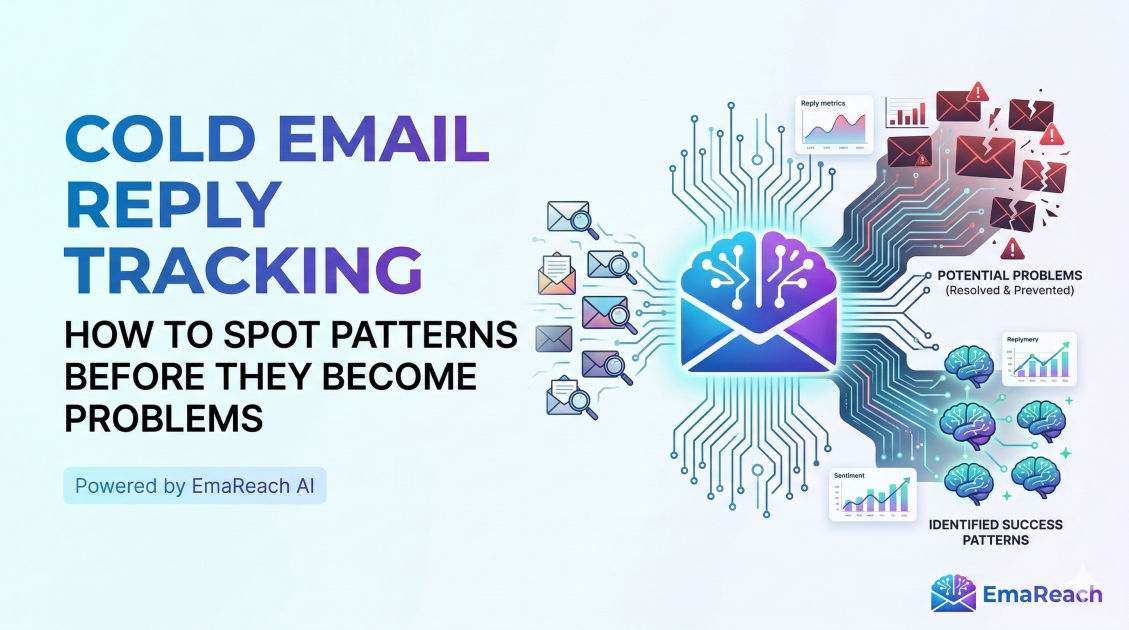
Cold Email Reply Tracking: How to Spot Patterns Before They Become Problems
cold emailoutreach strategyemail deliverabilitysales automationlead generationsentiment analysis
Introduction
In the high-stakes world of outbound sales, a reply is the ultimate currency. However, most practitioners treat replies as isolated events—either a 'yes' to be celebrated or a 'no' to be archived. This binary view overlooks the most valuable asset in your outreach strategy: the data hidden within the patterns of those replies.
Cold email reply tracking is not merely about counting how many people wrote back; it is about forensic analysis. By systematically monitoring the nature, timing, and sentiment of your replies, you can identify systemic issues in your targeting, messaging, or deliverability before they spiral into a campaign-killing crisis. When you stop looking at replies as individual interactions and start viewing them as data points, you gain the ability to predict the health of your entire sales funnel.
The Architecture of Effective Reply Tracking
To spot patterns, you first need a structure that captures more than just a 'Reply Rate' percentage. Effective tracking requires categorizing responses into specific buckets. Without this granularity, a 10% reply rate could look like a success on paper, even if 9% of those replies are 'Unsubscribe' requests or hostile complaints.
Quantitative vs. Qualitative Tracking
Quantitative tracking tells you that something is happening. It involves metrics like:
- Total Reply Volume: The raw number of responses.
- Reply-to-Open Ratio: A high open rate with a low reply rate usually signals a disconnect between the subject line and the body copy.
- Time-to-Reply: How long it takes for a prospect to respond after the email is sent.
Qualitative tracking tells you why it is happening. This involves sentiment analysis and objection tagging:
- Positive Sentiment: Requests for a demo, pricing, or a discovery call.
- Neutral Sentiment: Referral to another stakeholder or a request for more information.
- Negative Sentiment: Hard 'no's, requests to be removed from the list, or critiques of the outreach method.
Identifying Early Warning Signs in Reply Patterns
Problems in cold email campaigns rarely appear overnight. They manifest as subtle shifts in reply patterns. By keeping a finger on the pulse of these shifts, you can pivot before your domain reputation is permanently damaged.
The 'Wrong Person' Trend
If you notice an uptick in replies stating, "I'm not the right person for this, try [Name]," your targeting is slightly off. While a few of these are natural, a high percentage suggests that your ICP (Ideal Customer Profile) definition is too broad or based on outdated firmographic data. This is a 'soft' problem that, if ignored, wastes your daily sending limit on non-decision makers.
The Passive-Aggressive Surge
When replies shift from "Not interested" to "How did you get my email?" or "Stop emailing me," you are facing a relevance or frequency problem. This pattern often emerges when your copy feels too 'templated' or when your follow-up cadence is too aggressive. High volumes of negative sentiment are a leading indicator that your emails are being marked as spam, even if your tracking software hasn't reported a deliverability drop yet.
The 'No-Context' Response
If prospects reply with "What is this about?" or "Who are you?", your value proposition is buried. This pattern indicates that your lead-in or 'hook' is too vague. You are capturing attention but failing to deliver clarity, leading to high-friction conversations that rarely convert.
Using Sentiment Analysis to Protect Deliverability
Deliverability is the foundation of cold email. If your emails don't reach the inbox, your copy doesn't matter. Modern email service providers (ESPs) use sophisticated algorithms to determine if an account is sending 'wanted' or 'unwanted' mail.
Negative replies are a precursor to spam reports. When a prospect is annoyed enough to write a negative reply, they are one click away from hitting the 'Report Spam' button. By tracking the ratio of negative to positive replies, you can gauge your 'Spam Risk.' If negative sentiment exceeds a certain threshold, it is time to pause the campaign, refresh the list, and soften the copy.
To ensure your outreach remains sustainable, using a dedicated platform like EmaReach can be a game-changer. EmaReach helps you stop landing in spam by ensuring cold emails reach the inbox through a combination of AI-written outreach and automated inbox warm-up. By managing multi-account sending, it ensures your emails land in the primary tab, which naturally leads to more positive reply patterns and fewer deliverability headaches.
Mapping Reply Patterns to the Sales Funnel
Different patterns emerge at different stages of the email sequence. Analyzing when people reply provides insights into your persistence and the logic of your follow-ups.
Front-Loaded vs. Back-Loaded Replies
- Front-Loaded: Most replies come from the first or second email. This suggests a strong, immediate value proposition but might indicate that your follow-up sequence lacks a 'reason to respond' beyond the initial pitch.
- Back-Loaded: Replies come late in the sequence (e.g., email 5 or 6). This often signifies that your 'break-up' email or later-stage educational content is more resonant than your initial pitch. It may be worth moving those later-stage insights to the front of the campaign.
The 'Auto-Reply' Trap
High volumes of Out-of-Office (OOO) replies are often ignored, but they are a goldmine for pattern tracking. A sudden surge in OOO replies might indicate that you are targeting an industry during a major conference or a seasonal holiday. Tracking these allow you to pause campaigns and resume when the target audience is back at their desks, improving your chances of a real human interaction.
The Role of Timing and Geography
Patterns are often tied to when the email hits the inbox. If you are sending globally, tracking replies by timezone is essential.
| Time Sent | Reply Sentiment | Conversion Rate |
|---|---|---|
| Monday Morning | Often Short/Abrupt | Low |
| Tuesday Mid-day | High Engagement | High |
| Friday Afternoon | Lower Volume | Moderate |
| After Hours | High 'Unsubscribe' | Low |
By analyzing these patterns, you might find that while you get more replies on Monday morning, they are more likely to be rejections because prospects are overwhelmed by their weekend backlog. Shifting your sending window to Tuesday through Thursday could result in fewer, but higher-quality, conversations.
Turning Patterns into Action: A Three-Step Framework
Once you have identified a pattern, you must act on it. Use this framework to course-correct your campaigns.
1. Diagnose the Root Cause
Don't assume a low reply rate is always a 'copy' problem. Use the pattern to isolate the variable:
- Pattern: High open rate, zero replies. Diagnosis: Copy/CTA problem.
- Pattern: Low open rate, low replies. Diagnosis: Deliverability or Subject Line problem.
- Pattern: High 'Not Interested' replies. Diagnosis: Targeting/ICP problem.
2. Segment and Test
If you spot a negative pattern, don't change everything at once. Create a sub-segment of your list and test a single variable. For example, if you see the 'Wrong Person' pattern, try changing the job title filter in your lead sourcing tool and run a test batch of 100 emails. Compare the reply patterns of the test batch against the original.
3. Feedback Loop with Sales Development
If you are a manager or a founder, the reply tracking data must be shared with the people writing the copy and the people sourcing the leads. Often, the 'silo' effect prevents these patterns from being addressed. Weekly 'Reply Reviews' where the team looks at the top 10 negative and top 10 positive responses can align the team on what the market is actually saying.
Advanced Tracking: Beyond the Inbox
As your outbound operations scale, manual tracking becomes impossible. You should look toward systems that use natural language processing (NLP) to automatically categorize sentiment. This allows you to see high-level trends across thousands of emails.
For instance, an NLP-based dashboard might show you that over the last 30 days, the mention of 'Pricing' in replies has increased by 40%. This is a clear signal that your market is becoming more price-sensitive, suggesting you should adjust your copy to focus more on ROI and cost-savings rather than just features.
Common Pitfalls in Reply Analysis
While tracking patterns is vital, there are a few traps that can lead to wrong conclusions:
- Small Sample Sizes: Don't pivot your entire strategy based on three angry replies. Ensure you have a statistically significant volume (usually 200+ sends) before identifying a pattern.
- The 'False Positive' Reply: Be wary of people who reply with "Interesting, let's talk in six months." Often, this is a polite 'no.' If these are your only 'positive' replies, you are likely missing a sense of urgency in your messaging.
- Ignoring Technical Bounces: Hard bounces and soft bounces are technically 'replies' from a server. A sudden spike in bounces is a pattern that signals your list provider's data has gone stale or your domain has been blacklisted.
Conclusion
Cold email reply tracking is the difference between a salesperson who is guessing and a growth engine that is evolving. By looking past the surface-level metrics and diving into the sentiment, timing, and objections within your replies, you can spot the 'smoke' of a failing campaign before it turns into a 'fire' that burns your domain reputation.
Success in outbound is not about hitting a 'home run' with your first template; it is about the continuous, data-driven refinement of your approach. When you master the art of pattern recognition, every reply—even a rejection—becomes a stepping stone toward a more effective, more resilient outreach strategy. Keep your data clean, your categories specific, and your response to patterns swift, and you will find that the 'problems' most cold emailers face become the very insights that drive your growth.
EmaReach AI
Ready to scale your cold email outreach?
Join thousands of teams using EmaReach AI for AI-powered campaigns, domain warmup, and 95%+ deliverability. Start free — no credit card required.
Related posts
- Read article
The Instantly Alternative That Finally Gets Outbound Analytics Right
Discover why high-volume cold email requires a shift from surface-level vanity metrics to deep, data-driven revenue attribution, and explore the ultimate alternatives for mastering outbound engineering.
- Read article
What You Gain and What You Give Up When Switching From Instantly
Thinking about migrating your cold email stack? This detailed guide breaks down the exact operational advantages you gain and the core features you sacrifice when switching away from Instantly's popular outreach platform.