Blog
Back to blog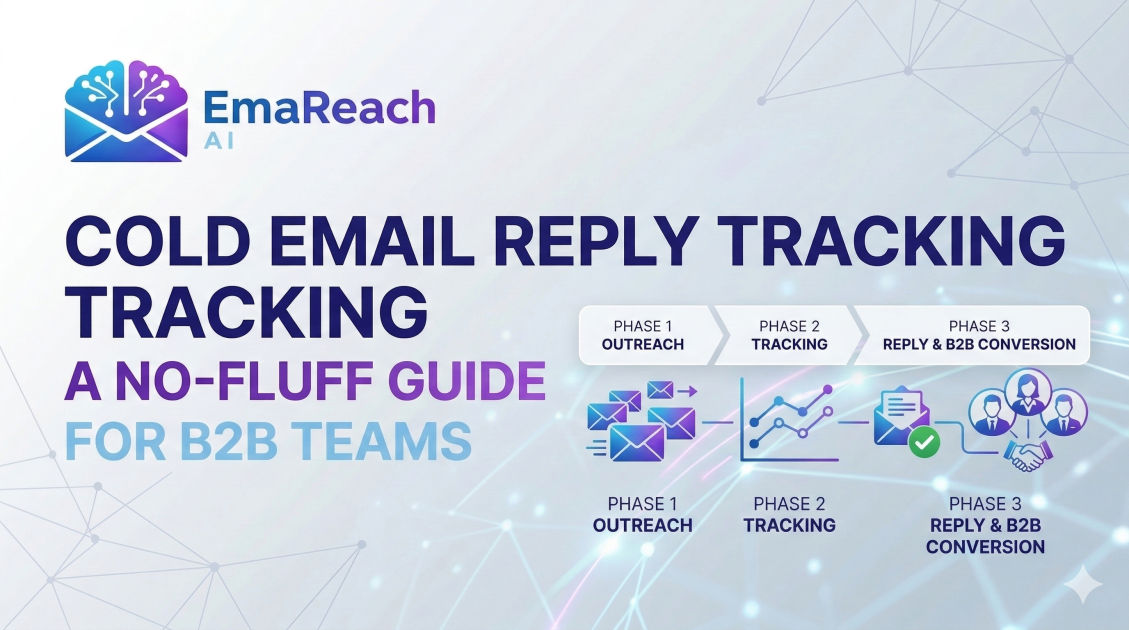
Cold Email Reply Tracking for B2B Teams: A No-Fluff Guide
cold emailB2B salesoutreach strategyemail trackinglead generationsales operationsdeliverability
Introduction
In the high-stakes world of B2B sales, the metric that matters above all else isn't just the open rate or the click-through rate—it is the reply. While many teams obsess over deliverability and subject line optimization, the actual management and tracking of replies often remain a chaotic manual process. For B2B teams scaling their outreach, a lack of structured reply tracking leads to missed opportunities, duplicate follow-ups, and a fragmented view of the sales pipeline.
Cold email reply tracking is the systematic process of identifying, categorizing, and responding to incoming messages from prospects. It bridges the gap between the initial outbound send and the eventual booked meeting. This guide strips away the fluff to focus on the technical infrastructure, organizational workflows, and data-driven insights required to master reply management at scale.
The Anatomy of an Email Reply
Before diving into the mechanics of tracking, it is essential to understand what constitutes a reply in a professional B2B context. Not all replies are created equal, and treating them as a monolithic metric is a recipe for skewed data.
Positive Replies
These are the 'gold' of cold outreach. A positive reply indicates interest, a request for more information, or an invitation to schedule a call. Tracking these accurately is vital for calculating your true Return on Ad Spend (ROAS) or Return on Effort (ROE).
Objection-Based Replies
Often mistaken for hard 'nos,' objection-based replies (e.g., "We don't have the budget," or "We are using a competitor") are valuable data points. Tracking these allows teams to refine their messaging and identify common market hurdles.
Neutral or Referral Replies
These occur when a prospect points you toward another stakeholder within the organization. While not an immediate conversion, these are critical for account-based marketing (ABM) strategies.
Negative Replies and Unsubscribes
Hard 'nos' and requests to be removed from the list must be tracked with surgical precision to ensure global opt-out compliance and protect sender reputation.
Why Tracking Replies is Non-Negotiable for Scaling Teams
For an individual founder sending ten emails a day, tracking is simple. For a B2B team sending thousands, it is a complex logistics problem. Without a robust tracking system, several critical failures occur:
- Lead Leakage: Replies get buried in individual sales development representative (SDR) inboxes, never to be seen again.
- Damaged Reputation: Sending a follow-up email to someone who already replied "No" is the fastest way to get marked as spam.
- Data Blindness: Without knowing which campaigns yield the highest positive reply rate, teams continue to invest in underperforming scripts.
To solve these issues, teams must implement systems that move beyond the basic 'Reply Rate' percentage found in most dashboards.
Technical Foundations of Reply Tracking
To track replies effectively, your technical stack must be configured to 'listen' for incoming mail. This usually involves several layers of technology working in tandem.
IMAP and SMTP Integration
Most outreach platforms use IMAP (Internet Message Access Protocol) to monitor your inbox. When a prospect replies, the tracking software detects the new message in the 'Sent' or 'Inbox' folder and matches the 'In-Reply-To' header with the original outgoing message. This is how the system attributes a reply to a specific campaign.
Sentiment Analysis
Modern B2B teams utilize AI-driven sentiment analysis to categorize replies automatically. Instead of an SDR manually reading 500 emails to find the five people who want a demo, the system flags 'Interested' vs. 'Not Interested' based on the text's semantic meaning. For teams looking to optimize this entire flow, EmaReach provides a powerful solution. EmaReach AI combines AI-written cold outreach with inbox warm-up and multi-account sending—so your emails land in the primary tab and get replies, making the tracking process significantly more fruitful.
Threading and Attribution
Proper tracking requires maintaining the 'thread.' If a prospect replies from a different email address (an alias or a colleague's account), the system must be smart enough to link that reply back to the original company or opportunity record. This is where advanced CRM synchronization becomes indispensable.
Establishing a Reply Tracking Workflow
A tool is only as good as the process surrounding it. To manage replies at a high volume, B2B teams should adopt a standardized 'Reply Workflow.'
Step 1: Centralization
Individual SDR inboxes are silos. A centralized 'Master Inbox' or a shared workspace allows managers to see the status of all active conversations. This prevents 'cherry-picking' and ensures that every lead is handled according to the company's Service Level Agreement (SLA).
Step 2: Immediate Categorization
As soon as a reply hits the system, it should be tagged. Common tags include:
- Meeting Requested
- Information Requested
- Not the Right Person (Referral)
- Later (Follow up in X months)
- Not Interested
Step 3: Automated Campaign Pausing
This is perhaps the most critical step in reply tracking. Once a reply is detected, the automated sequence for that specific prospect must pause immediately. Nothing kills a deal faster than an automated "Just checking in on my previous email!" arriving two hours after the prospect has already replied with a question.
Key Metrics to Track Beyond the 'Reply Rate'
If you only track the percentage of people who reply, you are missing 90% of the story. Professional B2B teams look at the following KPIs:
| Metric | Definition | Why it Matters |
|---|---|---|
| Positive Reply Rate | % of total emails that resulted in interest. | Measures lead quality and offer resonance. |
| Time to First Response | The time it takes for an SDR to respond to a prospect's reply. | Directly correlates with meeting booking rates. |
| Objection Distribution | A breakdown of why prospects say no. | Informs product development and sales training. |
| Reply-to-Meeting Ratio | % of replies that turn into a scheduled call. | Measures the effectiveness of the SDR's handling skills. |
| Bounce-to-Reply Ratio | Comparison of dead data vs. engaged data. | Evaluates the health of your lead sourcing. |
Common Pitfalls in Reply Tracking
Even with the best intentions, B2B teams often stumble when managing their reply data. Avoiding these common mistakes will keep your pipeline clean.
The 'Auto-Reply' Trap
Out-of-office (OOO) messages are technically replies. If your tracking system counts every "I am currently on vacation" as a lead, your data will be artificially inflated. Advanced tracking filters out these automated responses to ensure only human interactions are measured.
Manual Data Entry Lag
If an SDR receives a positive reply but waits three days to update the CRM, the marketing team might think the campaign is failing while the sales team is actually overwhelmed. Real-time, bi-directional sync between your email tool and your CRM is the only way to maintain a single source of truth.
Ignoring the 'Ghost' Replies
Sometimes, a prospect replies with a question, the SDR answers, and then the prospect goes silent. Tracking the 'Last Reply Age' helps identify leads that are stalling so they can be moved into a specific re-engagement sequence.
Optimizing for High-Quality Replies
Tracking is the reactive part of the equation; optimization is the proactive part. To improve the quality of the replies you are tracking, you must focus on the fundamentals of deliverability. If your emails are landing in the 'Promotions' or 'Spam' folders, you won't have any replies to track.
By utilizing multi-account sending and inbox warm-up, teams ensure that their messages reach the primary inbox. When you combine this with AI-driven personalization, the replies you track shift from "Remove me from this list" to "Can we talk on Thursday?"
Integrating Reply Tracking with CRM Systems
For a B2B organization, the CRM is the heart of operations. Reply tracking should never exist in a vacuum. A sophisticated integration should perform the following actions automatically:
- Create/Update Lead Status: Change a lead from 'Nurturing' to 'Engaged' upon receipt of a reply.
- Log Email Content: Store the text of the reply directly in the CRM timeline for visibility across the organization.
- Assign Tasks: Automatically create a 'Follow-up' task for the account owner when a positive sentiment is detected.
- Attribute Revenue: Link the eventual closed-won deal back to the specific cold email campaign that started the conversation.
Advanced Strategy: The 'Negative Reply' Goldmine
Most teams delete negative replies and move on. However, tracking the reasons for negative replies can provide a competitive advantage. For example, if you track that 30% of your negative replies mention a specific competitor by name, you can create a dedicated 'battle card' or a specific outreach sequence designed to highlight your advantages over that competitor.
Similarly, tracking 'Later' replies (e.g., "Check back in Q3") allows you to build a long-term pipeline that most of your competitors are ignoring. A disciplined tracking system ensures these prospects are automatically moved into a long-term nurture track and resurfaced at exactly the right time.
Conclusion
Cold email reply tracking is the backbone of a professional B2B outreach engine. It is the difference between a chaotic 'spray and pray' approach and a sophisticated, data-driven sales machine. By focusing on technical accuracy, sentiment analysis, and seamless CRM integration, teams can ensure that no lead is left behind and every conversation is pushed toward a conversion.
Effective tracking doesn't just show you where you've been; it lights the path to where you should go next. Stop guessing which campaigns are working and start measuring the conversations that build your business. The goal isn't just to send more emails—it's to generate more meaningful responses.
EmaReach AI
Ready to scale your cold email outreach?
Join thousands of teams using EmaReach AI for AI-powered campaigns, domain warmup, and 95%+ deliverability. Start free — no credit card required.
Related posts
- Read article
The Instantly Alternative That Finally Gets Outbound Analytics Right
Discover why high-volume cold email requires a shift from surface-level vanity metrics to deep, data-driven revenue attribution, and explore the ultimate alternatives for mastering outbound engineering.
- Read article
What You Gain and What You Give Up When Switching From Instantly
Thinking about migrating your cold email stack? This detailed guide breaks down the exact operational advantages you gain and the core features you sacrifice when switching away from Instantly's popular outreach platform.