Blog
Back to blog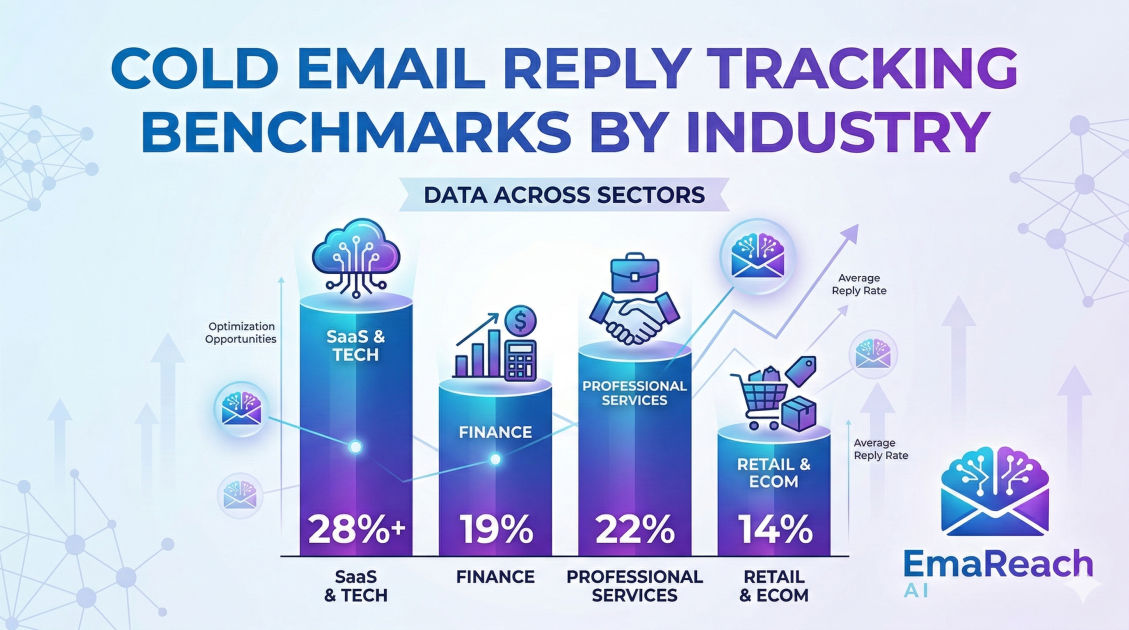
Cold Email Reply Tracking: Benchmarks by Industry
cold emailoutreach strategysales benchmarksemail deliverabilityB2B salesreply tracking
Introduction
In the world of outbound sales, data is the only compass that matters. While open rates were once the darling of email marketing, the landscape has shifted. Today, sophisticated teams recognize that an email opened is merely a vanity metric; an email replied to is a business opportunity. Tracking cold email replies effectively requires more than just a tally—it demands an understanding of how your performance stacks up against your specific industry peers.
Reply rates are the ultimate stress test for your value proposition, your targeting, and your timing. However, a "good" reply rate in the high-stakes world of Enterprise SaaS looks very different from a "good" rate in Professional Services or Manufacturing. Without industry-specific benchmarks, you are effectively flying blind, potentially optimizing for the wrong outcomes or abandoning a campaign that is actually performing above average for its niche.
This guide breaks down the essential benchmarks for cold email reply tracking across major industries and provides actionable insights into the factors that move the needle from ignored to engaged.
Why Reply Tracking is the North Star of Modern Outreach
For years, sales teams obsessed over open rates. However, with the rise of automated privacy protections and "bot opens" from email security filters, open rates have become increasingly unreliable. A tracking pixel might fire because a security scanner inspected the link, not because a human read the message.
Reply rates provide the most honest feedback loop. They indicate:
- Relevance: Did the recipient feel this was worth their time?
- Targeting: Did you reach the person who actually has the pain point you solve?
- Deliverability: Did your email land in the primary inbox or the promotions tab?
To ensure your outreach is actually reaching the human behind the screen, tools like EmaReach are designed to stop your messages from landing in spam. EmaReach AI combines AI-written cold outreach with inbox warm-up and multi-account sending, ensuring your emails land in the primary tab where they can actually get replies.
Global Cold Email Benchmarks: The Baseline
Before diving into industry specifics, it is helpful to establish a global baseline. Across all B2B industries, the typical cold email reply rate ranges from 3% to 7%.
- Below 2%: This usually signals a structural issue. It could be poor lead quality, a weak value proposition, or a deliverability crisis where your emails are being filtered into spam folders.
- 3% to 5%: This is the "Average" tier. You are reaching the right people, but your message may not be compelling enough to spark an immediate conversation.
- 5% to 10%: This is considered "Good to Great." You have likely nailed your Ideal Customer Profile (ICP) and are offering a clear, low-friction next step.
- Above 10%: This is "Elite." These rates are typically achieved through hyper-personalized, low-volume campaigns or by leveraging unique timing triggers (like a recent funding round or a new executive hire).
Industry-Specific Benchmarks
Not all inboxes are created equal. Some industries are saturated with outreach, leading to "inbox fatigue," while others are less frequented by sales reps, leading to higher receptivity.
1. Technology & SaaS
- Average Reply Rate: 3% – 5%
- Top Performers: 8% – 12%
The technology sector is perhaps the most difficult to break into via cold email. Decision-makers in SaaS are bombarded with hundreds of pitches daily. To hit the top-tier benchmarks here, you must move beyond generic templates. High-performing campaigns in SaaS often rely on "Trigger Events"—such as a company adopting a specific piece of technology (detected via technographics) or a recent product launch.
2. Professional Services & Consulting
- Average Reply Rate: 6% – 8%
- Top Performers: 12% – 15%
Professional services—including legal, accounting, and management consulting—often see higher reply rates than software. This is because these services are human-centric. Outreach that positions the sender as a peer or a subject matter expert, rather than a vendor, tends to perform exceptionally well. Providing a "mini-audit" or a specific industry insight within the first email can push reply rates toward the 15% mark.
3. Healthcare & Life Sciences
- Average Reply Rate: 2% – 4%
- Top Performers: 6%+
Healthcare is notoriously difficult due to strict privacy regulations (like HIPAA) and the sheer busyness of practitioners and administrators. However, when outreach is focused on operational efficiency or compliance—two major pain points in the sector—replies become more frequent. Successful outreach in this space often requires a longer lead time and a "soft" call to action, such as offering a white paper or a case study rather than a 15-minute demo.
4. Manufacturing & Logistics
- Average Reply Rate: 5% – 7%
- Top Performers: 10%+
Manufacturing professionals are often less targeted by "modern" digital sales tactics compared to tech companies. This lack of saturation represents an opportunity. Straightforward, jargon-free emails that focus on cost reduction or supply chain reliability tend to resonate deeply here.
5. Financial Services
- Average Reply Rate: 3% – 4.5%
- Top Performers: 7% – 9%
Finance is a high-trust industry. Cold emails here face significant skepticism. Benchmarks in this industry are often lower because security filters are aggressive. To succeed, senders must prioritize technical deliverability and use social proof—mentioning recognizable clients or regulatory compliance—to build immediate credibility.
Summary Table: Benchmarks by Industry
| Industry | Average Reply Rate | Top-Tier Performance |
|---|---|---|
| Software / SaaS | 3% – 5% | 10%+ |
| Professional Services | 6% – 8% | 15%+ |
| Healthcare | 2% – 4% | 6%+ |
| Manufacturing | 5% – 7% | 11%+ |
| Financial Services | 3% – 4.5% | 8%+ |
| Education / EdTech | 4% – 6% | 9%+ |
Factors That Influence Your Reply Rate
If your current tracking shows you are falling below these industry benchmarks, it is rarely due to just one factor. Usually, it is a combination of these three pillars:
The Quality of the "Hook"
Research indicates that different types of "hooks" (the opening or angle of your email) yield vastly different results.
- Timeline Hooks: Emails that mention a specific timeline for results (e.g., "How we helped X achieve Y in 30 days") can outperform traditional problem-based hooks by over 100%.
- Social Proof: Mentioning a competitor or a peer in the same industry increases trust and, consequently, the likelihood of a reply.
Personalization Depth
Simple personalization (using a first name or company name) is now the bare minimum. Today, "Deep Personalization" is what drives replies. This involves referencing a specific podcast the recipient was on, a recent LinkedIn post they wrote, or a specific business challenge their company is currently facing. Moving from basic to deep personalization can often double your reply rates.
The Sequence Length and Cadence
One email is rarely enough. Data shows that over 50% of replies come from follow-up emails.
- The First Follow-Up: Typically provides the highest lift in replies.
- The Optimal Range: Most successful sequences consist of 3 to 5 touchpoints spaced out over 10 to 14 days.
- Diminishing Returns: Sending more than 6 emails without a response often leads to an increase in spam complaints rather than a late-stage reply.
Technical Barriers to High Reply Rates
You could write the most compelling email in the world, but if it never reaches the inbox, your reply rate will be 0%. Technical tracking is just as important as the content itself.
Deliverability and Authentication
Modern email providers use sophisticated algorithms to filter out bulk mail. To maintain high reply rates, you must ensure your technical house is in order:
- SPF, DKIM, and DMARC: These are authentication protocols that prove you are who you say you are. Without them, your emails are likely to be flagged as suspicious.
- Inbox Warm-up: New domains or accounts with no sending history are often throttled. Gradually increasing volume through a warm-up process is essential.
- Spam Complaint Thresholds: Most providers now have a very low tolerance for spam complaints (often as low as 0.1%). If 1 out of every 1,000 people marks your email as spam, your entire domain's reputation could suffer.
Tracking Ethics and Deliverability
Interestingly, some top-tier sales teams have found that disabling open-rate tracking actually improves reply rates. This is because the tracking pixels used to monitor opens can sometimes trigger spam filters. By focusing solely on reply tracking, you reduce the technical footprint of your email, making it look more like a "one-to-one" personal message from a human, which naturally boosts the likelihood of it reaching the primary inbox.
Positive vs. Negative Replies
When tracking benchmarks, it is vital to distinguish between a total reply rate and a positive reply rate.
- Total Reply Rate: Includes every response, including "Not interested," "Unsubscribe," and "Take me off your list."
- Positive Reply Rate: Includes only those who show interest, ask for more information, or book a meeting.
In industries like Real Estate or Recruitment, total reply rates can be high, but many of those replies may be negative. Conversely, in Enterprise Software, you might have a lower total reply rate, but a much higher percentage of those replies are high-intent. A healthy campaign typically sees a positive reply rate that is 20% to 30% of the total replies.
Strategies to Improve Your Industry Standing
If your metrics are lagging behind the benchmarks mentioned above, consider implementing these three strategies:
1. Narrow Your ICP (Ideal Customer Profile)
High reply rates come from relevance. If you are emailing "all Marketing Managers," your message is likely too broad. If you narrow your focus to "Growth Marketing Managers at Series B Fintech companies who are currently hiring for SEO roles," your message becomes an order of magnitude more relevant.
2. Use Low-Friction Calls to Action (CTAs)
Asking for a "30-minute demo" is a high-friction request. It asks the recipient to give up a significant chunk of their day to someone they don't know. Instead, try low-friction CTAs:
- "Worth a quick look?"
- "Open to me sending over a 2-minute video on how we handle this?"
- "Is this a priority for your team this quarter?"
3. Leverage Multi-Channel Outreach
While this post focuses on email benchmarks, the reality is that email works best as part of a multi-channel approach. An email followed by a LinkedIn connection request or a phone call often sees a "halo effect," where the recipient replies to the email simply because they recognize your name from another platform.
Conclusion
Tracking cold email reply rates by industry is not about hitting a static number; it is about continuous refinement. By understanding the benchmarks for your specific sector, you can set realistic KPIs and identify exactly where your outbound engine needs tuning.
Remember that in the current era of outreach, quality beats quantity every time. A small, hyper-targeted list of 100 prospects with a 15% reply rate is infinitely more valuable than a list of 10,000 prospects with a 0.5% reply rate. Focus on deliverability, lean into deep personalization, and use these industry benchmarks to guide your journey toward a more predictable and profitable sales pipeline.
EmaReach AI
Ready to scale your cold email outreach?
Join thousands of teams using EmaReach AI for AI-powered campaigns, domain warmup, and 95%+ deliverability. Start free — no credit card required.
Related posts
- Read article
The Instantly Alternative That Works Better for Trigger-Based Campaigns
Discover why Instantly falls short for advanced, signal-driven outbound and explore the ultimate API-first alternatives optimized for high-converting, trigger-based cold email campaigns.
- Read article
The Instantly Alternative That Handles High Bounce Rates Without Panic
Discover how transitioning to an advanced Instantly alternative can safeguard your cold email infrastructure. Learn to handle high bounce rates effortlessly using real-time verification, smart mailbox rotation, and automated safety nets to protect your sender reputation and maintain consistent primary inbox placement.