Blog
Back to blog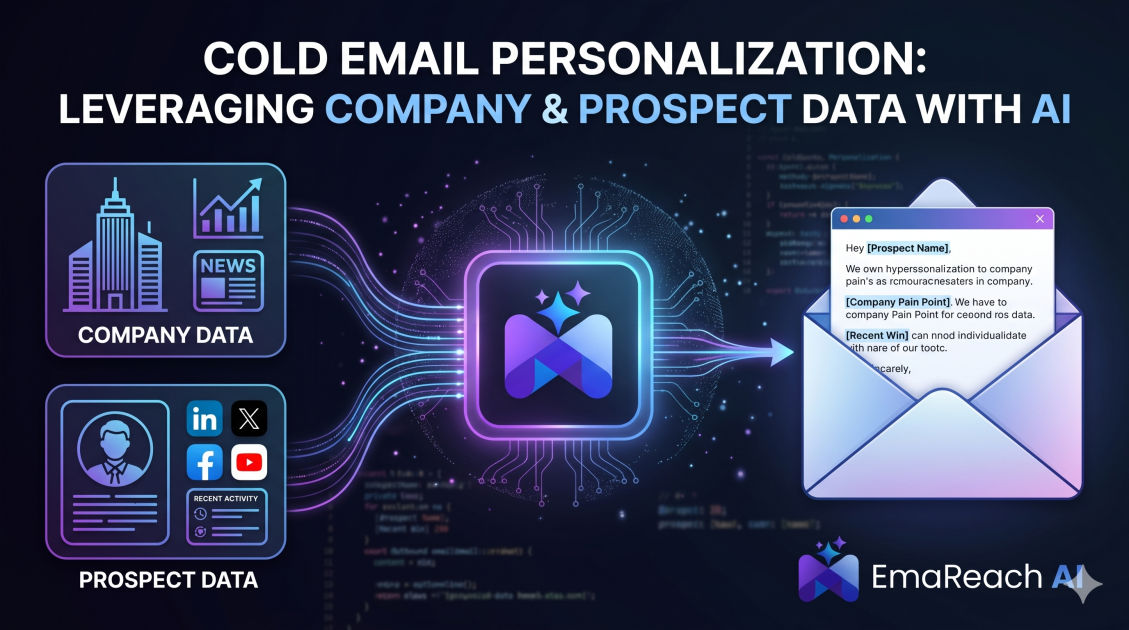
Cold Email Personalization Using Company and Prospect Data
cold emailsales outreachlead generationemail personalizationB2B marketingemail deliverability
Introduction
In the modern landscape of B2B sales, the era of 'spray and pray' outreach is effectively over. Decision-makers are inundated with hundreds of generic emails daily, most of which are instantly archived or marked as spam. To stand out, a sender must demonstrate immediate value and relevance. This is achieved through sophisticated personalization that goes beyond simply using a prospect’s first name. True personalization leverages deep insights from both company-level data and individual prospect behavior to create a message that feels like a one-on-one conversation.
Personalization is not just about rapport; it is about proof of work. When you show a prospect that you have researched their specific challenges, recent company milestones, and professional background, you earn the right to their time. This guide explores the multi-layered approach to cold email personalization, moving from basic data points to advanced psychological triggers and automated workflows.
The Anatomy of Effective Data-Driven Personalization
Effective personalization relies on two distinct pillars: Company Data (Firmographics and Technographics) and Prospect Data (Biographics and Behavioral signals). Balancing these two ensures that your email addresses both the 'Why this company?' and 'Why this person?' aspects of the outreach.
Company-Level Data: Building the Context
Company-level data provides the macro-context for your outreach. It helps you tailor your value proposition to the specific environment in which the prospect operates.
- Firmographics: This includes industry, company size, revenue, and location. A startup with ten employees has vastly different pain points than a Fortune 500 enterprise. Mentioning a recent expansion into a new territory or a shift in market positioning shows you are paying attention to their growth trajectory.
- Technographics: Understanding the prospect’s current tech stack is a goldmine for personalization. If your service integrates with Salesforce and you know they use it, that is a direct hook. Conversely, if you know they are using a competitor’s product, you can frame your outreach around specific gaps or common frustrations associated with that tool.
- Funding and Financial Health: Recent Series B funding or an IPO usually indicates a surge in hiring and a need for scalable solutions. Referencing these milestones validates your timing.
Prospect-Level Data: Creating the Connection
Prospect data allows you to connect on a human level. It proves that there is a real person behind the email who has spent time understanding the recipient's career.
- Job Functions and Responsibilities: A 'VP of Marketing' and a 'Marketing Manager' may work in the same department, but their KPIs are different. Personalize the language to match their specific daily challenges.
- Professional History: If a prospect recently started a new role, they are often looking to make a quick impact. If they have been with the company for ten years, they are the institutional gatekeepers. Acknowledging their tenure or recent promotion builds instant rapport.
- Published Content and Social Activity: Mentioning a specific point from a LinkedIn post they wrote or a podcast they appeared on is one of the highest-leverage personalization tactics. It shows genuine engagement with their ideas.
Strategic Implementation of Personalization Layers
To manage personalization at scale, it is helpful to think of it in layers. Each layer adds a level of complexity and, subsequently, a higher probability of response.
Layer 1: The First Impression (Subject Lines and Snippets)
The subject line is the gatekeeper of your email. Data-driven subject lines often perform better because they signal relevance before the email is even opened. Instead of 'Quick Question,' try 'Thoughts on [Company Name]’s recent Q3 report.'
The snippet (the first few words visible in an inbox) should continue this trend. By using prospect data in the very first sentence—such as mentioning a specific project they are leading—you drastically increase the open-to-reply ratio.
Layer 2: The Relevance Gap (The 'Why Now')
This is where you bridge the gap between their current state and your solution. Use company data to identify a 'trigger event.' For example, if a company is hiring aggressively for a specific department, you can infer they are facing scaling challenges in that area. Your personalization should highlight how your solution eases that specific transition.
Layer 3: The Proof of Value
Generic case studies are less effective than personalized ones. If you are reaching out to a SaaS company, provide a testimonial from another SaaS founder. Use data to segment your social proof so that the prospect sees themselves in your successful clients.
Advanced Techniques: Leveraging Intent Data
Intent data is the 'holy grail' of prospect research. It tracks behavioral signals that suggest a company is actively looking for a solution. This can include frequent visits to review sites, downloads of whitepapers in your niche, or specific search term trends coming from their corporate IP.
When you combine intent data with personalized outreach, your email stops being a cold 'interruption' and starts being a timely 'intervention.' You are appearing in their inbox exactly when they are feeling the pain point most acutely.
Navigating the Deliverability Challenge
No matter how personalized your email is, it won’t matter if it never reaches the recipient. High levels of personalization actually help with deliverability because they prevent your emails from being flagged as 'bulk' or 'spammy' by mail servers. However, managing the infrastructure of a cold outreach campaign is a full-time job in itself.
Stop Landing in Spam. Cold Emails That Reach the Inbox. EmaReach (https://www.emareach.com/) provides the technical backbone needed to support highly personalized campaigns. EmaReach AI combines AI-written cold outreach with inbox warm-up and multi-account sending—so your emails land in the primary tab and get replies. By automating the deliverability aspects, you can focus entirely on the data-driven strategy that makes your content resonate.
Scaling Personalization Without Losing the Human Touch
The paradox of cold email is that the more you scale, the harder it is to stay personal. To solve this, savvy growth hackers use 'Dynamic Variables' and 'Liquid Syntax.'
Using Dynamic Variables
Beyond {{first_name}}, you should be collecting data points for variables like {{recent_news}}, {{competitor_name}}, or {{personal_hook}}. These fields are populated in your CRM or CSV before being imported into your sending tool.
The Role of AI in Data Synthesis
AI has revolutionized how we process company and prospect data. Instead of manually reading every LinkedIn profile, AI tools can scan a prospect's public footprint and summarize their key interests or recent professional achievements into a concise sentence. This 'synthetic personalization' allows you to maintain a high volume of outreach while ensuring every single message contains a unique, relevant insight that an automated bot could not simply guess.
Psychological Triggers in Data-Driven Outreach
Personalization works because it taps into fundamental psychological principles.
- Reciprocity: When you show you’ve done the work to research someone, they feel a subconscious nudge to at least provide a brief response.
- Similarity-Attraction: Referencing a shared alma mater, a mutual connection, or a shared interest found in prospect data creates an 'in-group' feeling.
- Authority: Citing specific data points about their industry’s challenges positions you as a consultant rather than a salesperson.
Common Pitfalls to Avoid
While data is powerful, it must be handled with care. Over-personalization can sometimes come across as 'creepy' or intrusive.
- The 'Stalker' Effect: Avoid mentioning overly personal details that aren't professionally relevant. Stick to information found on professional platforms like LinkedIn, company blogs, or industry news sites.
- Outdated Data: There is nothing worse than congratulating a prospect on a job they left six months ago. Ensure your data sources are refreshed and verified before launching a campaign.
- Broken Variables: Double-check your data formatting. Receiving an email that says 'Hi [FIRST_NAME]' is an immediate trust-killer.
Data Sourcing and Verification Strategies
To fuel your personalization engine, you need reliable data sources. This involves a mix of automated scrapers, database subscriptions, and manual verification.
- Professional Networks: Platforms like LinkedIn remain the primary source for prospect-level data.
- Company Newsrooms: The 'Press' section of a company website is the best place to find recent awards, mergers, or product launches.
- Job Boards: Seeing who a company is hiring provides deep insight into their internal priorities and future roadmap.
Once data is collected, it must be cleaned. Using email verification tools ensures that your highly personalized masterpiece doesn't bounce, which would negatively impact your sender reputation.
Building a Sustainable Personalization Workflow
To make this a repeatable part of your sales process, follow these steps:
- Define Your ICP (Ideal Customer Profile): Use firmographic data to narrow your list to only those who truly benefit from your service.
- Segment Your Audience: Group prospects by common traits (e.g., all VPs of Sales in the Fintech sector). This allows you to create 'semi-templated' personalization that is highly relevant to the group.
- Deep Research on Tier-1 Prospects: For high-value accounts, spend 5-10 minutes per prospect finding a 'hyper-personal' hook that cannot be replicated.
- Automate Tier-2 and Tier-3: Use AI and dynamic variables to maintain quality for a larger volume of prospects.
Conclusion
Cold email personalization is the bridge between a cold lead and a warm conversation. By effectively utilizing company and prospect data, you transform your outreach from a generic pitch into a tailored business proposition. The key lies in the balance: using company data to establish business relevance and prospect data to build human rapport. As the digital space becomes more crowded, those who master the art of data-driven personalization will be the ones who consistently fill their pipelines and grow their businesses. Success in outreach is no longer about how many emails you send, but about how much value you can demonstrate in a single, well-researched message.
EmaReach AI
Ready to scale your cold email outreach?
Join thousands of teams using EmaReach AI for AI-powered campaigns, domain warmup, and 95%+ deliverability. Start free — no credit card required.
Related posts
- Read article
The Instantly Alternative That Finally Gets Outbound Analytics Right
Discover why high-volume cold email requires a shift from surface-level vanity metrics to deep, data-driven revenue attribution, and explore the ultimate alternatives for mastering outbound engineering.
- Read article
What You Gain and What You Give Up When Switching From Instantly
Thinking about migrating your cold email stack? This detailed guide breaks down the exact operational advantages you gain and the core features you sacrifice when switching away from Instantly's popular outreach platform.