Blog
Back to blog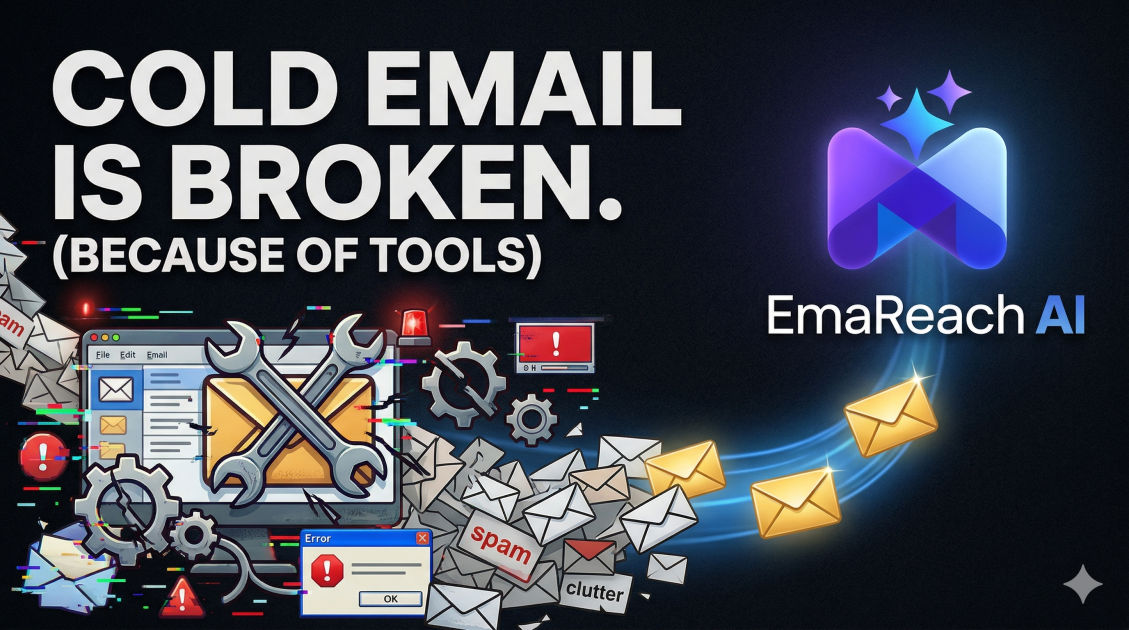
Cold Email Is Broken Because of Tools
cold emailemail deliverabilitysales automationoutreach strategyB2B marketingemail toolslead generation
The Paradox of Progress in Modern Outreach
For over a decade, cold email has been the backbone of B2B growth. It was the great equalizer, allowing a small startup in a garage to land a meeting with a Fortune 500 executive through nothing more than a well-crafted message and a clear value proposition. However, a fundamental shift has occurred. If you speak to any sales leader or founder today, the sentiment is almost universal: cold email feels broken.
Response rates are plummeting, open rates are being fabricated by bot activity, and the technical hurdles required just to reach a human inbox have become a full-time job. While many blame 'market saturation' or 'email fatigue,' the reality is more ironic. Cold email is broken because of the very tools designed to scale it. The explosion of automation, mass-sending platforms, and low-barrier-to-entry scrapers has turned a precision instrument into a blunt object, and the ecosystem is finally pushing back.
The Rise of the 'Spray and Pray' Infrastructure
In the early days of digital outreach, the 'cost' of sending an email was high—not in terms of currency, but in terms of effort. You had to find the prospect, research their business, and manually type a message. This friction was a natural filter that maintained a baseline of quality in the average inbox.
Today, that friction has been entirely removed by software. We have entered the era of the 'Spray and Pray' infrastructure. Tools now allow users to purchase thousands of aged domains, set up hundreds of mailboxes with a few clicks, and scrape tens of thousands of leads from social networks in minutes. This hyper-efficiency has led to a tragedy of the commons. Because it is so easy to send 50,000 emails, people do it—regardless of whether they have 50,000 qualified people to talk to.
This volume-first approach has forced email service providers like Google and Microsoft to deploy increasingly aggressive AI-driven spam filters. These filters are no longer just looking for keywords like 'free' or 'buy now'; they are looking for patterns of behavior. When a tool sends identical metadata signatures across thousands of accounts, the filters flag the entire operation. By trying to use tools to outsmart the system, marketers have actually trained the system to block them more effectively.
The Template Trap and the Death of Authenticity
One of the most significant ways tools have broken cold email is through the democratization of the 'perfect template.' Sales engagement platforms often come pre-loaded with 'proven' sequences or allow users to share templates that have seen high reply rates in the past.
While this sounds helpful, it creates a monoculture of communication. When ten thousand sales reps use the same 'Is this a bad time?' or 'Thought you’d find this interesting' opening line, prospects develop a psychological blind spot. These patterns are instantly recognized as 'automated noise.' The tools have made it so easy to look professional that everyone looks exactly the same, which is the ultimate sin in marketing.
Furthermore, the 'personalization' features in many tools are often shallow. Replacing a [Company Name] or [Job Title] tag is no longer enough to convince a high-level executive that you’ve done your homework. In fact, poorly executed 'merge tag' personalization often does more harm than good, signaling to the recipient that they are just a row in a spreadsheet.
Technical Debt: The Hidden Cost of Automation
As tools have made it easier to send mail, they have also made it easier to ruin your sender reputation. Many users plug their primary business domain into automation tools without understanding the technical ramifications. High bounce rates from unverified lists and high spam complaint rates from irrelevant targeting can 'burn' a domain in a matter of weeks.
To combat this, a new category of tools emerged: inbox warm-up services. For a long time, these were seen as a silver bullet. However, even these have contributed to the problem. Many legacy warm-up tools use 'fake' traffic—bots emailing other bots. Email providers are now sophisticated enough to distinguish between this artificial activity and genuine human interaction. If your 'warm-up' signature is detected as bot-driven, your reputation takes a deeper hit.
To solve this technical crisis, you need a solution that mimics human behavior and prioritizes deliverability over raw volume. This is where EmaReach changes the game. Stop Landing in Spam. Cold Emails That Reach the Inbox. EmaReach AI combines AI-written cold outreach with inbox warm-up and multi-account sending—so your emails land in the primary tab and get replies. By focusing on the quality of the interaction rather than just the quantity of the send, it fixes the technical brokenness that most tools ignore.
The Data Decay Problem
Cold email tools are only as good as the data fed into them. We have seen an explosion in 'B2B Database' tools that promise millions of verified emails. The problem? Data decays at an incredible rate. People change jobs, companies fold, and email addresses are deactivated.
Because tools make it so easy to import massive lists, many marketers skip the crucial step of data cleaning. Sending emails to invalid addresses (hard bounces) is the fastest way to get your IP blacklisted. The 'convenience' of these tools has fostered a culture of laziness where marketers prioritize the size of their list over its accuracy. When you combine bad data with high-speed automation, you aren't just missing opportunities; you are actively damaging your ability to send email in the future.
The Psychological Impact on the Recipient
We cannot discuss why cold email is broken without looking at the other side of the screen. The average decision-maker is now bombarded with dozens, if not hundreds, of 'automated' outreach attempts per day. This has led to a state of 'Outreach Fatigue.'
Psychologically, the threshold for a prospect to mark an email as spam has lowered. Previously, they might have just deleted it. Now, they report it to clear their inbox faster. Tools have made it so easy to reach people that we have collectively annoyed the very people we want to help. The 'tool-driven' mindset treats prospects as a statistical probability (e.g., 'If I send 1,000 emails, 1% will reply'), whereas a human-centric mindset treats them as a person with a specific problem to solve.
Moving from Automation to Augmentation
The solution to the 'broken' state of cold email isn't to stop using tools altogether; that would be impossible in a modern competitive landscape. Instead, the shift must be from 'Automation' (letting the tool do the work) to 'Augmentation' (using the tool to enhance human capability).
Augmentation looks like using AI to write better, more contextual openers that actually relate to a prospect’s recent achievements. It looks like using multi-account infrastructure to spread out volume so that no single mailbox ever looks like a 'spammer.' It looks like using sophisticated warm-up protocols that involve real engagement, not just bot-to-bot pings.
This is why platforms that integrate the entire lifecycle of an email—from writing to sending to warming—are becoming the new standard. By using EmaReach, you aren't just adding another tool to the pile; you are adopting a strategy designed to bypass the 'broken' parts of the ecosystem. It ensures that while the rest of the world is screaming into the void of the spam folder, your messages are landing where they belong: the primary inbox.
Best Practices for the New Era of Outreach
To thrive in an environment where tools have broken the traditional models, you must adopt a new set of rules:
- Prioritize Deliverability Over Volume: It is better to send 50 emails that get a 50% open rate than 5,000 emails that get a 1% open rate. High engagement signals to providers that you are a sender of value.
- Use Subdomains and Separate Mailboxes: Never send cold outreach from your primary business domain. Tools have made it easy to set up 'lookalike' domains (e.g., getcompany.com instead of company.com). Use this to protect your main brand infrastructure.
- Human-in-the-Loop AI: Don't let AI write and send without a human eye. Use AI to generate insights and drafts, but ensure a human provides the final touch of empathy and context.
- Continuous Warm-up: Warm-up isn't a one-time task; it's a continuous process. Your mailboxes should be in a constant state of 'conversation' to maintain their reputation against the evolving algorithms of Google and Microsoft.
- Strict List Hygiene: Use verification tools for every single list import. If a lead hasn't been verified in the last 30 days, consider it 'dirty' and re-verify it before sending.
Conclusion: Fixing the Machine
Cold email is not dead, but the 'tool-first' version of it is certainly dying. The era of clicking a button and waiting for the millions to roll in is over. The very software that promised to make our lives easier ended up making the landscape more complex by lowering the bar for everyone else.
To fix cold email, we have to look past the tools and return to the fundamentals of communication: sending the right message to the right person at the right time. The tools should be the engine, not the driver. When you combine a strategic, human-centric approach with a platform built for the modern reality of deliverability—like EmaReach—you don't just fix what is broken; you gain a massive competitive advantage over those still trying to 'spray and pray' their way to success. The future of outreach belongs to those who use tools to be more human, not less.
EmaReach AI
Ready to scale your cold email outreach?
Join thousands of teams using EmaReach AI for AI-powered campaigns, domain warmup, and 95%+ deliverability. Start free — no credit card required.
Related posts
- Read article
The Instantly Alternative That Finally Gets Outbound Analytics Right
Discover why high-volume cold email requires a shift from surface-level vanity metrics to deep, data-driven revenue attribution, and explore the ultimate alternatives for mastering outbound engineering.
- Read article
What You Gain and What You Give Up When Switching From Instantly
Thinking about migrating your cold email stack? This detailed guide breaks down the exact operational advantages you gain and the core features you sacrifice when switching away from Instantly's popular outreach platform.