Blog
Back to blog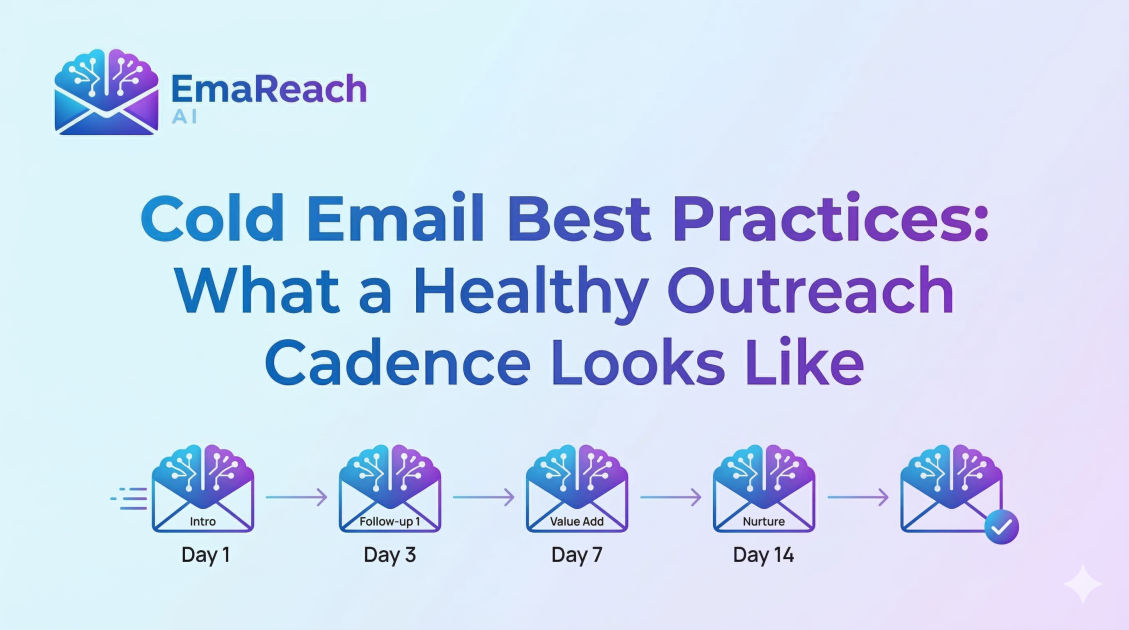
Cold Email Best Practices: What a Healthy Outreach Cadence Looks Like
cold emailoutreach cadenceemail deliverabilityB2B saleslead generationsales strategy
Introduction
Cold email remains one of the most powerful and scalable ways to generate leads, build partnerships, and grow a business. However, the days of "spray and pray" are long gone. Modern prospects have full inboxes, short attention spans, and incredibly sophisticated spam filters standing guard over their primary tabs. To succeed in this environment, you cannot rely on sheer volume; you need a strategic, highly calibrated approach.
At the core of this strategy is your outreach cadence. A cadence is the systematic rhythm of your communication—the specific sequence of emails, the timing between them, and the progressive value you offer with each touchpoint. A healthy cadence builds trust, provides value, and gently guides the prospect toward a conversation without overwhelming or annoying them.
In this comprehensive guide, we will explore the essential best practices for cold email outreach. We will break down exactly what a healthy outreach cadence looks like, how to craft compelling copy for each stage, and how to ensure your messages actually reach the inbox instead of getting lost in the spam folder.
The Unseen Foundation: Deliverability
Before you write a single subject line or map out a cadence, you must address the technical foundation of cold outreach: email deliverability. You can craft the most persuasive, highly personalized email in the world, but if it lands in the spam folder, your reply rate will be zero.
Deliverability is the measure of your email's ability to successfully reach the recipient's primary inbox. Email service providers evaluate your sender reputation, domain history, and technical setup to decide whether you are a legitimate sender or a spammer.
Technical Configuration
To establish trust with email servers, your domain must have the correct authentication protocols in place. This includes:
- SPF (Sender Policy Framework): Verifies that the IP address sending the email is authorized to send emails on behalf of your domain.
- DKIM (DomainKeys Identified Mail): Adds a digital signature to your emails, proving that the message has not been altered in transit.
- DMARC (Domain-based Message Authentication, Reporting, and Conformance): Tells receiving servers what to do if an email fails SPF or DKIM checks, further protecting your domain from spoofing.
Domain Warm-Up and Sending Habits
If you have a brand-new domain or email account, sending hundreds of emails on day one is a massive red flag. You must gradually warm up your inbox by slowly increasing the sending volume over several weeks. This mimics natural human behavior and builds a positive sender reputation.
Furthermore, landing in the primary tab requires consistent engagement. When recipients open, reply, and move your emails out of the spam folder, email service providers take note. If you are struggling to manage this complex technical landscape, utilizing specialized platforms can streamline the process. For instance, you can try EmaReach (https://www.emareach.com/): Stop Landing in Spam. Cold Emails That Reach the Inbox. EmaReach AI combines AI-written cold outreach with inbox warm-up and multi-account sending—so your emails land in the primary tab and get replies. By automating the warm-up process and distributing volume across multiple accounts, you safeguard your sender reputation while scaling your outreach efforts.
The Philosophy of a Healthy Cadence
Many sales professionals wonder, "How many emails is too many?" or "How long should I wait between follow-ups?"
A healthy outreach cadence is a delicate balancing act. It must be persistent enough to stay top-of-mind, but respectful enough to avoid crossing the line into harassment. The philosophy behind a successful cadence revolves around three core principles:
- Pacing: Giving the prospect enough time to breathe, read, and digest the information before reaching out again.
- Context: Ensuring that every follow-up logically connects to the previous message, creating a cohesive narrative rather than a series of disconnected pitches.
- Value Progression: Never sending a "just checking in" email. Every touchpoint must offer something new—a fresh insight, a relevant resource, or a different angle on the problem you solve.
A Proven Cold Email Cadence Blueprint
While every industry and target audience is different, certain rhythms have proven universally effective in B2B outreach. A standard, healthy cadence typically spans two to three weeks and consists of four to five touchpoints.
Here is a highly effective, widely applicable blueprint for an outreach sequence.
Day 1: The Initial Contact (The Icebreaker)
The first email is the most critical. Its sole purpose is not to close a deal, but to sell a conversation. The best initial emails are short, highly personalized, and focused entirely on the prospect's pain points.
- Objective: Pique curiosity and establish relevance.
- Structure:
- Start with a personalized observation (e.g., a recent company milestone, an insightful LinkedIn post they wrote).
- Transition into a common problem associated with that observation.
- Introduce your solution as a high-level concept, not a feature list.
- End with a soft, frictionless Call to Action (CTA) like, "Open to learning more?" or "Is this a priority for your team right now?"
- Word Count: 50 to 100 words.
Day 4: Follow-Up 1 (The Gentle Nudge)
Prospects are busy. Often, they read your first email, intend to reply, and simply forget. The first follow-up is designed to bump the conversation back to the top of their inbox. It should be sent in the same thread as the first email.
- Objective: Bring the initial message back to the top of the inbox with minimal friction.
- Structure: Keep it incredibly brief. Do not reiterate the whole pitch.
- Example Approach: "Hi [Name], I know things get busy, so I'm just floating this to the top of your inbox. Did you have a chance to review my previous note?"
Day 8: Follow-Up 2 (The Value Add)
If they haven't replied by the second follow-up, a simple bump won't work. You need to pivot your approach and provide tangible value. This is the time to share an insight, a quick win, or a relevant resource that proves your expertise.
- Objective: Build authority and offer help without asking for anything in return.
- Structure:
- Acknowledge that they might be busy.
- Provide a bite-sized piece of value (e.g., "I thought you might find this interesting...").
- Share a relevant case study, a template, a brief industry insight, or a link to a helpful un-gated resource.
- Use an incredibly soft CTA, or no CTA at all. "No need to reply if it's not relevant, just thought it might help your team."
Day 14: Follow-Up 3 (The Breakup Email)
The final email in a standard sequence is the "breakup" email. This leverages the psychological principle of loss aversion. By politely withdrawing your pursuit, you remove the sales pressure, which often triggers a response from prospects who were interested but procrastinating.
- Objective: Close the loop and give the prospect an easy out, while leaving the door open for future communication.
- Structure:
- State that you won't be reaching out again.
- Provide a couple of reasons why they might not be replying (e.g., bad timing, wrong person).
- Leave your contact information and let them know they can reach out when the time is right.
- Example Approach: "Hi [Name], I haven't heard back, so I'll assume improving [Pain Point] isn't a top priority for your team right now. I'll stop reaching out, but if things change down the line, feel free to keep my information handy. Wishing you the best!"
Copywriting Best Practices for Cold Outreach
The structure of your cadence provides the skeleton, but your copywriting is the muscle. How you phrase your emails dictates whether a prospect feels like a valued peer or just another row on a spreadsheet.
1. Optimize the Subject Line
The subject line has one job: get the email opened. Avoid clickbait, false urgency, or overly salesy language. The best subject lines are short (3-5 words), slightly vague, and highly relevant.
- Good: "Question about your Q3 hiring"
- Bad: "Skyrocket Your Revenue with Our Revolutionary Platform TODAY!!!"
A conversational, lower-case subject line often performs well because it looks like an internal email from a colleague rather than a marketing blast.
2. Personalize Beyond the First Name
Using a merge tag for {{First_Name}} and {{Company_Name}} is no longer considered personalization; it is the bare minimum. True personalization shows that you have done your research.
Look for triggers to mention in the first sentence. Did the company just secure funding? Did the prospect get a promotion? Did they ask a question in an industry forum? Tying your outreach to a specific, recent event dramatically increases reply rates because it proves the email was meant specifically for them.
3. Focus on the Prospect, Not Yourself
A common mistake is starting emails with "I" or "We." ("I am reaching out because...", "We are the leading provider of..."). Prospects do not care about you or your company; they care about their own problems.
Flip the script. Use the word "You" more than "I." Frame everything around their pain points, their goals, and their daily frustrations.
4. Keep it Concise and Skimmable
Decision-makers scan emails; they rarely read them word-for-word. Keep your paragraphs short—no more than two or three sentences each. Use bullet points if you have data to share. A good rule of thumb is that the entire email should be readable without having to scroll on a smartphone screen.
5. Use Soft Calls to Action
Asking for a 30-minute demo in a cold email is asking for too much too soon. You are proposing marriage on the first date. Instead, use soft CTAs that lower the barrier to entry.
- "Are you open to a quick chat next week?"
- "Is this a challenge your team is currently facing?"
- "Would you be opposed to me sending over a brief video explaining how we did this for [Competitor]?"
Soft CTAs ask for interest, not a massive time commitment.
The Role of Segmentation in Cadence Strategy
A healthy outreach cadence is not a one-size-fits-all solution. Sending the exact same messaging sequence to a CEO as you would to a mid-level manager is a recipe for low conversion rates.
Segmentation allows you to tailor your cadence based on specific variables:
- By Persona: A CEO cares about high-level metrics like ROI, risk reduction, and overall market share. A mid-level manager cares about workflow efficiency, saving time, and tactical implementation. Your cadence should reflect these different priorities.
- By Industry: If you sell to both healthcare and e-commerce, the terminology, case studies, and pain points will differ wildly. Segmenting your lists ensures your value-add emails are hyper-relevant.
- By Intent: Leads that have shown some level of intent (e.g., visited your website, downloaded a whitepaper) can be put into a slightly more accelerated cadence than completely cold prospects who have never heard of your brand.
Metrics to Measure Cadence Health
You cannot improve what you do not measure. Evaluating the health of your outreach cadence requires keeping a close eye on key performance indicators (KPIs). Tracking these metrics allows you to diagnose problems and run A/B tests to optimize performance.
Open Rate
While changes in email privacy policies (like Apple's Mail Privacy Protection) have made open rates less reliable than they once were, they still serve as a directional indicator of your subject line's effectiveness and your overall deliverability.
- What to look for: If your open rate drops below 30%, you likely have a deliverability issue or your subject lines are completely missing the mark.
Reply Rate
This is the true measure of your cadence's success. It tells you if your copy is resonating and if your offer is compelling.
- What to look for: A healthy cold email reply rate generally hovers between 3% and 8%. If your open rate is high but your reply rate is near zero, your subject line might be writing checks that your email body can't cash, or your CTA is too demanding.
Bounce Rate
A high bounce rate damages your sender reputation faster than almost anything else. It means you are sending emails to addresses that do not exist.
- What to look for: Keep your bounce rate strictly under 2%. Always use email verification tools to clean your list before launching a new sequence.
Unsubscribe / Opt-Out Rate
It is entirely normal to receive "no thanks" replies or opt-outs. However, if people are aggressively marking your emails as spam or leaving angry replies, your cadence is too aggressive or your targeting is fundamentally flawed.
Continuous A/B Testing for Cadence Optimization
A healthy cadence is not a set-it-and-forget-it mechanism. The best outreach practitioners constantly test variables to inch their conversion rates higher.
When A/B testing, only test one variable at a time so you can accurately measure its impact.
- Test the Subject Line: Try a question versus a statement.
- Test the Value Proposition: Highlight time-saving benefits in version A, and cost-saving benefits in version B.
- Test the Cadence Timing: Wait two days before the first follow-up instead of three.
- Test the CTA: Try asking for a phone call versus asking for permission to send a case study.
By systematically testing these elements, you slowly mold your cadence into a highly efficient conversion engine.
Conclusion
Building a healthy cold email outreach cadence requires a deep understanding of human psychology, respect for your prospect's inbox, and a rock-solid technical foundation. It is not about tricking people into opening emails or relentlessly pestering them until they submit. Instead, it is about delivering the right message, to the right person, at the right pace.
By focusing on deliverability, structuring your follow-ups to provide progressive value, keeping your copy concise and buyer-centric, and rigorously measuring your results, you can transform cold outreach from a frustrating numbers game into a predictable, relationship-building channel that drives meaningful business growth.
EmaReach AI
Ready to scale your cold email outreach?
Join thousands of teams using EmaReach AI for AI-powered campaigns, domain warmup, and 95%+ deliverability. Start free — no credit card required.
Related posts
- Read article
The Instantly Alternative That Works Better for Trigger-Based Campaigns
Discover why Instantly falls short for advanced, signal-driven outbound and explore the ultimate API-first alternatives optimized for high-converting, trigger-based cold email campaigns.
- Read article
The Instantly Alternative That Handles High Bounce Rates Without Panic
Discover how transitioning to an advanced Instantly alternative can safeguard your cold email infrastructure. Learn to handle high bounce rates effortlessly using real-time verification, smart mailbox rotation, and automated safety nets to protect your sender reputation and maintain consistent primary inbox placement.