Blog
Back to blog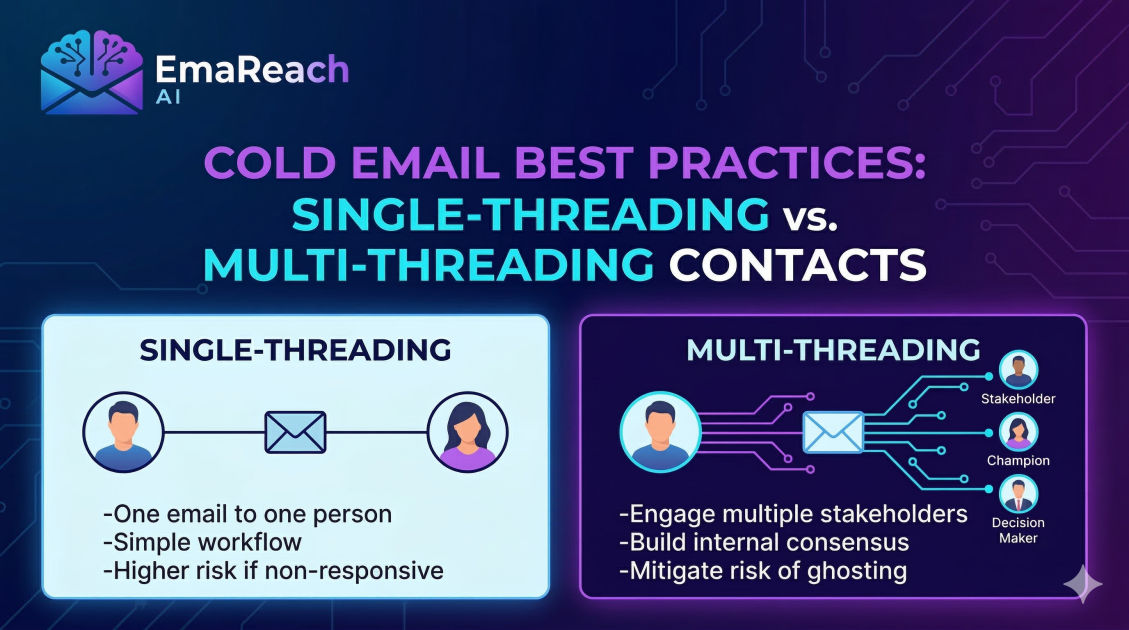
Cold Email Best Practices: Single-Threading vs. Multi-Threading Contacts
cold emailsales strategyoutreach tacticsmulti-threadingB2B salesemail deliverability
Introduction
In the high-stakes world of B2B sales, the difference between a closed-won deal and a silent inbox often comes down to the architecture of your outreach strategy. Sales professionals have long debated the efficacy of different contact methods, but two specific philosophies dominate the landscape: Single-Threading and Multi-Threading.
While the former focuses on building a deep, singular connection with one individual, the latter acknowledges the reality of modern enterprise buying committees, which now often include six to ten stakeholders. Understanding when to use each—and how to execute them without appearing intrusive—is essential for any modern growth team.
To ensure these sophisticated strategies actually reach their destination, tools like EmaReach help sales teams stop landing in spam. EmaReach AI combines AI-written cold outreach with inbox warm-up and multi-account sending, ensuring your single-threaded or multi-threaded campaigns land in the primary tab where they belong.
Defining the Architectures
What is Single-Threading?
Single-threading is the traditional approach to cold email. You identify one 'ideal' prospect within a company—usually the person with the most relevant job title—and direct all your communication efforts toward them. If they don't respond, the lead is often marked as 'lost' or 'unresponsive' for that cycle.
What is Multi-Threading?
Multi-threading is the practice of engaging multiple stakeholders within the same target account simultaneously or in a coordinated sequence. Instead of betting the entire deal on one person, you build a web of relationships across departments (e.g., Marketing, IT, and Finance) or levels of seniority (e.g., Manager, Director, and VP).
The Case for Single-Threading: Precision and Personalization
Single-threading isn't obsolete; it is a tactical choice. It is often the preferred method for smaller companies or highly specialized niche services where only one person truly understands the problem you solve.
Benefits of Single-Threading
- Deep Personalization: When you only have one person to focus on, you can spend more time researching their specific history, recent social media posts, and public contributions. This results in an incredibly high-quality first touch.
- Clear Chain of Command: You avoid the risk of 'stepping on toes.' Some prospects feel defensive if they realize you are emailing their boss and their subordinates at the same time.
- Resource Efficiency: It takes significantly less time to manage one relationship than five. For small sales teams, this allows for a higher volume of accounts to be touched, even if the depth within those accounts is shallow.
The Risks of Single-Threading
The primary risk is single-point failure. If your contact leaves the company, goes on vacation, or simply doesn't like the tone of your first email, the entire account is effectively dead to you. You have no 'champions' elsewhere to advocate for your solution.
The Case for Multi-Threading: Stability and Consensus
In enterprise sales, the 'lone wolf' buyer is a myth. Decisions are made by committee. Multi-threading mirrors the way modern companies actually buy software and services.
Benefits of Multi-Threading
- Risk Mitigation: If your primary contact goes silent, you still have active conversations with two or three other people in the organization.
- Consensus Building: By communicating with different departments, you can address specific pain points for each. You might sell 'efficiency' to the Manager and 'ROI' to the CFO.
- Increased Brand Awareness: When three people in a department receive a high-quality, relevant email from the same company, it creates an internal 'buzz.' They are more likely to mention your name in their next internal meeting.
The Challenges of Multi-Threading
- Complexity: Keeping track of who said what to whom requires a robust CRM and meticulous note-taking.
- Message Consistency: If you tell the Director one thing and the VP another, and they compare notes, you lose all credibility. Your value proposition must be cohesive even when tailored to different personas.
Strategy: How to Execute Multi-Threading Without Being a Spammer
One of the biggest fears in multi-threading is being perceived as a 'carpet bomber'—someone who blasts the whole company with the same generic message. To avoid this, you must use a strategic horizontal and vertical approach.
1. The Vertical Thread (Top-Down/Bottom-Up)
This involves reaching out to a subordinate and their manager.
- The Bottom-Up Approach: You ask the end-user about their daily struggles. Once they engage, you use that 'intel' to email the Director: "I was chatting with [Name] about the bottlenecks in your workflow, and it seems like..."
- The Top-Down Approach: You email the VP. If they refer you down to a Manager, you now have the ultimate 'social proof' to start that conversation: "[VP Name] suggested I reach out to you regarding..."
2. The Horizontal Thread (Cross-Functional)
This involves reaching out to peers in different departments who are all affected by the same problem. For example, if you sell security software, you might thread into both the IT department and the Legal/Compliance department.
3. Tailored Messaging by Persona
This is the golden rule of multi-threading.
- For the Executioner (User): Focus on features, ease of use, and time-saving.
- For the Manager: Focus on team productivity, reporting, and oversight.
- For the Executive: Focus on bottom-line impact, competitive advantage, and long-term ROI.
When to Choose Single-Threading vs. Multi-Threading
Not every prospect deserves a multi-threaded campaign. Use this breakdown to decide your path:
| Factor | Choose Single-Threading | Choose Multi-Threading |
|---|---|---|
| Company Size | 1-50 Employees | 500+ Employees |
| Deal Value | Low (Transactional) | High (Enterprise) |
| Product Complexity | Simple/Self-serve | Complex/Integrations needed |
| Sales Cycle | Short (Days/Weeks) | Long (Months/Years) |
| Market Density | High (Many small targets) | Low (Few 'Whale' targets) |
Best Practices for Successful Delivery
Regardless of your threading strategy, your emails are useless if they don't arrive. High-volume multi-threading can sometimes trigger spam filters if not handled correctly.
To keep your reputation pristine, consider these technical best practices:
- Stagger Your Sends: Do not email five people at the same company at the exact same second. Space them out over hours or days.
- Unique Content: Even if the core message is the same, vary the subject lines and opening sentences. This prevents filters from flagging your content as a 'blast.'
- Monitor Deliverability: Use a service like EmaReach to ensure that your multi-account sending strategy is actually working. Their inbox warm-up features are particularly useful when you are ramping up the number of contacts per account, as it maintains the 'human' sender reputation necessary for the primary tab.
Common Mistakes to Avoid
The 'CC' Trap
Never CC multiple people on a cold email. It feels like a formal memo and immediately signals 'Sales Pitch.' It also makes it easy for everyone to ignore the email, assuming someone else will handle it. Always send individual, BCC-free emails to each contact.
The 'Tattletale' Tone
When multi-threading, don't say, "I emailed your boss and they didn't respond, so I'm emailing you." This creates a negative atmosphere. Instead, frame it as: "I'm reaching out to different members of the team to get a holistic view of how you handle [Process]."
Ignoring the Gatekeeper
Sometimes the most important person in a multi-threaded campaign isn't the decision-maker, but the Executive Assistant or the Office Manager. Treating these individuals with the same respect and personalization as the CEO can often be the 'key' that unlocks the entire account.
Creating the Multi-Threaded Sequence
An effective multi-threaded sequence usually lasts 15-21 days and involves 7-10 touches across different channels.
- Day 1: Highly personalized email to the primary 'Champion' (Single-thread start).
- Day 3: LinkedIn connection request (no note or very soft note) to the Champion.
- Day 4: Email to the 'Economic Buyer' (VP level) referencing the company's high-level goals.
- Day 7: Follow-up to the Champion with a value-add (case study).
- Day 10: Email to a 'Peer' or 'Influencer' in a tangential department.
- Day 14: The 'Consolidation' email. You email the Champion and mention: "I've been exploring how [Product] might help both your team and the [Other] department. Would it make sense to have a brief cross-functional chat?"
Conclusion
Mastering the balance between single-threading and multi-threading is what separates average sales reps from top performers. Single-threading offers the surgical precision needed for smaller deals and initial breakthroughs. Multi-threading provides the resilience and consensus-building required to navigate the complexities of modern enterprise organizations.
By diversifying your points of contact, you ensure that your message isn't just heard—it's discussed. When paired with high-deliverability tactics and tools that ensure your voice reaches the inbox, these threading strategies become the backbone of a predictable, scalable revenue engine.
EmaReach AI
Ready to scale your cold email outreach?
Join thousands of teams using EmaReach AI for AI-powered campaigns, domain warmup, and 95%+ deliverability. Start free — no credit card required.
Related posts
- Read article
The Instantly Alternative That Works Better for Trigger-Based Campaigns
Discover why Instantly falls short for advanced, signal-driven outbound and explore the ultimate API-first alternatives optimized for high-converting, trigger-based cold email campaigns.
- Read article
The Instantly Alternative That Handles High Bounce Rates Without Panic
Discover how transitioning to an advanced Instantly alternative can safeguard your cold email infrastructure. Learn to handle high bounce rates effortlessly using real-time verification, smart mailbox rotation, and automated safety nets to protect your sender reputation and maintain consistent primary inbox placement.