Blog
Back to blog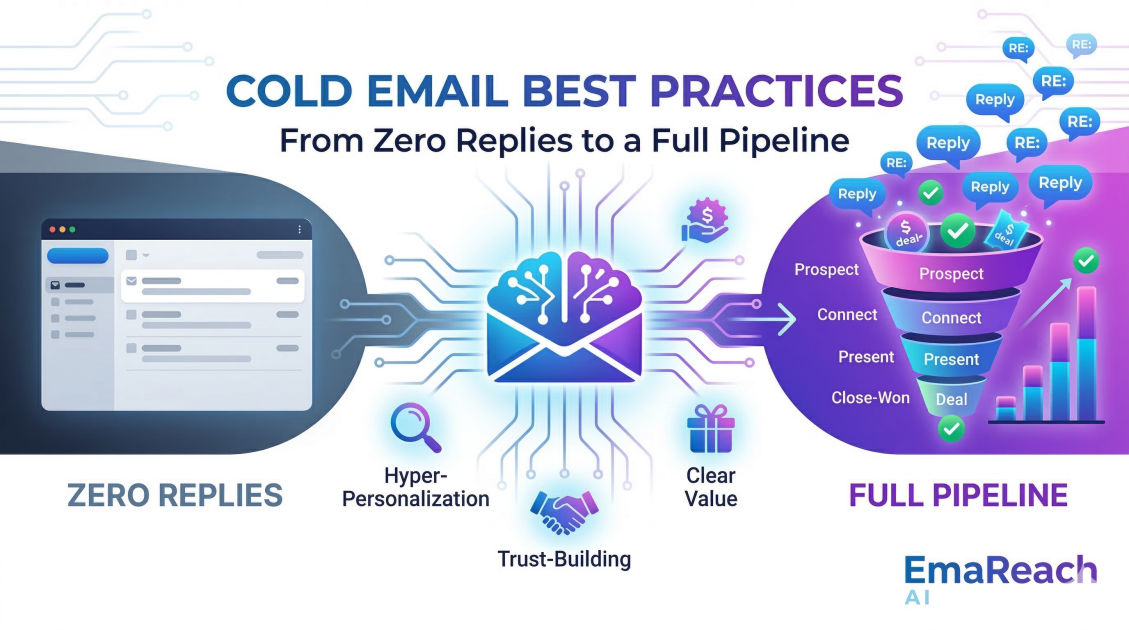
Cold Email Best Practices: From Zero Replies to a Full Pipeline
cold emaillead generationoutreach strategyemail deliverabilitysales pipelineb2b marketing
Introduction
Cold email is often misunderstood as a numbers game where quantity reigns supreme. However, in the modern landscape of digital communication, sending thousands of generic messages is a fast track to the spam folder rather than a full pipeline. The transition from zero replies to a consistent flow of high-quality leads requires a fundamental shift in strategy. It demands a move from mass broadcasting to precision targeting, from generic templates to deep personalization, and from technical negligence to rigorous deliverability standards.
Building a successful cold email engine is both an art and a science. It involves understanding the psychology of your recipient, the technical nuances of mail servers, and the strategic importance of a well-defined value proposition. This guide explores the comprehensive best practices that transform cold outreach into a reliable revenue driver.
The Foundation: Deliverability and Technical Setup
Before a single word is written, the technical infrastructure must be flawless. If your emails don't reach the inbox, your copy—no matter how brilliant—is irrelevant. Deliverability is the bedrock of cold email success.
Authentication Protocols
To ensure your emails land in the primary tab, you must prove to receiving servers that you are a legitimate sender. This is done through three key protocols:
- SPF (Sender Policy Framework): A DNS record that specifies which mail servers are authorized to send email on behalf of your domain.
- DKIM (DomainKeys Identified Mail): An encrypted signature that verifies the email was indeed sent by the domain owner and wasn't tampered with in transit.
- DMARC (Domain-based Message Authentication, Reporting, and Conformance): A policy that tells receiving servers what to do if an email fails SPF or DKIM checks.
The Importance of Warm-up
New domains or accounts with no sending history are viewed with suspicion by internet service providers (ISPs). Jumping from zero to fifty emails a day can trigger spam filters. A gradual "warm-up" process, where sending volume is slowly increased while engagement is simulated, is essential. For those looking to streamline this, EmaReach provides a solution: "Stop Landing in Spam. Cold Emails That Reach the Inbox." EmaReach AI combines AI-written cold outreach with inbox warm-up and multi-account sending—so your emails land in the primary tab and get replies.
Identifying the Ideal Customer Profile (ICP)
A common reason for zero replies is a misaligned audience. You cannot sell a solution to someone who doesn't have the problem. Defining your Ideal Customer Profile (ICP) involves more than just selecting an industry or a company size.
Firmographics and Psychographics
Go beyond the basics. While industry, revenue, and headcount are important, consider the following:
- Technographics: What tools are they already using? (e.g., Are they using a specific CRM that your product integrates with?)
- Trigger Events: Has the company recently raised a series A? Have they hired a new VP of Sales? These events create a window of opportunity.
- Pain Points: What keeps your target persona awake at night? Are they struggling with churn, inefficiency, or slow growth?
Building a High-Quality Lead List
Data hygiene is critical. Using outdated lists results in high bounce rates, which damages your domain reputation. Use reputable data providers and always run your list through a verification tool to remove invalid addresses before launching a campaign.
Crafting the Perfect Cold Email Structure
The anatomy of a high-converting cold email is lean and focused. Every sentence must serve a specific purpose: to move the reader to the next line.
The Subject Line: The Gatekeeper
The only goal of the subject line is to get the email opened. Avoid "salesy" language, all-caps, or excessive exclamation points. The most effective subject lines are often short (2-4 words), personalized, and low-friction.
Examples:
- Question regarding [Project Name]
- Idea for [Company Name] growth
- Quick thought on [Specific Challenge]
The Opening Line: Establishing Relevance
Do not waste the opening line on a self-introduction. The recipient doesn't care who you are yet; they care why you are emailing them. Start with a personalized observation that proves you've done your research. This could be a comment on a recent LinkedIn post, an interview they gave, or a specific achievement of their company.
The Value Proposition: The "What's In It For Me?"
Once you have their attention, clearly state the value you provide. Avoid listing features. Instead, focus on outcomes. Use the "Before/After" framework: identify a current struggle they likely face and describe the improved state they could achieve with your help.
The Social Proof: Building Trust
Cold outreach suffers from a lack of inherent trust. Use a brief, one-sentence mention of a similar company you’ve helped or a specific metric you’ve achieved for a client. This transforms your claims from marketing fluff into credible solutions.
The Call to Action (CTA): Lowering the Barrier
A common mistake is asking for a 30-minute meeting right away. This is a high-friction request for a stranger. Instead, use a "low-friction" CTA that asks for interest rather than time.
- High-friction: "Are you free for a 30-minute demo on Tuesday at 2 PM?"
- Low-friction: "Would you be open to a brief document outlining how we solved this for [Competitor]?" or "Is this something your team is currently focusing on?"
Personalization at Scale
Personalization is no longer optional, but doing it manually for hundreds of leads is unsustainable. The key is to find the balance between automation and human touch.
Variable Tags and Custom Snippets
Use dynamic fields beyond just {{First_Name}}. Create custom columns in your lead list for things like "Recent Achievement" or "Specific Tool Used." This allows you to weave specific details into a template, making it feel like a 1-to-1 message even when sent to a segment of 50 people.
Segmented Messaging
Instead of one broad campaign, break your list into smaller segments based on persona or use case. A CFO cares about cost reduction and ROI, while a Creative Director cares about workflow efficiency and output quality. Your messaging should reflect these distinct priorities.
The Power of the Follow-Up
Studies consistently show that the majority of sales happen after the fourth or fifth touchpoint, yet most cold emailers stop after one or two. A lack of reply isn't necessarily a "no"; it’s often just a "not right now" or a result of a busy inbox.
A Strategic Follow-Up Sequence
Your follow-ups should not just be "bumping this to the top of your inbox." Each touchpoint should add new value or offer a different perspective.
- Follow-up 1 (2-3 days later): A brief nudge referencing the previous email with a slightly different value angle.
- Follow-up 2 (5-7 days later): Share a relevant resource, case study, or blog post that addresses a pain point.
- Follow-up 3 (10-14 days later): Use social proof or a different CTA.
- The Break-up Email: Politely state that you’ll stop reaching out since the timing might not be right. Ironically, this often gets the highest reply rate.
Testing, Iterating, and Optimization
Cold email is an iterative process. You must treat your campaigns as experiments. A/B testing (or split testing) allows you to isolate variables and determine what truly resonates with your audience.
What to Test
- Subject Lines: Test curiosity vs. directness.
- CTAs: Test interest-based vs. time-based.
- Value Propositions: Test different pain points.
- Send Times: Depending on your industry, mid-morning on a Tuesday might perform better than Friday afternoon.
Metrics That Matter
- Open Rate: High opens suggest your subject line and deliverability are healthy.
- Reply Rate: This is the ultimate health check of your offer and personalization.
- Positive Reply Rate: Not all replies are good. Track how many leads are actually moving into the pipeline.
- Bounce Rate: Keep this under 2% to protect your sender reputation.
Avoiding the Spam Filter: Common Pitfalls
As spam filters become more sophisticated, you must stay ahead of the curve. Beyond the technical setup, certain content triggers can land you in the junk folder.
Spam Trigger Words
Avoid excessive use of words like "Free," "Guarantee," "Cash," "Urgent," and "Act Now." While one or two won't kill your campaign, a high density of these terms signals a low-quality promotional blast.
Link and Attachment Best Practices
Avoid including links in the first email if possible. If you must include a link, use only one. Never use link shorteners (like bit.ly), as these are heavily flagged by filters. Similarly, avoid attachments in initial outreach; use a link to a hosted file if absolutely necessary.
Image-to-Text Ratio
Emails that are primarily images with very little text are often flagged. Stick to a clean, text-based format that looks like an email a real person would send to a colleague.
Compliance and Ethics
Respecting privacy laws is not just about being a good digital citizen; it’s about protecting your business. Familiarize yourself with regulations like GDPR (Europe), CAN-SPAM (USA), and CASL (Canada).
- Provide an Opt-out: Always include a clear way for recipients to unsubscribe, whether through a link or a simple "Reply 'Stop' to opt out."
- Legitimate Interest: Under GDPR, you must have a justifiable reason to contact the individual, and your offering must be relevant to their professional role.
- Data Privacy: Ensure you are sourcing and storing lead data responsibly.
Conclusion
Transitioning from zero replies to a full pipeline is a journey of refinement. It starts with a solid technical foundation to ensure deliverability, moves through a deep understanding of your ideal customer, and culminates in the execution of highly personalized, value-driven messaging. By focusing on the quality of your outreach rather than just the volume, and by consistently testing and optimizing every element of your campaign, you can turn cold email into one of the most effective and predictable channels for business growth. The key is persistence, relevance, and a commitment to providing genuine value to your prospects at every touchpoint.
EmaReach AI
Ready to scale your cold email outreach?
Join thousands of teams using EmaReach AI for AI-powered campaigns, domain warmup, and 95%+ deliverability. Start free — no credit card required.
Related posts
- Read article
The Instantly Alternative That Finally Gets Outbound Analytics Right
Discover why high-volume cold email requires a shift from surface-level vanity metrics to deep, data-driven revenue attribution, and explore the ultimate alternatives for mastering outbound engineering.
- Read article
What You Gain and What You Give Up When Switching From Instantly
Thinking about migrating your cold email stack? This detailed guide breaks down the exact operational advantages you gain and the core features you sacrifice when switching away from Instantly's popular outreach platform.